Huawei DTSU666-H
Power and energy meter
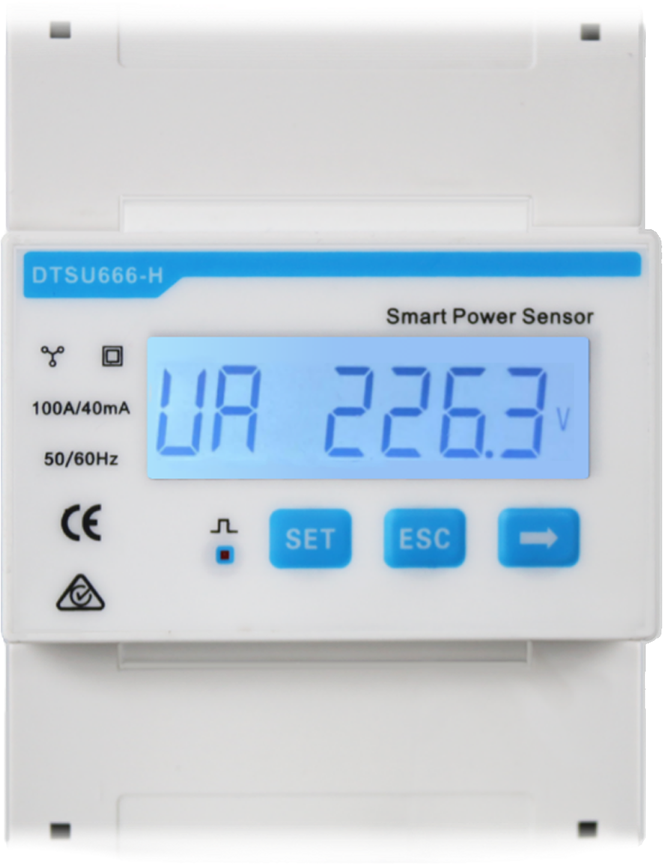
The DTSU666-H is the three-phase smart power sensor Huawei supplies for the grid connection point of a FusionSolar inverter system. It measures through three split-core CTs, 100 A/40 mA or 250 A/50 mA, and reports to the inverter or a SmartLogger over RS-485 using Modbus RTU at address 11. Huawei documents the wiring and serial settings but publishes no register list, and in a normal installation the inverter already polls the bus. Edge reads its grid-point values through that inverter or a SmartLogger, or measures the same point with an EpiSensor ZEM.
Compatibility
Compatible with EpiSensor Edge through the Huawei inverter or SmartLogger that reads it
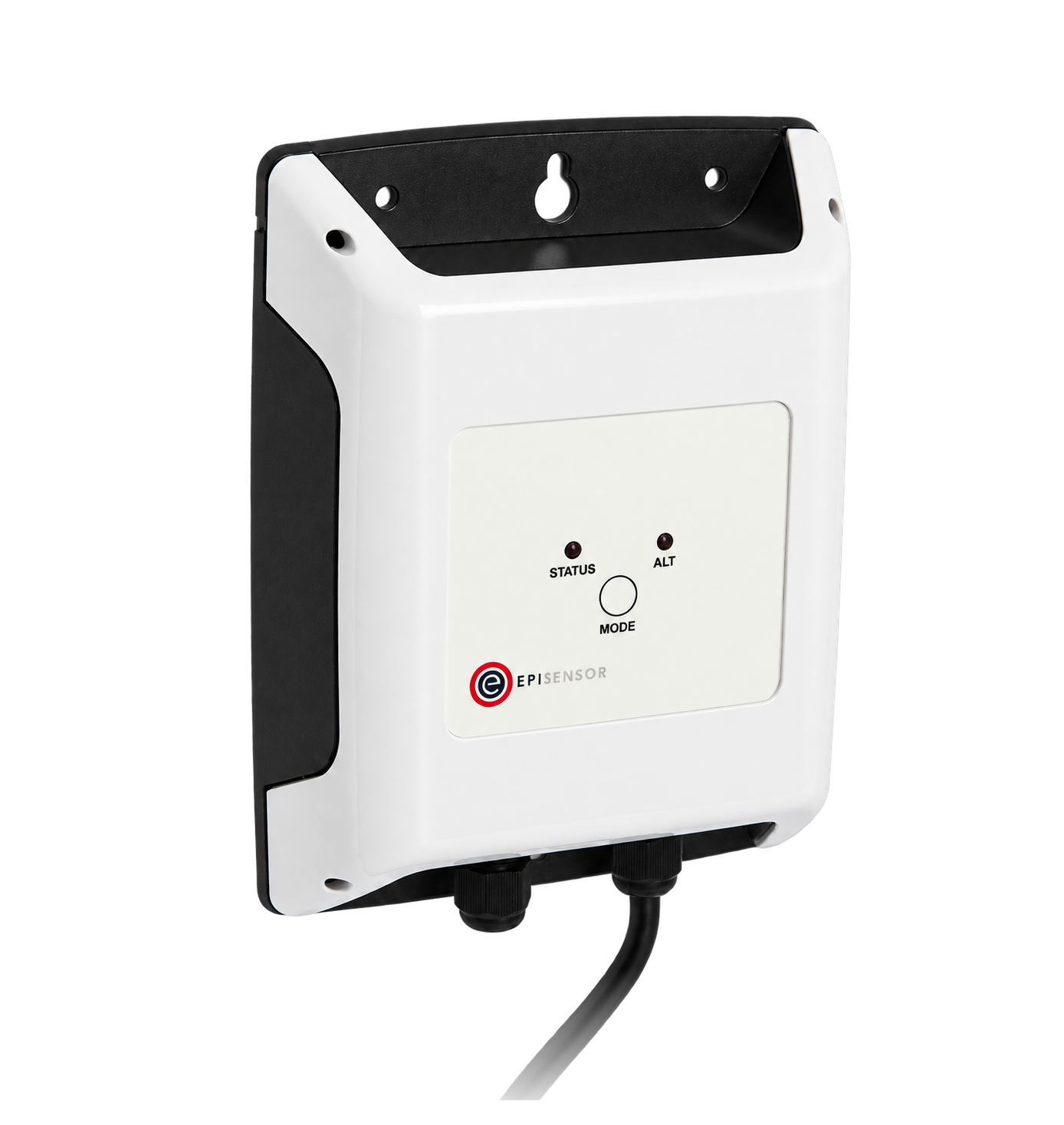
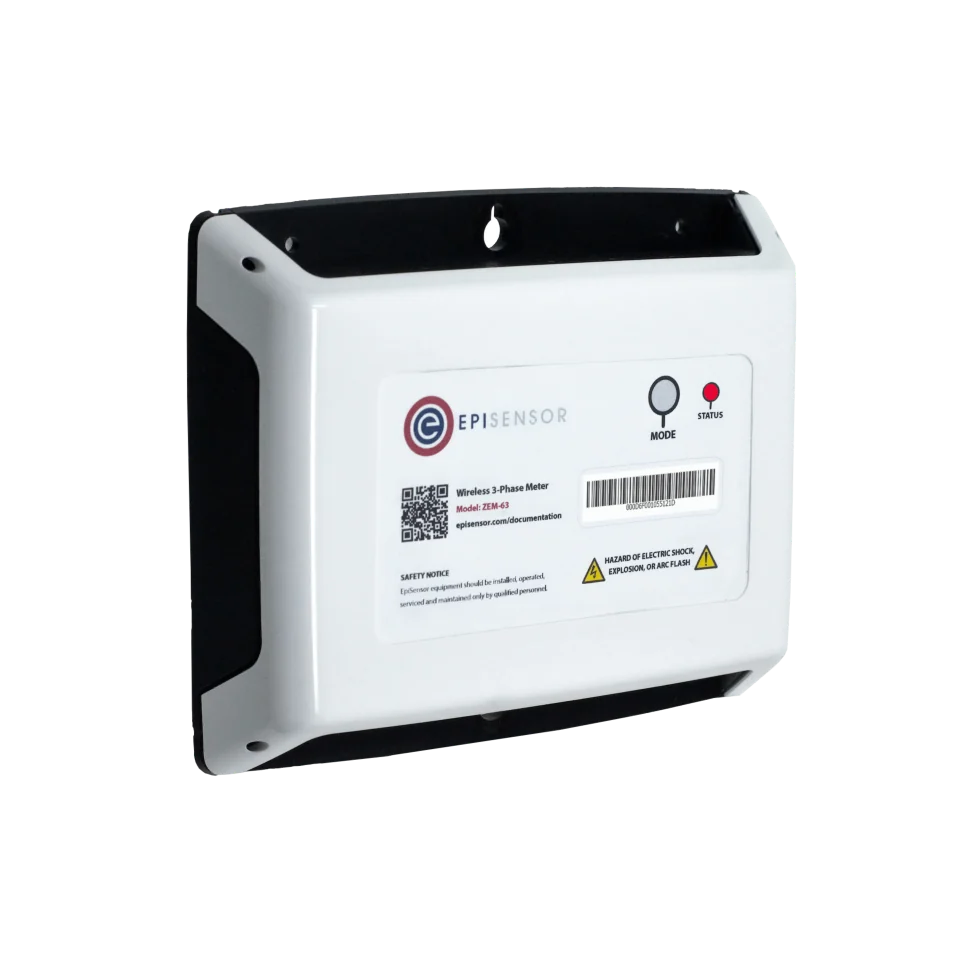
The DTSU666-H's RS-485 Modbus RTU port belongs to the Huawei inverter or SmartLogger, which polls it at address 11 for export limitation and battery control. Edge reads that equipment instead: the SmartLogger3000 over its Modbus TCP interface, or the SUN2000 inverter over its own Modbus RTU communications pair, as the Huawei inverter and SmartLogger guides describe. Where Edge needs grid-point readings of its own, an EpiSensor ZEM with its own CTs measures the same connection point.
DTSU666-H (100 A/40 mA) and DTSU666-H 250 A/50 mA, as described in Huawei user manual EDOC1100020898 and quick guide Issue 03. Site check: confirm in the installed inverter's or SmartLogger's Modbus interface definition which power-meter values it publishes. Leave the sensor's RS-485 pair, address and serial settings on the inverter or SmartLogger; Edge is not a second client on that bus. The DTSU666-HW is a separate product.
Connect it with
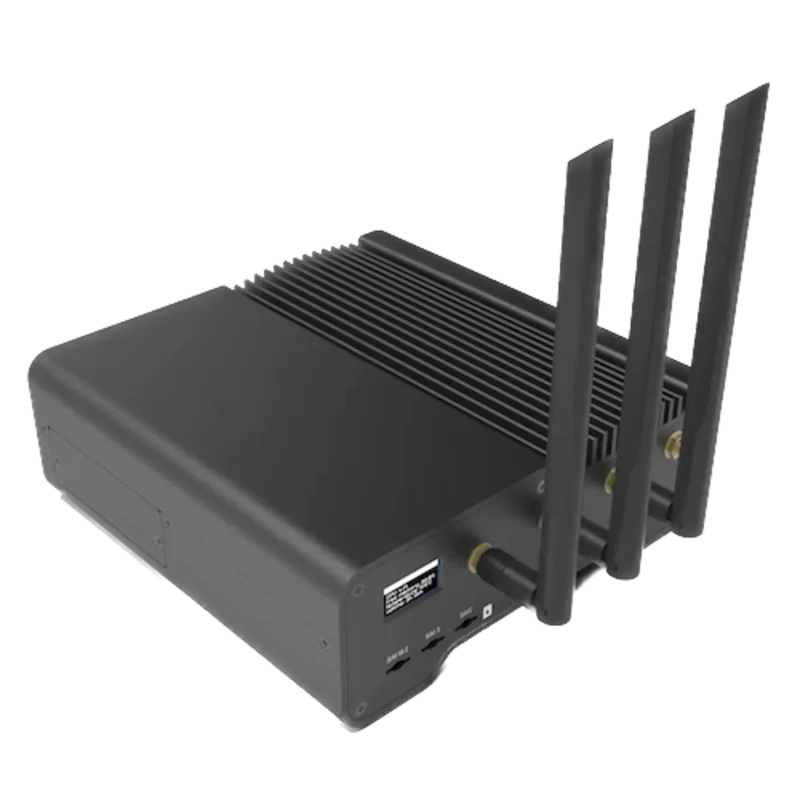
In SmartLogger networking, where the sensor's RS-485 pair connects to a SmartLogger COM port
- Modbus
- Edge
- Platforms
In Smart Dongle networking, where the sensor's RS-485 pair connects to the inverter's meter port
- Modbus
- Edge
- Platforms
When Edge needs grid-point readings of its own, independent of the Huawei control loop
- Wired
- Edge
- Platforms
Models
| Models | Interface | Route into Edge |
|---|---|---|
| DTSU666-H (front label 100A/40mA) | Three 100 A/40 mA split-core CTs, 0 to 100 A; RS-485 on terminals 24 (A) and 25 (B); nameplate address 11 | Huawei's manual and quick guide list three-phase four-wire wiring only for this version; the current specification page lists 3P3W/3P4W. Follow the manual's wiring diagram and leave the RS-485 pair on the inverter or SmartLogger. |
| DTSU666-H 250 A/50 mA | Three 250 A/50 mA split-core CTs, 0 to 250 A; 3 x 230/400 V or 3 x 400 V; three-phase four-wire or three-wire | Same serial port, defaults and absence of a published register map. The three-wire diagram in Huawei's documents applies to this version only. |
| DTSU666-HW (SmartPS-80AI-T0 family) | A different Huawei-listed sensor, 0 to 80 A, with 4800, 9600, 19200 or 115200 bit/s | Not covered by this guide. Do not transfer its ratings or serial settings to the DTSU666-H. |
| Chint DTSU666 | Chint's own meter family; Huawei names CHINT as the DTSU666-H manufacturer | Huawei does not state that the Chint DTSU666 register map applies to the DTSU666-H. See the Chint DTSU666 page for that meter. |
Specifications
Huawei's documents disagree on one point: the manual and quick guide list three-phase four-wire wiring only for the 100 A version and add three-wire for the 250 A version, while the current 100 A specification page lists 3P3W/3P4W. The wiring diagrams in the manual are the conservative reference.134
- Variants
- DTSU666-H with three 100 A/40 mA CTs (0 to 100 A). DTSU666-H 250 A/50 mA with three 250 A/50 mA CTs (0 to 250 A).34
- Voltage
- Nominal 230/400 V AC. Phase voltage 176 to 288 V AC and line voltage 304 to 499 V AC on the 100 A specification page. Regulated working range 0.9 to 1.1 Un, extended 0.7 to 1.3 Un.14
- Accuracy
- Active energy class 1, 400 imp/kWh, connected via current transformers. The specification page lists current and voltage +/-0.5%, power and energy +/-1% and frequency +/-0.01 Hz. The supplied CTs are rated accuracy 0.5.14
- Current transformers
- Split-core. Ratio 2500:1 for 100 A and 5000:1 for 250 A, rated load 20 ohm. IA*, IA, IB*, IB, IC*, IC go to terminals 13, 14, 16, 17, 19 and 21; the CT arrow must match the direction in Huawei's diagram.34
- RS-485
- Modbus RTU on terminals 24 (A) and 25 (B), shielded twisted pair 0.20 to 1 mm². Default 9600 bit/s, no parity, one stop bit; nameplate address 11. The front-panel menu offers addresses 11 to 19, 4800 or 9600 bit/s, and none, even or odd parity.34
- Power and data retention
- Powered from the measured voltage, at most 1.5 W/6 VA on the voltage circuit. Data is kept for at least 10 years after power loss. A fuse and a thermistor protect each phase input inside the sensor.4
- Mounting
- Four modules on a 35 mm DIN rail, 72 x 100 x 65.5 mm. The manual gives at most 0.8 kg; the specification page gives 1.5 kg including cables.14
- Environment
- Operating -25 to +60 °C, limited working range -40 to +70 °C. Annual average humidity up to 75% in the manual; 5% to 95% non-condensing on the specification page.14
- Standards
- EN and IEC 61326-1, 61326-2-1, 61010-1 and 61010-2-1, plus EN 61000-3-2 and 61000-3-3 for EMC.4
Interface
Documented measurements and integration boundaries for DTSU666-H.
- Huawei publishes no Modbus register list for the DTSU666-H in its quick guide, user manual, datasheet or specification page, so this guide lists no register addresses.
- The display pages in the user manual show positive (import), negative (export) and combined active energy, total and per-phase active power, phase voltages, phase currents, total and per-phase power factor marked L or C, and frequency. These are display items, not a register map.
- Huawei states that combined active energy equals import minus export, and that displayed values are primary-side values. Energy is shown from 0 to 999999.9 kWh.
- The manual's product overview also mentions reactive power and four-quadrant energy, which do not appear in its display tables.
- Huawei describes the sensor as mainly for power control at the grid connection point. Its energy readings are for reference only and are not a basis for billing.
Assessment
DTSU666-H (100 A/40 mA) and DTSU666-H 250 A/50 mA, as described in Huawei user manual EDOC1100020898 and quick guide Issue 03. Edge reads it through the inverter or SmartLogger that polls its RS-485 port, or through an EpiSensor ZEM at the same point. The DTSU666-HW is a separate product.
- InteroperabilityLimited
- Huawei documents RS-485, Modbus RTU and the serial defaults, but publishes no register list, and its documents give the port to the inverter or SmartLogger as the polling host.134
- AccuracySupported with conditions
- Class 1 active energy through supplied CTs, with import, export and per-phase values on the display. Huawei limits the energy readings to reference use, not billing, and the result depends on CT orientation and phase matching.14
- SecurityNot yet assessed
- The front-panel settings menu is password protected, but Huawei says nothing about access control on the RS-485 port.4
- ReliabilitySupported with conditions
- Data is retained for at least 10 years after power loss, the sensor runs from 0.7 to 1.3 Un, each phase input has an internal fuse and thermistor, and EMC follows IEC 61326-1 and 61326-2-1. It is powered from the measured voltage, so a supply loss is also a measurement gap.4
- RuggednessSupported with conditions
- Operating -25 to +60 °C with a limited working range of -40 to +70 °C, DIN-rail mounting in a distribution box. Huawei's two humidity figures differ and no IP rating is published.14
Setup
-
Identify the variant
Read the front label: DTSU666-H with 100A/40mA, or DTSU666-H 250A/50mA. The rear nameplate shows type, current, class and the communication address. A DTSU666-HW is a different product.
-
Find the bus owner
Trace the pair on terminals 24 (A) and 25 (B). Huawei connects it to the inverter's meter port in Smart Dongle networking or to a SmartLogger COM port in SmartLogger networking. If it is connected, the inverter or logger is polling it for export limitation or battery control; leave that wiring as it is.
-
Read the settings without changing them
Step through the display pages with the arrow key to see the serial settings (for example n1-9600) and the address. Record them. Huawei says these must match the inverter, so changing them interrupts the inverter's control loop.
-
Check the CT orientation
Compare per-phase active power on the display with the expected direction of flow. Huawei's troubleshooting table says negative Pa, Pb or Pc values point to a reversed CT or a mismatch between voltage and current phases.
-
Choose how Edge gets grid-point data
Connect Edge to the inverter or SmartLogger, not to this bus: read the SmartLogger3000 over Modbus TCP or the inverter over its communications pair, as their guides describe. If Edge needs independent grid-point readings, fit an EpiSensor ZEM with its own CTs at the same point.
Common questions
- Does the Chint DTSU666 register map apply to the DTSU666-H?
- Huawei does not say so. Its specification page and datasheet name CHINT as the manufacturer and the nameplate carries the CHINT mark, but none of Huawei's DTSU666-H documents publishes a register list or points to Chint's map. Edge does not need one: it reads the grid-point values through the inverter or SmartLogger that polls the sensor.134
- Can Edge read the sensor while the inverter is connected to it?
- Huawei connects the RS-485 pair to the inverter or SmartLogger, which uses the readings to limit export or control the battery, and tells installers to set the sensor's address, baud rate and parity to match the inverter. On a Modbus RTU serial line one client polls the devices, and Huawei does not describe adding a second reader. Edge therefore reads the inverter or SmartLogger over its own Modbus interface and takes the grid-point values from there, rather than joining this bus.34
- What are the default serial settings and address?
- Huawei gives 9600 bit/s, no parity and one stop bit, with address 11 on the nameplate. The front-panel menu offers addresses 11 to 19 and 4800 or 9600 bit/s; the manual's communication section also mentions 1200 and 2400 bit/s. The settings are protected by a password printed in the manual.34
- Can the DTSU666-H be used for billing?
- No. Huawei states that the sensor is mainly for power control at the grid connection point, that its energy readings are for reference only, and that electricity charges follow the meter provided by the grid company.4
- Is the DTSU666-HW the same product?
- No. Huawei lists the DTSU666-HW in the separate SmartPS-80AI-T0 datasheet with a 0 to 80 A range and 4800 to 115200 bit/s, alongside sensors from other manufacturers. This guide covers only the DTSU666-H and DTSU666-H 250 A/50 mA.5
Related devices
Sources
- DTSU666-H 100A Smart Power Sensor technical specifications page (opens in a new tab)
- Smart Power Sensor DTSU666-H 100A datasheet, version 01-202509 (opens in a new tab) (PDF)
- DTSU666-H and DTSU666-H 250 A/50mA Smart Power Sensor Quick Guide, Issue 03, 29 September 2019 (opens in a new tab) (PDF)
- DTSU666-H 100 A and 250 A Smart Power Sensor User Manual, EDOC1100020898 (cover Issue 03, 10 October 2021; change history to Issue 06, 6 May 2024) (opens in a new tab)
- Smart Power Sensor SmartPS-80AI-T0 datasheet (DTSU666-HW, YDS60-80, DTSU71C, DHSU1079-ZT), version 02-202311 (opens in a new tab) (PDF)
Further reading
Product names and trademarks belong to their owners. Publication does not imply endorsement or a commercial relationship.