Chint DTSU666
Three-phase energy meter
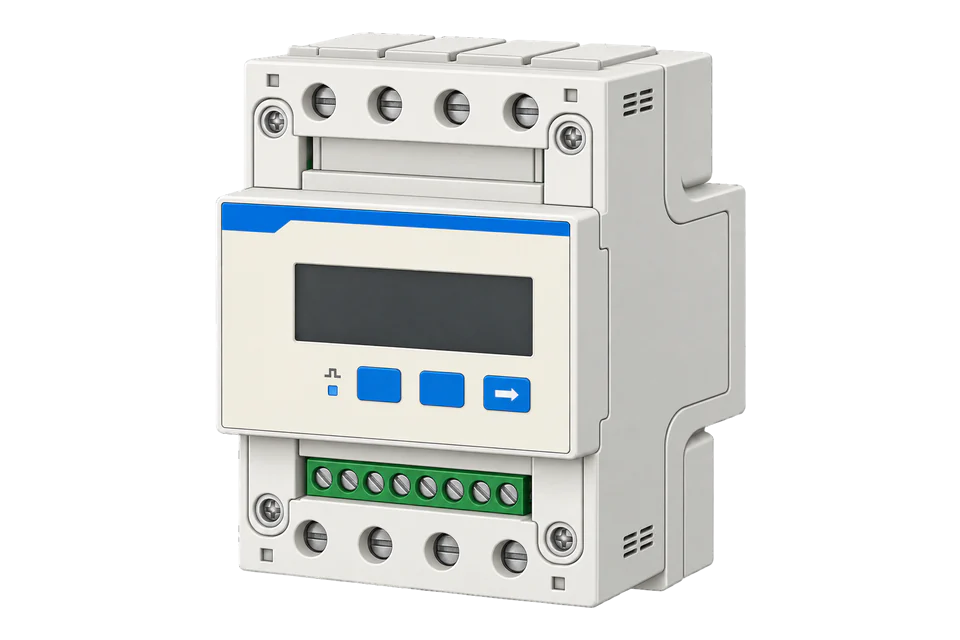
A three-phase, four-wire DIN-rail energy meter that reads current transformers, with Class 1 active energy, per-phase import and export counters and an RS-485 Modbus RTU port, in a 72 mm housing.
Compatibility
Compatible with EpiSensor Edge over Modbus RTU.
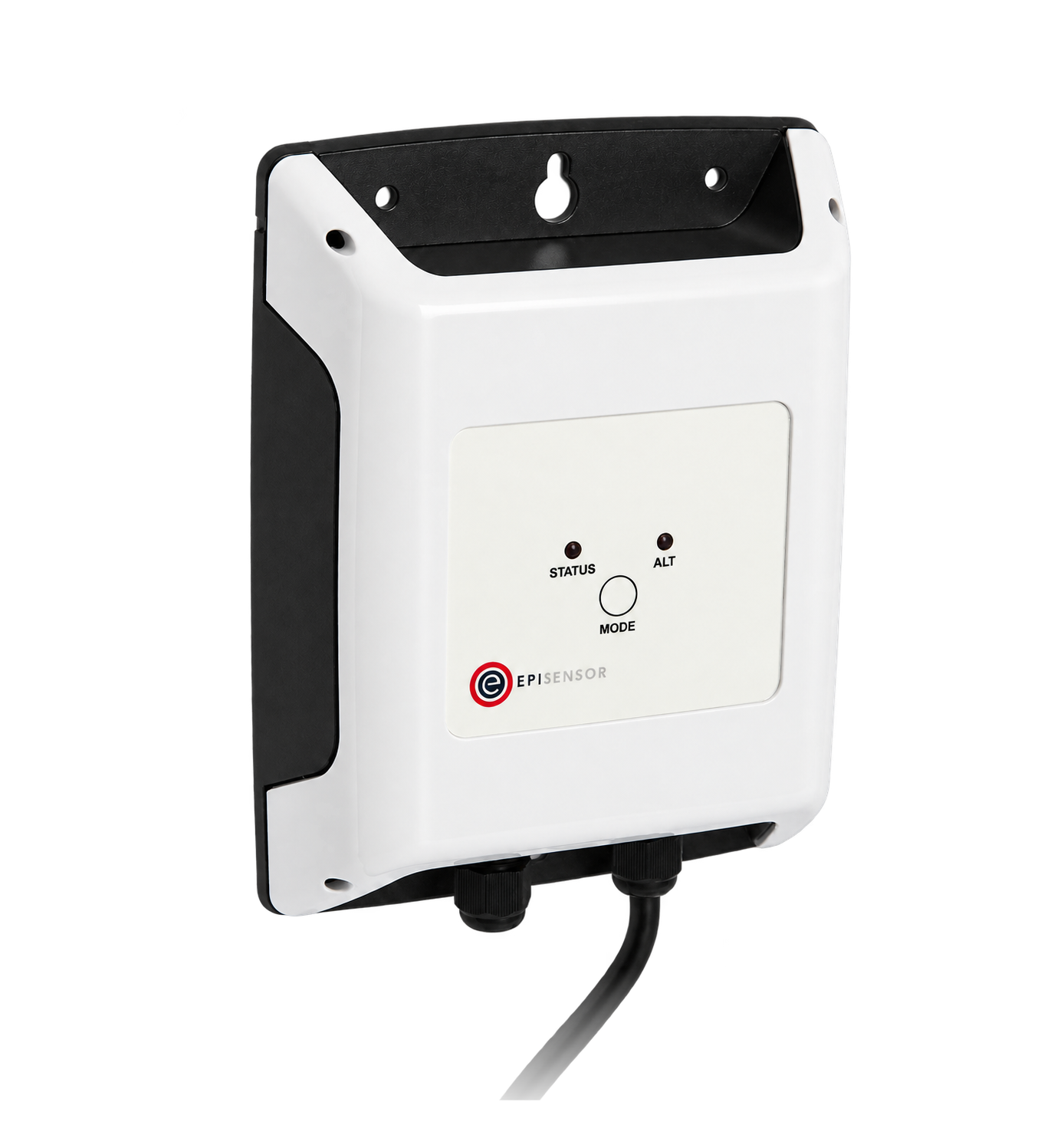
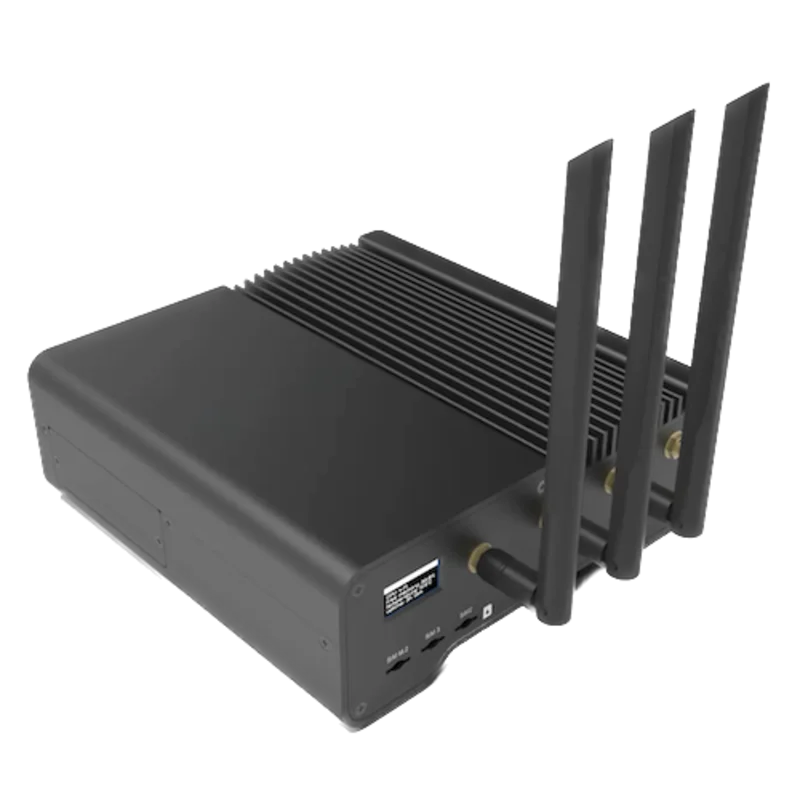
Connect its RS-485 port to a Modbus Interface or to a serial interface on the Gateway. Edge polls it with its Modbus client.
Edge reads 30 values from it, listed under Interface.
Connect it with
-
Modbus Interface ZMB-3XFrom €399 ex VAT Configure Modbus Interface
-
Gateway ZGW-20From €899 ex VAT Configure Gateway
Specifications
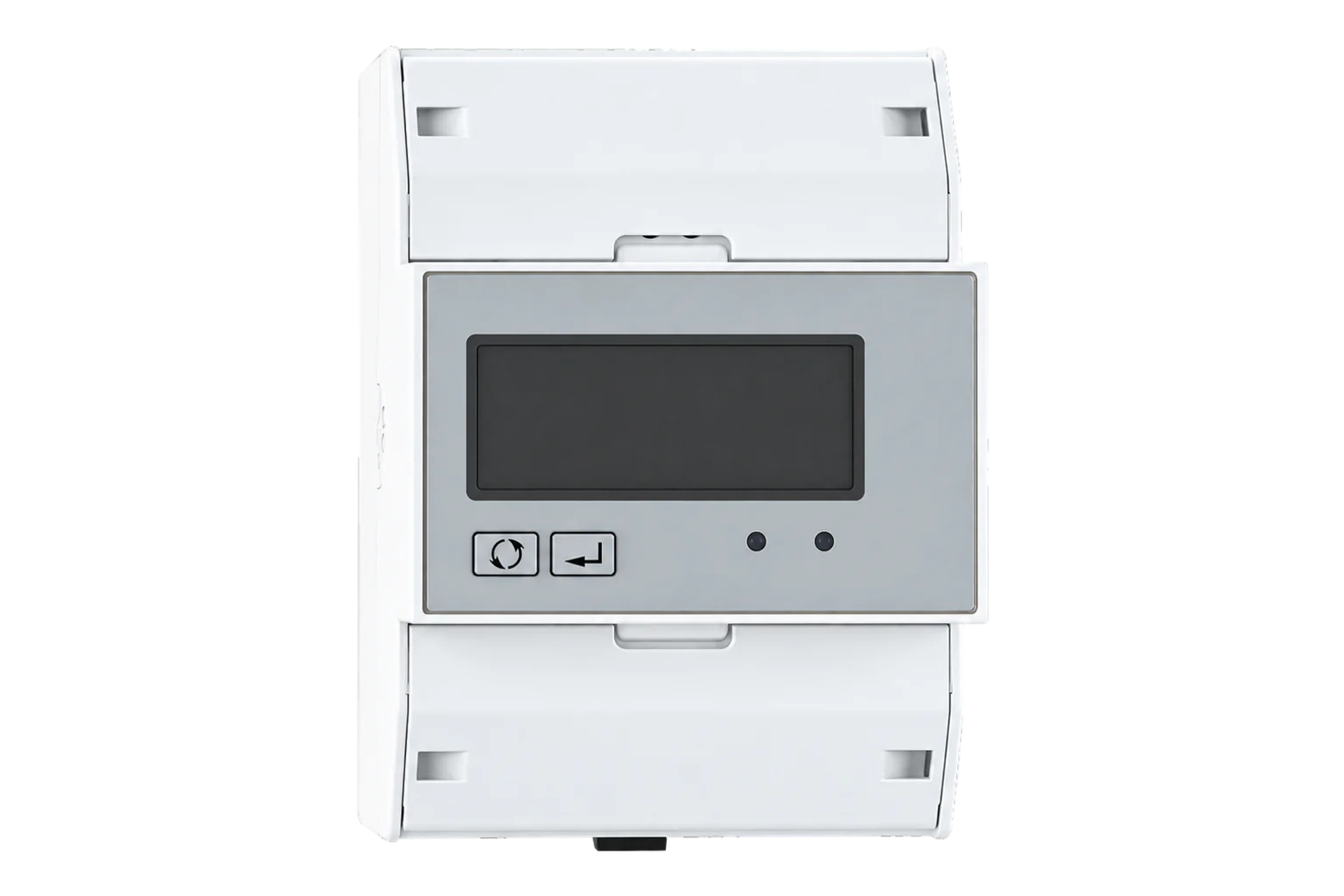
The DTSU666 is a three-phase, four-wire energy meter in a 4-module DIN-rail housing, made by Chint for energy monitoring in industrial sites, hotels, schools and large buildings. It measures line and phase voltage, phase current, active and reactive power per phase and in total, power factor and frequency, and keeps forward and reverse active energy for each phase and in total.1
- Power
- Self-powered from the measured supply. Powered through its voltage inputs, terminals 3, 6, 9 and 10; it has no separate supply terminals.1
- Nominal voltage
- 3 × 230/400 V AC1
- Current input
- Through current transformers, 100 A/40 mA or 250 A/50 mA1
- Active energy accuracy
- Class 11
- Operating voltage range
- 0.9 to 1.1 Un specified, 0.8 to 1.15 Un extended1
- Wiring
- 3-phase 4-wire (n.34) or 3-phase 3-wire (n.33)1
- Pulse constant
- 400 imp/kWh1
- RS-485 port
- Modbus RTU or DL/T 645, 1200 to 9600 bit/s, terminals 24 (A) and 25 (B)1
- Dimensions
- 100 × 72 × 65 mm, 4 DIN modules1
- Protection
- IP51 front panel, for use in an IP51 enclosure1
- Working temperature limits
- -40 to 70 °C1
- Standards
- IEC 61010-1, IEC 61326-11
Where it is used
Grid-connection metering on three-phase solar PV and battery systems, from the forward and reverse energy on each phase.
Solar PV monitoringDistribution board and feeder monitoring through current transformers in commercial and public buildings.
Transformer and distribution board monitoringBringing DTSU666 meters already on an RS-485 bus into a BMS or SCADA system through Edge.
Modbus meter integration for a BMS or SCADA system
Interface
This register map is for the DTSU666.
Communication settings
- Protocol
- Modbus RTU over RS-485 (DL/T 645 selectable)
- Unit address
- 1 to 247, default 1
- Baud rate
- 1200, 2400, 4800 or 9600 bit/s, default 9600
- Parity and stop bits
- n.1 (no parity, 1 stop bit) by default; n.2, E.1 or O.1
- Functions
- FC03 reads, FC16 (10h) writes
- Float order
- IEEE 754, high word first (ABCD)
- Read with
- FC03 (holding registers)
- Word order
- High word first on every value
- Addresses
- Zero-based PDU addresses, as sent on the bus
From DTSU666.001 and DSSU666.001 series electronic energy meter user manual (ZTW0.464.0104)1.
Register map
| Point | Address | Hex | Format | Scale | Unit |
|---|---|---|---|---|---|
| Voltage L1-L2 | 8192 | 0x2000 |
FLOAT32 | ×0.1 | V |
| Voltage L2-L3 | 8194 | 0x2002 |
FLOAT32 | ×0.1 | V |
| Voltage L3-L1 | 8196 | 0x2004 |
FLOAT32 | ×0.1 | V |
| Voltage L1-N | 8198 | 0x2006 |
FLOAT32 | ×0.1 | V |
| Voltage L2-N | 8200 | 0x2008 |
FLOAT32 | ×0.1 | V |
| Voltage L3-N | 8202 | 0x200A |
FLOAT32 | ×0.1 | V |
| Current L1 | 8204 | 0x200C |
FLOAT32 | ×0.001 | A |
| Current L2 | 8206 | 0x200E |
FLOAT32 | ×0.001 | A |
| Current L3 | 8208 | 0x2010 |
FLOAT32 | ×0.001 | A |
| Total Active Power | 8210 | 0x2012 |
FLOAT32 | ×0.1 | W |
| Active Power L1 | 8212 | 0x2014 |
FLOAT32 | ×0.1 | W |
| Active Power L2 | 8214 | 0x2016 |
FLOAT32 | ×0.1 | W |
| Active Power L3 | 8216 | 0x2018 |
FLOAT32 | ×0.1 | W |
| Total Reactive Power | 8218 | 0x201A |
FLOAT32 | ×0.1 | VAr |
| Reactive Power L1 | 8220 | 0x201C |
FLOAT32 | ×0.1 | VAr |
| Reactive Power L2 | 8222 | 0x201E |
FLOAT32 | ×0.1 | VAr |
| Reactive Power L3 | 8224 | 0x2020 |
FLOAT32 | ×0.1 | VAr |
| Total Power Factor | 8234 | 0x202A |
FLOAT32 | ×0.001 | - |
| Power Factor L1 | 8236 | 0x202C |
FLOAT32 | ×0.001 | - |
| Power Factor L2 | 8238 | 0x202E |
FLOAT32 | ×0.001 | - |
| Power Factor L3 | 8240 | 0x2030 |
FLOAT32 | ×0.001 | - |
| Frequency | 8260 | 0x2044 |
FLOAT32 | ×0.01 | Hz |
| Import Active Energy | 4126 | 0x101E |
FLOAT32 | ×1 | kWh |
| Import Active Energy L1 | 4128 | 0x1020 |
FLOAT32 | ×1 | kWh |
| Import Active Energy L2 | 4130 | 0x1022 |
FLOAT32 | ×1 | kWh |
| Import Active Energy L3 | 4132 | 0x1024 |
FLOAT32 | ×1 | kWh |
| Export Active Energy | 4136 | 0x1028 |
FLOAT32 | ×1 | kWh |
| Export Active Energy L1 | 4138 | 0x102A |
FLOAT32 | ×1 | kWh |
| Export Active Energy L2 | 4140 | 0x102C |
FLOAT32 | ×1 | kWh |
| Export Active Energy L3 | 4142 | 0x102E |
FLOAT32 | ×1 | kWh |
Edge template
This JSON file supplies the register map. Applying it to an existing meter replaces its sensor list while retaining the site connection, unit ID and enable state.
| Model | Connection | Points | Version | Updated | Download |
|---|---|---|---|---|---|
| DTSU666 | Modbus RTU over RS-485 (DL/T 645 selectable) | 30 | 1.0.0 | Download |
Downloads need a signed-in account with Edge download access.
Use the template in Edge
- Import the JSON file
In Edge, open Settings, then Devices and Templates. Choose Import JSON and select the downloaded file. Confirm that the model and template name match your device.
- Load the map for your meter
For a new Modbus device, use Load Template before entering the manufacturer or model; it fills those fields and the register list. Set the name, site connection and unit ID, check the polling enable state, then test before saving. For an existing device, apply only to the matching model; this replaces its sensor list but retains its connection, unit ID and enable state.
- Test a reading
Use Test in the wizard and compare a known reading with the meter display. Check its unit, sign and scale, then confirm that timestamps keep advancing. These starter maps are read-only and leave exports off until you configure them.
Setup
-
Wire voltage and current
Connect phase A, B and C voltage to terminals 3, 6 and 9 and neutral to 10. Wire the current transformers to 13 and 14 for phase A, 16 and 17 for phase B, and 19 and 21 for phase C; the first terminal of each pair, marked *, is the current input.1
-
Wire the bus
Connect RS-485 A to terminal 24 and B to terminal 25, with 0.25 to 1 mm² conductors, from a ZMB-31 or the Gateway's serial interface.1
-
Set address and speed
Press SET and enter the programming code (701 by default), then set Addr, bAud and the parity and stop bits. The factory setting is address 1, 9600 bit/s, no parity and 1 stop bit (n.1).1
-
Set wiring and ratios
Set net to n.34 for three-phase four-wire, and set the current ratio (Ct) and voltage ratio (Pt). For directly connected voltage, Pt is 1.0.1
-
Read one register
Import the Edge template and read Voltage L1-N at holding register 8198 (2006h) with function code 03. A raw float of 2200 is 220.0 V; compare it with the Ua page on the display.1
Common questions
- Why are my DTSU666 readings ten or a thousand times too large?
- The floats carry Chint's scale. Voltage is in 0.1 V, current in 0.001 A, power in 0.1 W or var, power factor in 0.001 and frequency in 0.01 Hz, so a voltage of 2300 is 230.0 V. Energy registers are already in kWh.1
- Which function code does the DTSU666 use?
- Function code 03 (read holding registers) for every value, and function code 16 (10h) to write settings. Each value is two registers.1
- What are the default communication settings?
- Modbus RTU at address 1, 9600 bit/s, 8 data bits, no parity and 1 stop bit. The meter also supports DL/T 645, so check the protocol setting if it does not answer Modbus.1
- What is the programming code?
- 701 by default. It unlocks the address, baud rate, parity, wiring mode and CT and PT ratio settings on the front buttons.1
- Can the DTSU666 measure exported energy?
- Yes. Reverse active energy is kept in total at 1028h (4136) and per phase at 102Ah to 102Eh, alongside forward energy at 101Eh (4126) onwards. Combined active energy on the display is forward plus reverse.1
- Does it work on a three-wire supply?
- Set net to n.33 for three-phase three-wire, or use the DSSU666. Phase voltages, phase B power and the phase power factors are then not valid.1
Related devices
Sources
- DTSU666.001 and DSSU666.001 series electronic energy meter user manual (ZTW0.464.0104) (opens in a new tab) (PDF)
- DTSU666 register driver (opens in a new tab)
Further reading
Product names and trademarks belong to their owners. Publication does not imply endorsement or a commercial relationship.