kW to amps calculator

Convert kW or kVA to amps and back for single-phase, three-phase and DC circuits.

Electrical power and current Updated Free, no sign-up

Three-phase

Supply

400line to line
230.9line to neutral
160.4in each line
L1L2L3N
No current in the neutral on a balanced load

Load

100active power
111.1apparent power
0.9power factor

The same load on other supplies

  • 120 V single-phase925.9 A
  • 208 V three-phase308.4 A
  • 230 V single-phase483.1 A
  • 480 V three-phase133.6 A
  • 690 V three-phase92.97 A
Choose a CT for 160.4 A
Example values
What do you want to calculate?
Conversion
Electrical system
System
Voltage entered as
Known values

Common supplies

V
A

Typically 0.8 to 1.0

More options
The power is

IE3 motors: 82% to 96%, rising with size

%

Line current, each line

160.4A

Balanced three-phase, 400 V line‑to‑line (230.9 V line‑to‑neutral).

Apparent power, total
111.1 kVA
Reactive power, total
48.43 kvar
Active power, each phase
33.33 kW
How it’s calculated
  1. I = P × 1000 ÷ (√3 × VLL × PF)=100 × 1000 ÷ (1.732 × 400 × 0.9)=160.4 A
  2. S = √3 × VLL × I ÷ 1000=1.732 × 400 × 160.4 ÷ 1000=111.1 kVA
  3. Q = √(S² − P²)=√(111.1² − 100²)=48.43 kvar

Choose the meter and CTs for this load.

Three-phase at 400 V · 160 A per phase, sized for 300 A CTs

Build a system

100 kW at 400 V three-phase with a power factor of 0.9 draws 160.4 A in each line.

Tip: A meter reading in kW is already electrical input. Use a motor’s efficiency only when you start from its nameplate shaft rating.

How to convert kW to amps

To convert kW to amps, multiply the power by 1,000 to get watts, then divide by the voltage. On an AC circuit, divide by the power factor as well. For a balanced three-phase load, divide by √3 times the line-to-line voltage. The answer is the current in each line, not a total across the three lines.

DC circuits

I = P × 1000 ÷ V

Batteries, PV strings and 24 V control supplies have no power factor. Current is watts divided by volts: 2 kW at 48 V DC is 41.67 A.

Single-phase AC

I = P × 1000 ÷ (V × PF)

Use the voltage between the line and neutral, 230 V in Europe and 120 V or 240 V in North America. A power factor below 1 means the circuit carries more current than the real power alone needs.

Three-phase AC, line-to-line voltage

I = P × 1000 ÷ (√3 × VLL × PF)

This is the usual form: 400 V in Europe, 208 V or 480 V in North America. The √3 comes from the relationship between line-to-line and line-to-neutral voltage in a balanced supply.

Three-phase AC, line-to-neutral voltage

I = P × 1000 ÷ (3 × VLN × PF)

If you only have the phase voltage (230 V), multiply it by three instead of √3. Choose “Line-to-neutral” in the calculator and it converts the voltage for you.

kVA to amps

I = S × 1000 ÷ (√3 × VLL)

Apparent power already includes the power factor, so it does not appear. Use this for transformer, generator and UPS ratings, which are given in kVA. For single-phase, leave out the √3.

To go the other way, from amps to kW, multiply instead of dividing: P = √3 × VLL × I × PF ÷ 1000 for three-phase and P = V × I × PF ÷ 1000 for single-phase.

kW to amps examples

A 22 kW EV charger on a 400 V three-phase supply

A 22 kW AC charger draws close to unity power factor at full output. With PF 0.99: 22 × 1000 ÷ (1.732 × 400 × 0.99) = 32.08 A in each line. That is why 22 kW chargers sit on a 32 A three-phase circuit: 3 × 230 V × 32 A is 22.08 kW.

For several chargers on one supply, the EV charging capacity calculator checks the total against the site limit.

Line current, each line 32.08 A Open in the calculator
A 3 kW immersion heater at 230 V single-phase

A resistive heater has a power factor of 1. Current is 3 × 1000 ÷ 230 = 13.04 A, comfortably within a 16 A circuit.

Line current 13.04 A Open in the calculator

A 15 kW motor at 400 V three-phase

A motor nameplate gives the mechanical output at the shaft, not the electrical input. With 92% efficiency and a power factor of 0.85 from the nameplate, the input is 15 ÷ 0.92 = 16.3 kW and the current is 16.3 × 1000 ÷ (1.732 × 400 × 0.85) = 27.69 A in each line.

Treating the 15 kW as electrical input would give 25.47 A, about 8% low. Choose “Motor shaft output” under More options when you start from a nameplate.

Line current, each line 27.69 A Open in the calculator

kW to amps table at 230 V, 208 V, 400 V and 480 V

Current for common loads at a power factor of 0.9. Three-phase columns give the current in each line. For another power factor, multiply a figure by 0.9 and divide by your power factor, or use the calculator.

kW to amps table at 230 V, 208 V, 400 V and 480 V, values in A
Power (kW)230 V single-phase (A)208 V three-phase (A)400 V three-phase (A)480 V three-phase (A)
14.83.11.61.3
29.76.23.22.7
314.59.34.84.0
524.215.48.06.7
7.536.223.112.010.0
1048.330.816.013.4
1572.546.324.120.0
2096.661.732.126.7
22106.367.935.329.4
25120.877.140.133.4
30144.992.548.140.1
40193.2123.464.253.5
50241.5154.280.266.8
75362.3231.3120.3100.2
100483.1308.4160.4133.6
150724.6462.6240.6200.5
200966.2616.8320.8267.3
2501,207.7771.0400.9334.1
3001,449.3925.2481.1400.9
4001,932.41,233.7641.5534.6
5002,415.51,542.1801.9668.2

Download this table (CSV)

Questions about kW to amps

How many amps is 1 kW?

It depends on the voltage and the power factor. At a power factor of 1, 1 kW is 4.348 A at 230 V single-phase, 8.333 A at 120 V single-phase and 1.443 A in each line at 400 V three-phase.

Is the three-phase answer per phase or the total?

Per line. Each of the three lines carries the calculated current, and that is the figure you compare with a breaker, a cable rating or a CT. Do not add the three together.

What happens if I use 230 V in the three-phase formula?

The answer comes out √3 times too high, about 73%, because the formula expects the line-to-line voltage. 100 kW at a power factor of 0.9 is 160.4 A at 400 V but 278.9 A if 230 V is entered as line-to-line. Choose “Line-to-neutral” if 230 V is the figure you have.

What power factor should I use?

Use the measured value or the one on the nameplate. Heaters and incandescent lighting are close to 1. Induction motors run at about 0.8 to 0.9 at full load and lower at part load. Loads with modern power electronics, such as EV chargers and drives with active front ends, are often above 0.95.

If you do not know it, 0.8 gives a higher, more cautious current than 0.9 or 1.

Is this enough to size a cable or a breaker?

No. It gives the design current. Cable and protection sizing also depend on installation method, grouping, ambient temperature, voltage drop and fault level, which your wiring rules set out. The voltage drop calculator covers one of those checks.

Limits of this result

  • The three-phase formula assumes a balanced load. For an unbalanced or distorted load, use simultaneous per-phase power measurements.
  • It does not size a cable, breaker, motor or transformer.

Measure it continuously

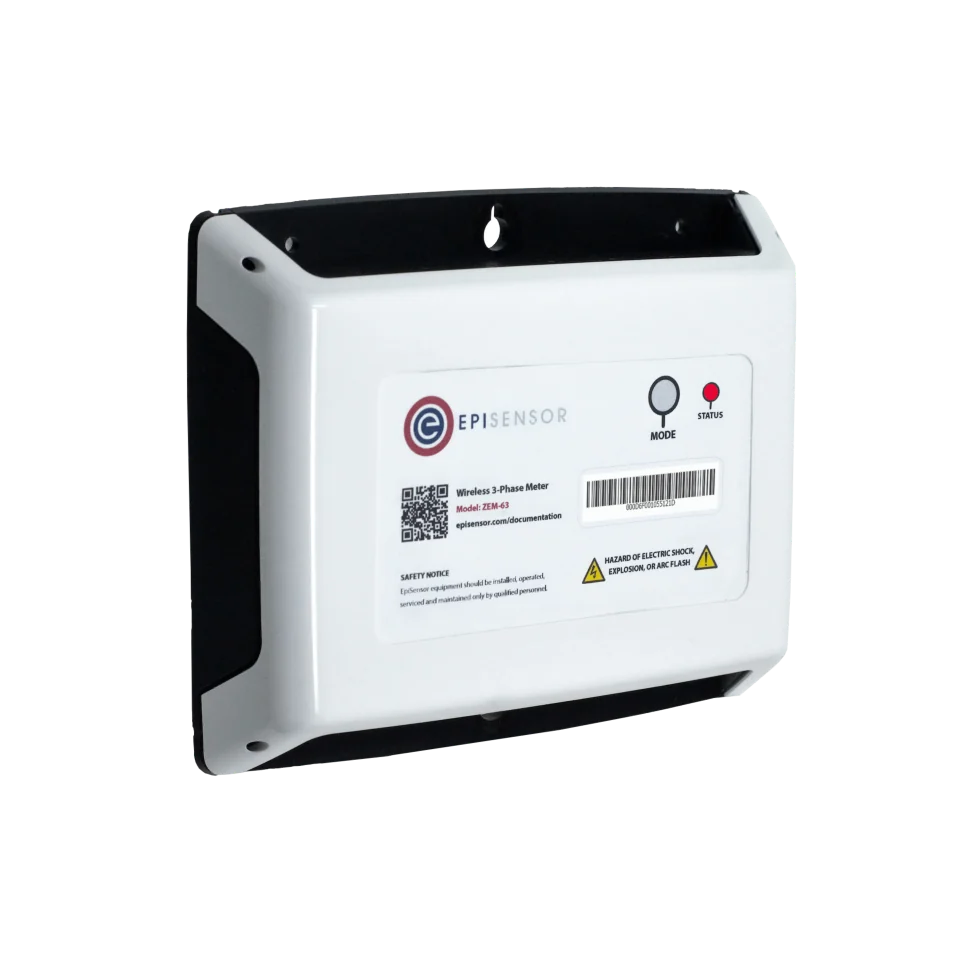
A calculation gives one operating point. A ZEM measures current, voltage and power on all three phases, so you can see the real load over time.

Related guides

Sources

  1. Calculation of electrical powers in Schneider Electric PMDs (opens in a new tab) Schneider Electric, 7EN52-0464-00, 2022-03-18
  2. What is the formula to determine the kVA on a transformer? (opens in a new tab) Schneider Electric, modified 2025-12-15