Inepro Metering PRO380-Mod
Power and energy meter
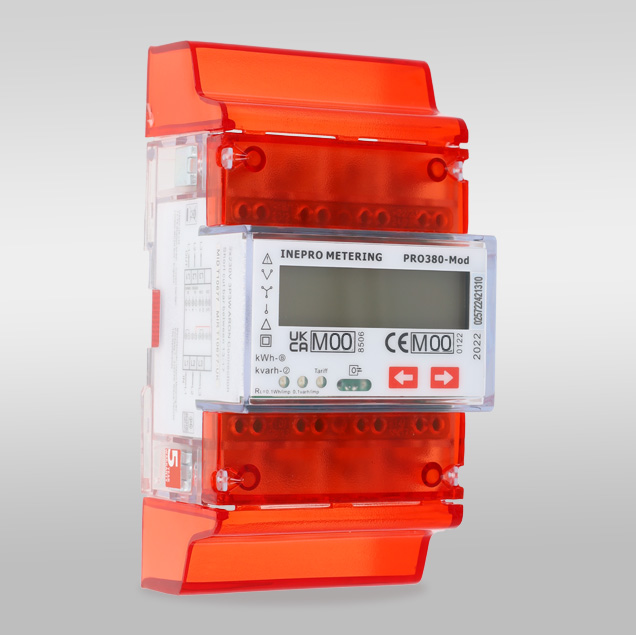
The PRO380-Mod is a four-module, three-phase DIN-rail kWh meter with an RS-485 Modbus RTU port on terminals 22 and 23. It comes as a direct-connected 5(100) A meter and as a PRO380-Mod CT for 1.5(6) A current transformers; both use the same Modbus appendix. Inepro prints its register addresses in hexadecimal and sends every measurement as a two-register IEEE-754 float, high word first, in V, A, kW or kWh.
Compatibility
Compatible with EpiSensor Edge over Modbus RTU
Inepro documents Modbus RTU over RS-485 for the PRO380-Mod and publishes an FC03 register map with hexadecimal addresses and Float32 ABCD values. This is documented compatibility, without a physical Edge test.
PRO380-Mod direct-connected (article 0257, 5(100) A) and PRO380-Mod CT (article 0260, 1.5(6) A with a programmed CT ratio), using the register map in PRO380 user manual version 2.18-8 as a best-effort starting point. Compare the first read with the meter display. The older V1.14 register map, the PRO380-S and PRO380-Mb, and other PRO380 versions are outside this guide. Read-only monitoring.
Connect it with
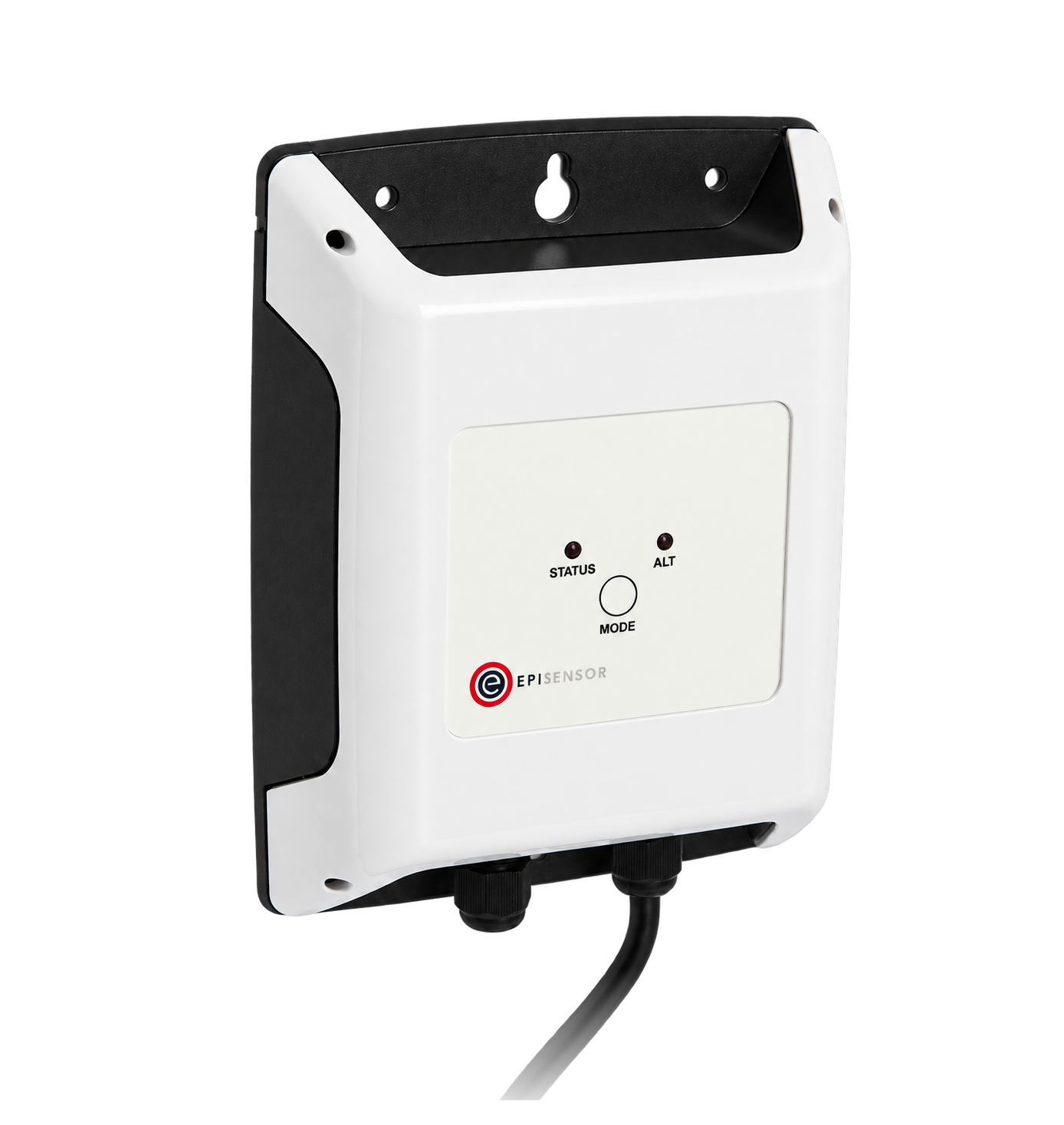
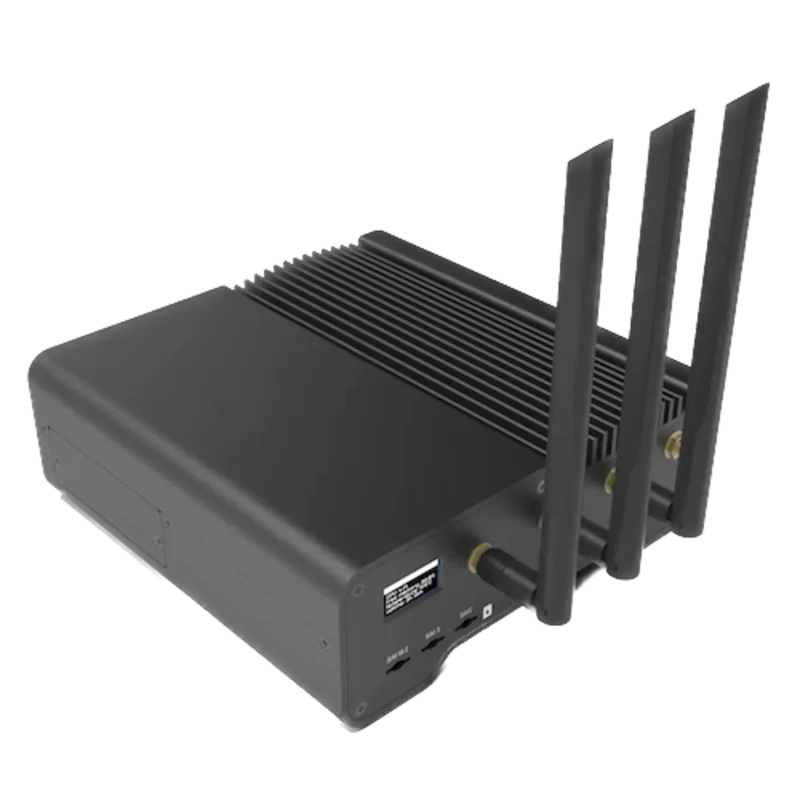
For the PRO380-Mod RS-485 port on terminals 22 and 23
- Modbus
- Edge
- Platforms
Models
| Models | Interface | Route into Edge |
|---|---|---|
| PRO380-Mod (article 0257) | Direct connection, 5(100) A; RS-485 Modbus RTU on terminals 22 and 23; forward and reverse S0 outputs | Read the Appendix 3 registers with FC03 on the serial path. |
| PRO380-Mod CT (article 0260) | 1.5(6) A current transformer input with voltage terminals 10 to 15; the same RS-485 Modbus appendix | Same read path. The CT ratio is programmed once at first power-up; confirm current and power against the display before trusting the scaling. |
| PRO380-S and PRO380-Mb | No RS-485 Modbus port in the manual; the Mb version communicates over M-bus (EN 13757-3) | The register map in this guide does not apply. |
Specifications
Pick the version by its current wiring; the Modbus map is shared. Each suits three-phase four-wire, three-phase three-wire (Aron or delta) and single-phase two-wire connection, carries MID class B approval, keeps two tariffs switched by a 230 V input, and pulses forward and reverse energy on separate S0 outputs.123
- Voltage
- Nominal 3 x 230/400 V AC; operating 3 x 230/400 V +/-20%; 45 to 60 Hz.3
- Current
- Direct: Ib 5 A, Imax 100 A. CT version: Ib 1.5 A, Imax 6 A, with a four-digit primary current on a /1 or /5 secondary, programmed once at first power-up.3
- Accuracy and approval
- Class B to EN 50470-1/3. The product pages list MID and MIR certification; the manual's declaration of conformity cites EC type-examination certificates T10677 (direct) and T10678 (CT).13
- RS-485
- Modbus RTU with 16-bit CRC on terminals 22 and 23. Modbus ID 1 to 247 (default 1). Default 9600 bit/s, 8 data bits, even parity, 1 stop bit; parity can be none or odd.3
- Bus
- Up to 60 meters per bus and 1000 m in the manual, depending on the converter, speed and installation.3
- Other interfaces
- Forward S0 output on 18/19 and reverse S0 output on 20/21 (5 to 27 V DC, 100 mA); 230 V tariff input on 24/25; infrared port to IEC 62056-21.3
- Mounting
- Four modules on a 35 mm DIN rail; 70 x 141 x 63 mm with the terminal covers; 0.39 kg. Terminals take 25 mm² flexible or 35 mm² solid copper.13
- Environment
- Direct version -40 to +70 °C; CT version -25 to +70 °C; humidity up to 75% in operation. IP51 front, IP20 terminals; indoor, inside a suitable enclosure (M1, E2).3
Interface
Documented measurements and integration boundaries for PRO380-Mod.
- Addresses are hexadecimal PDU addresses: 0x5002 is sent as 50 02 (decimal 20482). Read every point with FC03.
- L1, L2 and L3 voltage at 0x5002, 0x5004 and 0x5006: two registers, Float32 ABCD (high word first), V.
- Grid frequency at 0x5008: two registers, Float32 ABCD, Hz.
- L1, L2 and L3 current at 0x500C, 0x500E and 0x5010: two registers, Float32 ABCD, A.
- Total active power at 0x5012, then L1 to L3 at 0x5014, 0x5016 and 0x5018: Float32 ABCD, kW.
- Total reactive power at 0x501A (kvar), total apparent power at 0x5022 (kVA) and total power factor at 0x502A, each followed by its L1 to L3 values.
- Total active energy at 0x6000, forward active energy at 0x600C and reverse active energy at 0x6018: Float32 ABCD, kWh, each followed by T1, T2 and per-phase counters.
- Total, forward and reverse reactive energy at 0x6024, 0x6030 and 0x603C: Float32 ABCD, kvarh.
- Identity and settings: serial number at 0x4000 (two registers, hex), software version at 0x4007 (Float32), CT ratio at 0x400C, combination code at 0x400F and active tariff at 0x6048.
- 0x5000 Voltage, 0x500A Current and 0x4015 Error code are marked PRO1 only in this manual. Do not poll them on a PRO380.
Assessment
PRO380-Mod direct-connected (article 0257, 5(100) A) and PRO380-Mod CT (article 0260, 1.5(6) A with a programmed CT ratio), using the register map in PRO380 user manual version 2.18-8 as a best-effort starting point. Compare the first read with the meter display. The older V1.14 register map, the PRO380-S and PRO380-Mb, and other PRO380 versions are outside this guide. Read-only monitoring.
- InteroperabilityWell supported
- Inepro names Modbus RTU on RS-485 for the PRO380-Mod and publishes function codes, register lengths, units, data types and a hexadecimal address convention shown by its own command examples.13
- AccuracySupported with conditions
- Class B (1%) three-phase metering with per-phase voltage, current and power, and separate forward and reverse active and reactive energy. The CT version depends on a correctly programmed, one-time CT ratio, and total energy depends on the combination code.23
- SecurityNot yet assessed
- Program mode 3 on the display has a four-digit password, but the manual does not describe access control on the Modbus port, which accepts documented configuration writes.3
- ReliabilitySupported with conditions
- Data is retained for more than ten years without power, a power-down counter and a diagnostics display report program, EEPROM and phase status, and the meter tolerates +/-20% supply variation. Treat failed reads as missing data.3
- RuggednessSupported with conditions
- Rated -40 to +70 °C (direct) or -25 to +70 °C (CT), IP51 front and IP20 terminals, for indoor use in a suitable enclosure with surge protection where surges are frequent.13
- ScalabilitySupported with conditions
- Modbus IDs 1 to 247 and up to 60 meters per bus over 1000 m are documented; the manual notes the real limit depends on the converter, speed and installation.3
Setup
Read L1 voltage from hexadecimal address 0x5002
PRO380 user manual version 2.18-8, Appendix 3, lists L1 voltage at register address 5002 with function code 03, two registers, unit V and data type Float ABCD. Use that map as the starting point and compare the result with the display.
- Request
- 01 03 50 02 00 02 74 CB: Modbus ID 1, FC03, address 0x5002, two registers, RTU CRC.
- Address convention
- The table address is hexadecimal and goes on the wire as printed, as the manual's own write example 01 06 4003 000A shows. 0x5002 is decimal 20482 as a zero-based PDU address; a client that numbers registers from one shows it as 20483. Do not send decimal 5002.
- Synthetic response
- 01 03 04 43 66 00 00 0F A8: four data bytes, 43 66 00 00.
- Decode
- Float ABCD means high word first, high byte first: 0x43660000 as an IEEE-754 Float32 is 230.0 V. No scaling factor applies.
- Acceptance
- Keep the point when it agrees with L1 voltage on the meter display at the same time. If it does not, check the Modbus ID, address convention and installed version before adding more points.
Acceptance: The response bytes are a synthetic decoder check, not a captured meter reply. A real reply must agree with the display before current, power and energy points are enabled.
-
Identify the meter version
Read PRO380-Mod or PRO380-Mod CT from the front label and record the article number and the software version shown on the display. For the CT version, record the CT ratio set at first power-up.
-
Read the serial settings without changing them
Program mode 1 on the display shows the Modbus ID, baud rate and parity read-only. The defaults are ID 1, 9600 bit/s, 8 data bits, even parity and 1 stop bit. Enter the same values in the Edge serial client.
-
Wire the RS-485 pair
Connect the bus to terminals 22 and 23 and give each meter on the bus its own Modbus ID. The manual asks for a 120 ohm, 0.25 W resistor across 22 and 23 at the meter when it is tested through a serial converter.
-
Make one voltage read
Send FC03 to address 0x5002 for two registers and decode the Float32 high word first, as in the worked read below. Compare the result with L1 voltage on the display.
-
Add the points you need
Add current, power and energy registers from the same appendix. Log forward and reverse energy separately when export is possible, and keep FC06 and FC16 writes out of the polling configuration.
Common questions
- Is 5002 a decimal register number?
- No. Inepro prints the PRO380 addresses in hexadecimal, which is why the map has entries such as 400B and 501A. Send 0x5002, decimal 20482, as the PDU address. A tool that asks for one-based register numbers needs 20483.3
- Which energy register measures consumption?
- The combination code sets how the meter calculates total active energy: C-01 counts forward only, C-05 adds forward and reverse, and C-09 subtracts reverse from forward. The manual describes this for the displayed total, so compare 0x6000 with the display. Forward active energy at 0x600C and reverse active energy at 0x6018 are separate counters; read those two when a site can export.3
- Does the map include writable registers?
- Yes. The manual documents FC06 and FC16 writes for the Modbus ID, baud rate, parity, S0 rate, combination code, tariff and counter resets, and combination code C-10 can be set only once. A monitoring configuration should read with FC03 only.3
- Can I use the older PRO380 register map?
- The manual says the V1.14 Modbus registers still work and points to a separate document for them. This guide covers only the Appendix 3 map in version 2.18-8; do not mix addresses from the two maps in one configuration.3
- Does a 32-bit float energy counter lose resolution?
- Yes, gradually. A Float32 holds about seven significant digits: above about 131,000 kWh the counter moves in steps of about 0.016 kWh, and above about 1,050,000 kWh in steps of 0.125 kWh. Store each value as received and calculate consumption over intervals rather than from tiny differences.3
Related devices
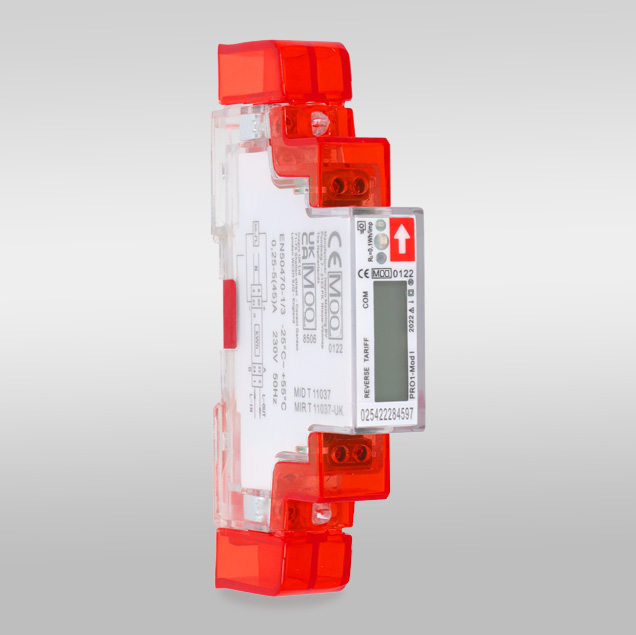
More from Inepro Metering
Sources
- PRO380-Mod electricity meter product page, article 0257 (opens in a new tab)
- PRO380-Mod CT electricity meter product page, article 0260 (opens in a new tab)
- PRO380 series MID user manual version 2.18-8 (PRO380-S, PRO380-Mb, PRO380-Mod), with Appendix 3 Modbus register map (opens in a new tab) (PDF)
Further reading
Product names and trademarks belong to their owners. Publication does not imply endorsement or a commercial relationship.