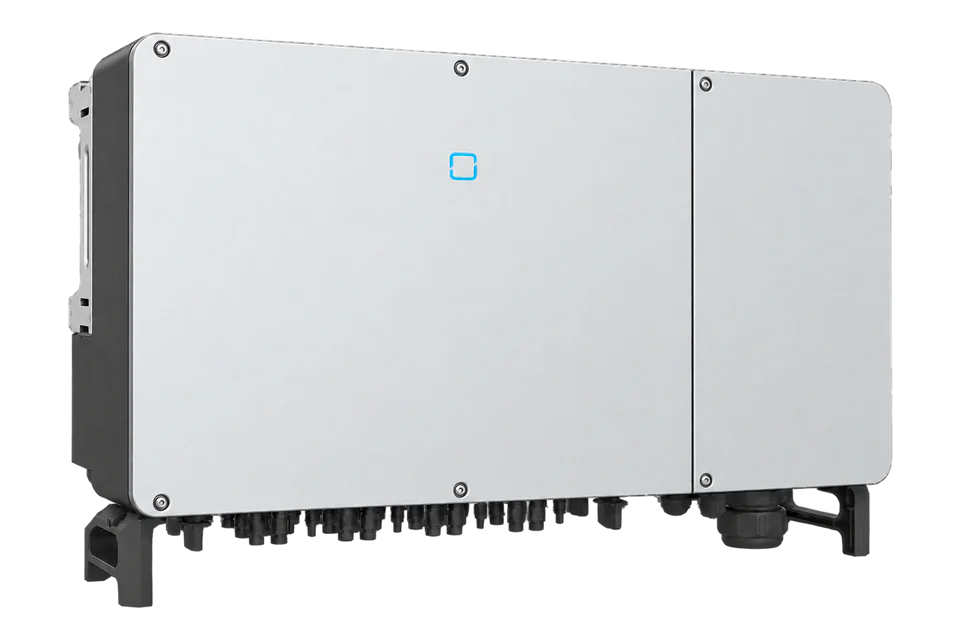
Sungrow SG350HX-20
Utility PV string inverter
The SG350HX-20 is a 1500 V DC, six-MPPT utility inverter with 800 V three-phase AC output. Sungrow rates apparent power differently at 30, 40 and 50 °C. Its communication path uses RS485_1 or power-line communication through a Sungrow logger; a third-party register contract is still needed.
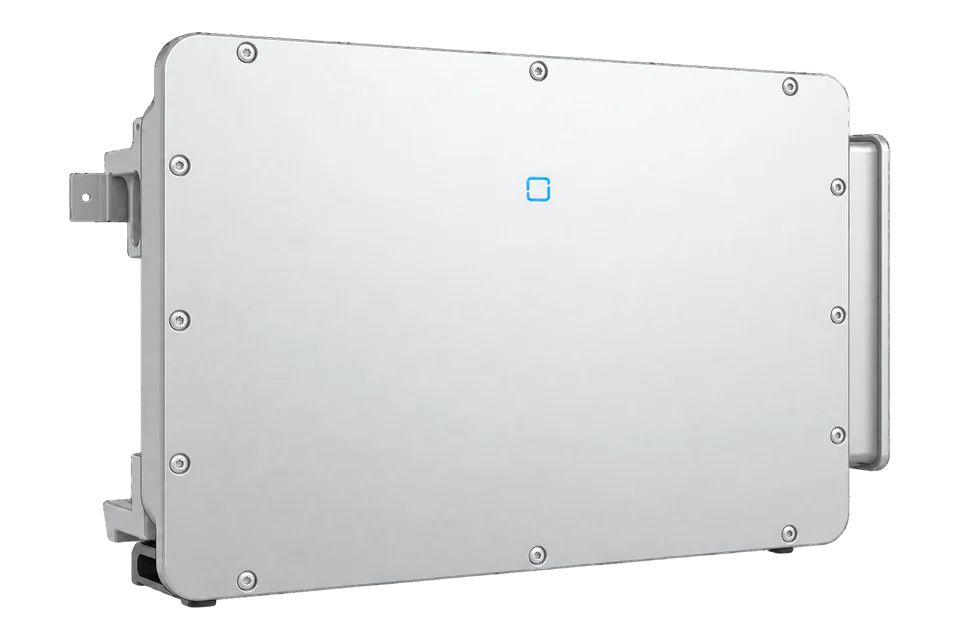
- RS485
Utility PV string inverter
Compatibility
External monitoring requires an exact-model protocol
The exact-family manual assigns RS485_1 to monitoring, RS485_2 to tracker communication and PLC over AC conductors to a Sungrow logger. Logger-side transparent Modbus RTU does not supply an SG350HX-20 firmware-matched register map or a native inverter TCP endpoint. No Edge path is established.
SG350HX-20 with English manual Ver13, October 2024, and exact-model datasheet V7. Check the installed nameplate, firmware, logger and regional grid configuration. SG350HX without the -20 suffix and SG320HX-20 are separate selections.
Models
| Models | Interface | Route into Edge |
|---|---|---|
| SG350HX-20 | Six MPPTs, up to five DC connectors per MPPT, 75 A maximum PV input per MPPT | RS485_1 is the monitoring port; alternative PLC needs a compatible Sungrow data logger. Confirm the external protocol for the installed firmware. |
| SG320HX-20 | The shared manual lists 300 kVA at 51 °C for SG320HX-20; SG350HX-20 lists 295 kVA at 50 °C. Both list 352 kVA at 30 °C and 320 kVA at 40 °C. | Keep model and ambient assumptions attached to measurements and sizing; do not choose a register map by enclosure likeness. |
| SG350HX, without -20 | An SG350HX document is not the exact SG350HX-20 datasheet used here. | Match the full suffix and manufacturer document revision before selecting hardware or protocol. |
Specifications
The SG350HX-20 V7 datasheet and Ver13 manual agree on six MPPTs, five connector positions each, 75 A maximum PV input per MPPT, 1500 V maximum DC input and an 800 V nominal three-phase AC connection. SG320HX-20 shares much of the enclosure but has a different high-temperature apparent-power row.12
- PV voltage
- 1500 V maximum; 500–1500 V MPPT range; 550 V startup2
- PV inputs
- Six MPPTs, up to five input connectors each; 75 A maximum input per MPPT2
- AC connection
- 800 V nominal, three-phase with protective earth; 640–920 V range2
- Efficiency
- 99.02% maximum; 98.8% European efficiency2
- Monitoring port
- COM1 RS485_1 for inverter monitoring or PLC through a Sungrow logger1
- Tracker port
- COM1 RS485_2 on pins 7 and 8 for tracking-system communication1
- Environment
- IP66; -30 to +60 °C ambient range; altitude to 5000 m with derating above 4000 m2
- Dimensions and weight
- 1148 × 779 × 371 mm; ≤106 kg, with manufacturer-stated ±8% component variation2
Interface
Documented measurements and integration boundaries for SG350HX-20.
- The local iSolarCloud interface documents string and MPPT electrical quantities, AC power, voltages, current and grid frequency. These are app-visible quantities, not a published external register list.
- The manual describes inverter yield, operating conditions and event histories; it does not establish an SG350HX-20 external scaling, update interval or accuracy class.
- A utility plant needs separate meter and tracker identities. Inverter yield alone does not prove revenue-meter output, curtailment delivery or the grid-point import/export value.
Assessment
SG350HX-20 V7 datasheet and Ver13 family manual; external protocol and firmware applicability are unverified.
- InteroperabilityLimited
- COM1 RS485_1 monitoring, serial settings and PLC logger topology are documented. An exact SG350HX-20 external register map and firmware scope remain necessary for independent telemetry.1
- AccuracyLimited
- The local app reports electrical quantities and yield, but an external point model, accuracy and grid-meter identity are not established by the retained sources.1
- SecuritySupported with conditions
- The local app uses accounts and supports changing its initial password. External RS485 access requires installation safeguards; the manual does not establish encryption or authenticated external reads.1
- ReliabilitySupported with conditions
- The manual documents operating logs, up to 400 fault entries and 400 event entries, fault diagnostics and maintenance. Continued operation depends on the specified cooling and electrical installation; retention duration through power loss is not established.12
- RuggednessSupported with conditions
- IP66, published temperature and altitude limits, surge protection and a fan-maintenance procedure support utility installations within the stated derating, ventilation and site conditions.12
- ScalabilitySupported with conditions
- The serial interface offers addresses 1–246 and multiple baud rates. Daisy-chain capacity belongs to the selected logger, while polling load and client limits need separate protocol confirmation.1
Setup
-
Confirm the -20 variant
Photograph the full model plate and record firmware, logger and installed configuration. Compare the SG350HX-20 datasheet and manual column rather than a nearby SG350HX or SG320HX document.
-
Trace the monitoring route
Identify whether the plant uses COM1 RS485_1 to a logger or PLC over the AC cables. Record the RS485_2 tracker connection separately and preserve the existing bus controller.
-
Request the exact read contract
Obtain the applicable SG350HX-20 protocol and logger forwarding description from Sungrow or the plant integrator. Check firmware, address convention, read function, scaling, timestamps and coexistence before designing Edge polling.
-
Validate a bounded pilot
Compare one or two approved read-only operational values with simultaneous local readings. Record units, signs, quality and loss-of-communication handling; use a separate meter for grid-point energy.
-
Keep control ownership explicit
Document who owns inverter commands, export limits and grid functions. Do not enable writes or VPP dispatch from this selection guide.
Common questions
- Can RS485_2 serve a second monitoring controller?
- The Ver13 manual assigns COM1 RS485_2 to tracker communication. Monitoring uses RS485_1, while the alternative PLC path depends on a Sungrow logger. Survey the commissioned topology before adding any client.1
- Does PLC mean the inverter has a Modbus TCP endpoint?
- No. PLC here is communication over AC conductors to the Sungrow logger. The manual describes transparent Modbus RTU through the logger’s RS485 interface but does not document a native SG350HX-20 TCP server or an external register map.1
- Can this guide qualify VPP dispatch?
- It describes selection and monitoring boundaries only. Active or reactive-power commands and grid settings need a separate manufacturer-approved control contract, plant-owner permission and witnessed site acceptance.1
Related devices
Sources
- SG305HX / SG320HX-20 / SG350HX-20 / SG250HX-20 user manual, Ver13, October 2024 (opens in a new tab) (PDF)
- SG350HX-20 global datasheet, V7 (opens in a new tab) (PDF)
- SG350HX-20 product and document page (opens in a new tab)
Further reading
Product names and trademarks belong to their owners. Publication does not imply endorsement or a commercial relationship.