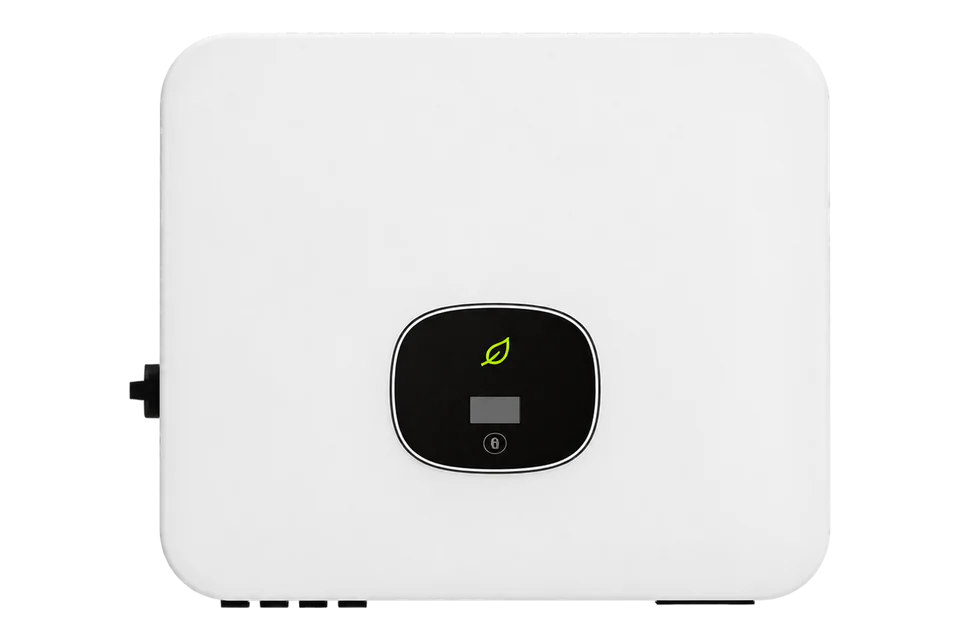
Growatt MOD 3-10KTL3-XH
Residential hybrid PV inverter
Growatt's exact-family manual separates four RS-485 terminal roles and documents optional Shine monitoring devices. It does not establish a firmware-matched third-party inverter telemetry map. A direct Edge read or write path is therefore unverified; the meter's Modbus RTU description is not an inverter interface specification.
- RS485
Residential hybrid PV inverter
Compatibility
Direct Edge integration not yet verified
The Growatt manual names RS-485 COM pins, optional loggers and a Modbus RTU meter interface, but supplies no third-party inverter register map, client role or coexistence contract for this family and firmware.
MOD 3-10KTL3-XH family only. Confirm the exact 3 to 10 kW rating, firmware, logger, meter, battery and regional grid settings before designing an integration. Do not transfer this claim to XH(BP) or XH2.
Models
| Models | Interface | Route into Edge |
|---|---|---|
| MOD 3000-6000TL3-XH | Two PV inputs; COM terminal and optional datalogger | Record the exact 3, 4, 5 or 6 kW nameplate and firmware before requesting a telemetry document. |
| MOD 7000-10KTL3-XH | Two PV inputs; COM terminal and optional datalogger | Record the exact 7, 8, 9 or 10 kW nameplate and firmware; do not infer a register map from the lower ratings. |
Specifications
The May 2024 manual covers MOD 3000 through 10KTL3-XH with two independent PV inputs. Battery-ready operation and export functions depend on the commissioned battery and meter arrangement.12
Interface
Documented measurements and integration boundaries for MOD 3-10KTL3-XH.
- Inverter production, operating state, alarms and battery state are candidate monitoring questions, not published addressable Edge points in this guide.
- The COM connector has separate RS485A1/B1 parallel, A3/B3 meter, A2/B2 battery and A4/B4 SYN roles. Never treat the meter or battery pair as a general inverter telemetry bus.
- Growatt's meter Modbus RTU description applies to its commissioned meter interface. Export limitation and storage operation depend on the meter and system configuration, not merely on an RS-485 connection.
- No active-power, reactive-power, export-limit, battery-mode or grid-setting write is approved by this guide.
Assessment
MOD 3000-10000TL3-XH only, with installed firmware and actual logger, meter and battery topology recorded; direct third-party read access is unverified.
- InteroperabilityLimited
- The published physical interfaces have assigned roles, but a firmware-matched third-party inverter read contract is absent from the retained sources.1
- AccuracyNot yet assessed
- Readable inverter values, types, scaling and freshness are not established for a third-party client.1
- SecurityNot yet assessed
- Client authentication, read-only privilege and network isolation are not specified for a third-party endpoint.1
- ReliabilityNot yet assessed
- Polling limits, stale-value signaling and logger coexistence are not established.1
- RuggednessSupported with conditions
- The inverter is documented for installed residential PV use; site conditions and the exact unit still require review.12
- ScalabilityNot yet assessed
- Parallel operation is documented, but third-party poll capacity and multi-inverter client ownership are not.1
Setup
-
Identify the installed variant
Capture the complete XH nameplate, firmware, country setting and any battery, meter, logger or parallel-inverter hardware. XH(BP) and XH2 need their own evidence.
-
Trace each communication role
Map COM pins 3/4, 5/6, 7/8 and 17/18 to their commissioned parallel, meter, battery and SYN functions. Document the reserved logger port separately; do not move a lead to an apparently spare pair.
-
Request the inverter read contract
Obtain the manufacturer-approved, firmware-matched third-party specification for the actual inverter or logger endpoint, including address convention, data types, scaling, permissions and coexistence rules.
-
Keep control and measurement boundaries
Use the commissioned meter for grid-point measurements and retain the existing protection and export-control design. Propose no third-party writes until a separate safety and controls review has been completed.
Common questions
- Does the RS-485 COM socket mean Edge can read this inverter?
- No. Growatt assigns the documented pairs to parallel, meter, battery and SYN roles. A third-party inverter or logger read needs its own firmware-matched protocol, endpoint role and coexistence approval.1
- Is the meter's Modbus RTU protocol an inverter register map?
- No. The manual's Modbus RTU description is in the meter specifications. It cannot be reused to claim inverter telemetry or control addresses.1
- Can this page be used to implement VPP export control?
- No. This is an interface assessment with no approved Edge write path. Export limitation depends on a commissioned meter and engineered control configuration; flexibility dispatch also needs the plant's separate controls and market arrangements.1
Related devices
Sources
- MOD 3-10KTL3-XH user manual (May 2024) (opens in a new tab) (PDF)
- MOD 3000-10000TL3-XH product page (opens in a new tab)
Further reading
Product names and trademarks belong to their owners. Publication does not imply endorsement or a commercial relationship.