Schneider Electric A9MEM1570
Three-phase energy sensor
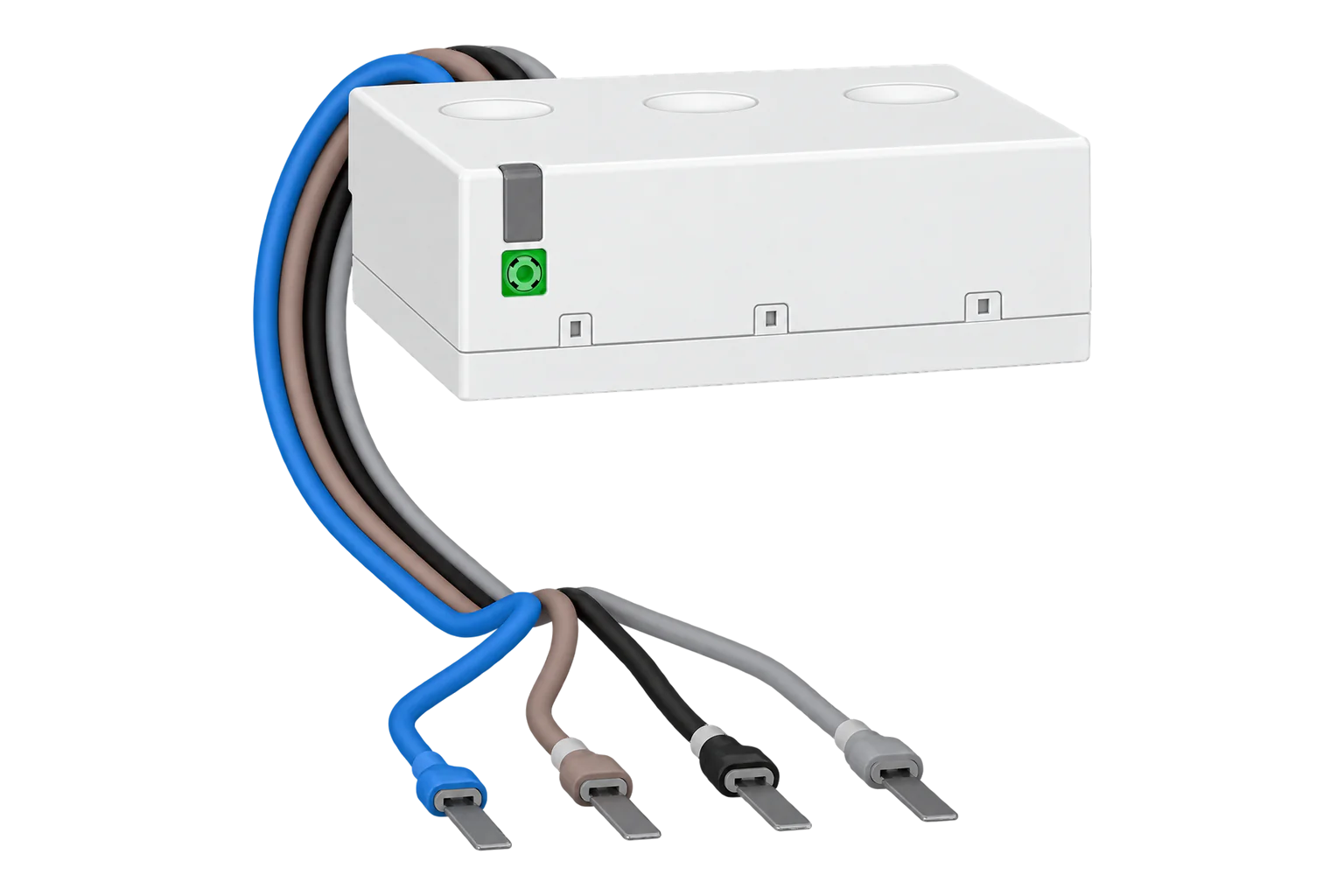
A 63 A three-phase and neutral energy sensor that fits on the terminals of a circuit breaker and reports voltage, current, power, power factor and energy over Zigbee Green Power, to Class 1 under IEC 61557-12.
Also sold asPowerTag Energy F63 3P+NSchneider Electric R9M70
- Zigbee
Three-phase energy sensor
Compatibility
Compatible with EpiSensor Edge over Zigbee.
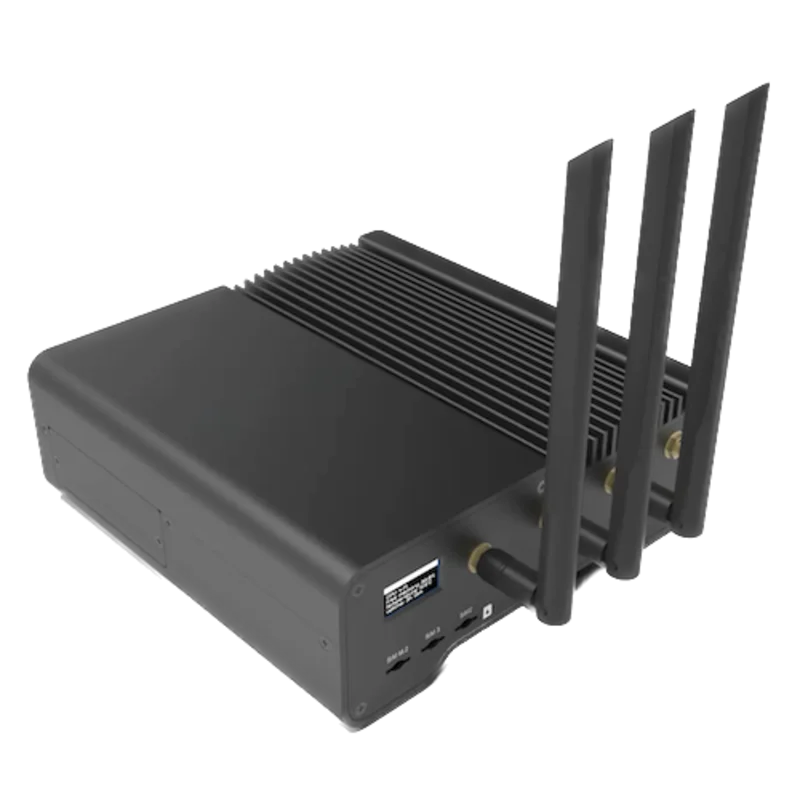
Pair it with the Zigbee radio on an EpiSensor Gateway. Edge reads it locally on the Gateway.
Edge reads 20 values from it, listed under Interface.
Connect it with
-
Gateway ZGW-20From €899 ex VAT Configure Gateway
Specifications
The A9MEM1570 is the three-phase and neutral version of Schneider Electric's PowerTag F63. It fits directly on the top or bottom terminals of a protective device rated up to 63 A, such as an Acti 9 circuit breaker or residual current device, and takes its supply from the circuit it measures through 0.25 m voltage leads. There is no separate current transformer to size or wire.12
- Power
- Self-powered from the measured supply. Powered from the circuit it measures through its voltage leads, at most 2 VA. No battery.1
- Maximum current (Imax)
- 63 A1
- Basic current (Ib)
- 10 A1
- Starting current
- 40 mA1
- Accuracy
- Class 1 for current, active power, active energy and power factor; Class 0.5 for voltage (IEC 61557-12)1
- Poles
- 3P + N1
- Network voltage
- 220 to 240 V AC phase to neutral, 380 to 415 V AC between phases, ±20 %1
- Network frequency
- 50 or 60 Hz1
- Radio
- IEEE 802.15.4, 2.4 to 2.4835 GHz, channels 11 to 262
- Transmit power
- 10 mW maximum (EIRP)2
- Zigbee certification
- Green Power Device, certificate ZIG22011GPF20060-246
- Operating temperature
- -25 to 60 °C1
- Protection
- IP20, IK05, indoor use1
- Voltage lead length
- 0.25 m1
- Dimensions (H × W × D)
- 20 × 54 × 46.6 mm, sensor element1
- Weight
- 40 g1
- Standards
- IEC 61557-12, IEC 61010-1, IEC 61010-2-030, IEC 61326-1, ETSI EN 300 3281
Where it is used
Energy and power per outgoing three-phase feeder in a distribution board, without separate current transformers or a DIN-rail meter.
Transformer and distribution board monitoringCost allocation where each tenant or department has its own three-phase breaker.
Tenant submetering and cost allocationHVAC plant, heat pumps and other three-phase loads up to 63 A.
HVAC energy monitoring for commercial buildings
Interface
Readings and settings, with units and ranges where Schneider Electric publishes them.
| Reading | Unit | Range or values | Access |
|---|---|---|---|
| Measurements 20 | |||
| Power | W | - | Read only |
| Power apparent | VA | - | Read only |
| Power phase a | W | - | Read only |
| Power phase b | W | - | Read only |
| Power phase c | W | - | Read only |
| Power factor | - | - | Read only |
| Energy | kWh | - | Read only |
| Energy phase a | kWh | - | Read only |
| Energy phase b | kWh | - | Read only |
| Energy phase c | kWh | - | Read only |
| AC frequency | Hz | - | Read only |
| Voltage phase a | V | - | Read only |
| Voltage phase b | V | - | Read only |
| Voltage phase c | V | - | Read only |
| Voltage phase ab | V | - | Read only |
| Voltage phase bc | V | - | Read only |
| Voltage phase ca | V | - | Read only |
| Current phase a | A | - | Read only |
| Current phase b | A | - | Read only |
| Current phase c | A | - | Read only |
It is a Zigbee Green Power device, not an ordinary end device or router. It transmits Green Power frames, so the Zigbee network has to accept Green Power devices for its readings to arrive.6
Zigbee2MQTT identifies it by the Green Power model ID GreenPower_254 and decodes its frames with a PowerTag converter. Per-phase values carry the suffixes phase_a, phase_b and phase_c; line-to-line voltages are voltage_phase_ab, voltage_phase_bc and voltage_phase_ca.7
A Schneider gateway records whether the sensor sits on the top or bottom of the breaker and which side the supply enters, because that sets the direction of energy flow. Check the sign of active power on a known load after you install it.3
Setup
-
Isolate the circuit
Switch off the supply and prove with a voltage tester that every conductor is dead before you work on the breaker.2
-
Fit the sensor
Mount it on the top or bottom terminals of the breaker and connect the voltage leads to the matching phase and neutral terminals. Some breakers need the lead ends replaced with AWG22 (0.33 mm²) cable ends.2
-
Open pairing in Edge
In Edge, open pairing on the Gateway's Zigbee network before you switch the circuit back on.
-
Energise the circuit
Switch the breaker on. The sensor powers up from its own leads and is discovered as it starts. Schneider commissions large boards the same way, switching circuits on one at a time so each sensor is found in order.3
-
Check one reading
Compare the phase voltages and currents with a clamp meter on a loaded circuit, and confirm that active power is positive for consumption.
Common questions
- Does the A9MEM1570 need a Schneider concentrator?
- Not for its Zigbee frames. It is a certified Zigbee Green Power device, and Zigbee2MQTT's definition decodes its measurements directly. The Zigbee network it reports to has to accept Green Power devices.67
- Which breakers does it fit?
- It fits the terminals of 3P+N protective devices up to 63 A. Schneider's compatibility guide CA908058E lists each Acti 9, Multi 9 and TeSys device with the top or bottom position it allows. Some devices need the voltage leads fitted with AWG22 (0.33 mm²) cable ends.25
- Can it go downstream of a contactor or drive?
- No. With a contactor, variable speed drive or motor starter, Schneider allows it only upstream. Schneider states that PowerTag sensors withstand motor starting inrush currents.25
- How often does it report?
- In Schneider's PowerTag system the gateway sets the period between 5 and 60 seconds. Schneider recommends at least 30 seconds where up to 400 wireless devices share a 20 m radius, and 60 seconds up to 600. A voltage loss alarm is sent as an event.4
Related devices
Sources
- A9MEM1570 energy sensor, PowerTag Flex 63A 3P+N: product page and datasheet (opens in a new tab)
- PowerTag F63 instruction sheet QGH78642 (opens in a new tab)
- PowerTag Link Gateway user guide DOCA0157EN (opens in a new tab)
- PowerTag System design and commissioning guide DOCA0194EN (opens in a new tab)
- PowerTag Energy selection guide for product compatibility CA908058E (opens in a new tab) (PDF)
- PowerTag F63 3P+N certified product (opens in a new tab)
- Schneider Electric A9MEM1570 converter source (opens in a new tab)
- Schneider Electric A9MEM1570 device documentation (opens in a new tab)
Further reading
Product names and trademarks belong to their owners. Publication does not imply endorsement or a commercial relationship.