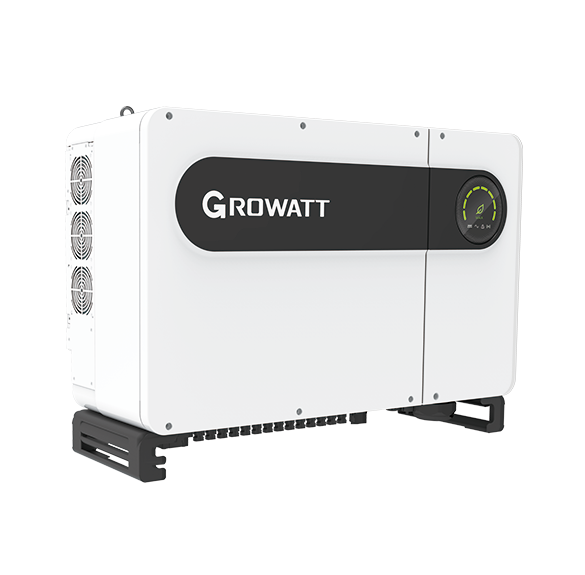
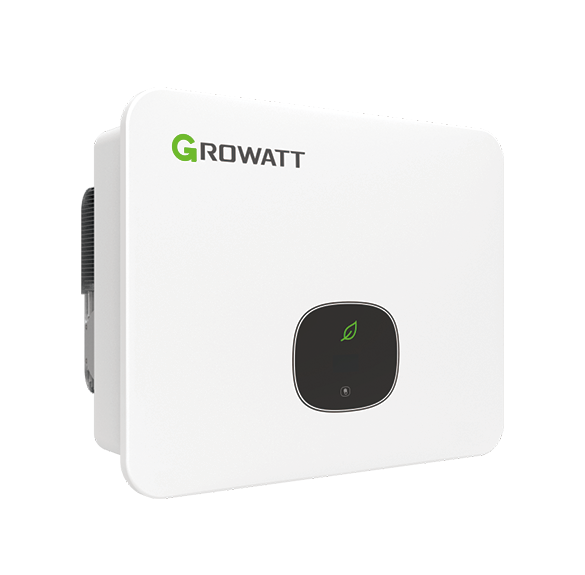
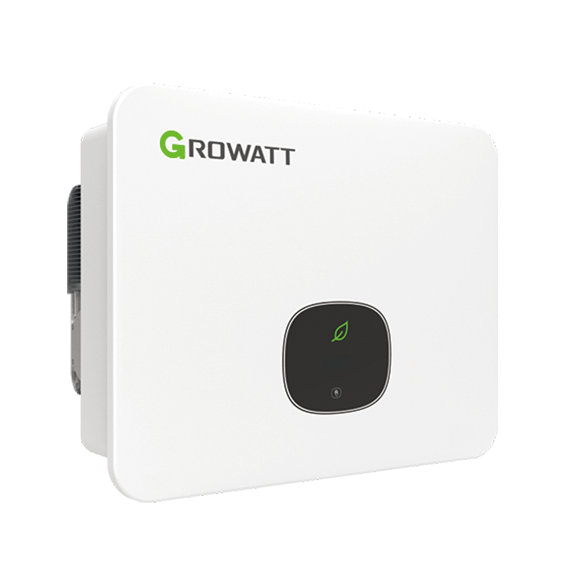
Growatt MAX 50-80KTL3 LV
Commercial PV inverter
The MAX 50-80KTL3 LV family has four 400 V-class ratings. Growatt documents an RS-485 daisy chain to ShineMaster, optional USB monitoring modules and separate DRMS contacts. Its manual does not define a firmware-matched third-party inverter read map or software dispatch interface, so a direct Edge connection remains unverified.
- RS485
Commercial PV inverter
Compatibility
Growatt monitoring topology documented; third-party read unverified
The January 2024 manual describes two RS-485 ports, up to 32 inverters on a monitored chain, and a ShineMaster at its end. It gives electrical and bus details but no firmware-matched third-party inverter register map, independent-client coexistence rule or Edge acceptance result.
Standard MAX 50KTL3 LV, 60KTL3 LV, 70KTL3 LV and 80KTL3 LV only. Record exact nameplate, firmware, country grid setting, ShineMaster or USB logger and the occupied RS-485/DRMS terminals. MAX 60-100KTL3 MV, MAX 100-150KTL3-X/X2 and similarly named XL families have separate electrical and interface scopes.
Models
| Models | Interface | Route into Edge |
|---|---|---|
| MAX 50KTL3 LV and MAX 60KTL3 LV | Six MPPTs and twelve PV strings; two RS-485 sockets support the documented ShineMaster chain | Record the commissioned chain and firmware. Request a separate external-client read specification before connecting Edge. |
| MAX 70KTL3 LV and MAX 80KTL3 LV | Seven MPPTs and fourteen PV strings at nominal 400 V | Confirm current limits and protections for the installed rating; do not substitute the MV variant's 500 V-class data. |
Specifications
The May 2026 datasheet lists MAX 50, 60, 70 and 80KTL3 LV at nominal 230/400 V. The 50 and 60 kW units have six MPPTs; the 70 and 80 kW units have seven. Two strings per tracker yield twelve or fourteen string inputs respectively. The named MV units in the broader manual use different AC voltages and are excluded.12
- Exact LV ratings
- MAX 50, 60, 70 and 80KTL3 LV; nominal 50, 60, 70 and 80 kW AC2
- AC connection
- Three phase, 230/400 V nominal, 3W+N+PE; country grid settings can alter allowed ranges2
- PV input limits
- 1100 V maximum DC; 200-1000 V MPPT range; 26 A maximum input and 32 A short-circuit current per tracker2
- RS-485 chain
- Two ports; manual states up to 32 inverters, 500 m and 38,400 baud for its monitoring topology1
- Monitoring accessories
- ShineMaster chain logger; optional USB-A ShineWiFi, Shine4G, ShineLan or ShineLink variants in the manual13
- DRMS
- Six-pin connector with four relay inputs, REF/GEN and DRM0/COM1
- Enclosure
- 860 × 600 × 300 mm; IP65; -25 to +60 °C operating range2
Interface
Documented measurements and integration boundaries for MAX 50-80KTL3 LV.
- Section 6.3.1 of the manual describes RS-485 monitoring for one or several inverters, with a maximum of 32 inverters, 500 m total distance and a stated 38,400 baud rate. These are Growatt topology limits, not independent-client or Modbus compatibility guarantees.
- Two RS-485 ports permit a daisy chain, whose end the manual connects to ShineMaster. Check existing termination, shield and grounding before adding equipment. A USB-A ShineWiFi, 4G or LAN accessory is a separate monitoring path.
- The manual's DRMS connector has relay contact inputs DRM1/5 through DRM4/8, REF/GEN and DRM0/COM. A dry-contact grid response is not a generic VPP command or register-write interface.
- Growatt says a smart meter and environmental monitor on its monitoring system must be from its designated manufacturers. A meter's own protocol and register addresses do not define an inverter telemetry endpoint.
- Inverter AC output is not site import or export. A point-of-connection meter must be identified and checked for CT ratio, phase orientation, interval and sign before reporting self-consumption or export.
Assessment
MAX 50/60/70/80KTL3 LV family at nominal 400 V. Growatt RS-485 monitoring is documented; third-party inverter reads and dispatch are unverified.
- InteroperabilityLimited
- Growatt documents two RS-485 ports and a ShineMaster chain, but no exact-firmware external inverter register contract or independent-client permissions.1
- AccuracyLimited
- Inverter generation and optional string monitoring are described, but third-party point definitions, scaling and freshness are not established. Grid-point values need a separate meter.12
- SecurityNot yet assessed
- Third-party serial access and network logger permissions are not established for this installation.1
- ReliabilityNot yet assessed
- The chain topology is documented, but external-client stale-data and recovery behavior are not.1
- RuggednessSupported with conditions
- The datasheet states IP65 and a -25 to +60 °C operating range. Preserve installation clearances, cooling and sealed communication glands.12
- ScalabilityLimited
- Growatt documents up to 32 inverters and 500 m on its monitoring chain. That limit does not authorize a second polling master or establish Edge capacity.1
Setup
-
Identify the exact LV variant
Record the 50, 60, 70 or 80 kW nameplate, firmware and country grid code. Verify 400 V-class LV equipment rather than a MAX MV or X/X2 relative.
-
Map the monitoring chain
Trace both RS-485 ports, device addresses, line termination, shield/grounding and the ShineMaster or other accessory. Record whether a USB monitoring module is also fitted.
-
Obtain the external read specification
Ask Growatt or the plant integrator for a firmware-matched protocol specifying the permitted endpoint, master/client ownership, function codes, addresses, data types, scaling, update frequency and coexistence with ShineMaster.
-
Define independent measurement acceptance
With a documented read path, compare PV power, energy and state at the inverter against the local Growatt display or logger. Verify timestamps, stale data and alarms. Use a separate site meter for import and export.
-
Keep plant control commissioned
Leave DRMS, export limitation and grid protection under the approved electrical design. Any flexibility dispatch requires a distinct command contract, authority, acknowledgement and fail-safe response.
Common questions
- Can Edge read a MAX LV directly over RS-485?
- The manual provides an RS-485 monitoring topology but does not provide a third-party inverter register map or client coexistence rules. Obtain those documents for the installed firmware before proposing an Edge read.1
- Does ShineMaster's Ethernet connection mean Modbus TCP is available?
- No local Modbus TCP service is established by the retained manual. ShineMaster is described as collecting inverter data and uploading it over a network. Its own supported third-party interface needs separate documentation.1
- Can the DRMS inputs provide VPP dispatch?
- DRMS is a commissioned dry-contact grid-response function. A VPP control design requires documented signals, priority, permissions, feedback and loss-of-communications behavior; the contacts alone do not supply that contract.1
- Are 50 and 80 kW MAX LV units electrically interchangeable?
- No. The current datasheet gives six trackers and twelve strings for 50/60 kW, versus seven trackers and fourteen strings for 70/80 kW, with different AC currents and PV sizing. Check the exact rating and country rules.2
Related devices
Sources
- MAX 50-100KTL3 LV/MV user manual, January 2024 (opens in a new tab) (PDF)
- MAX 50-80KTL3 LV datasheet, May 2026 update (opens in a new tab) (PDF)
- MAX 50-80KTL3 LV product page (opens in a new tab)
Further reading
Product names and trademarks belong to their owners. Publication does not imply endorsement or a commercial relationship.