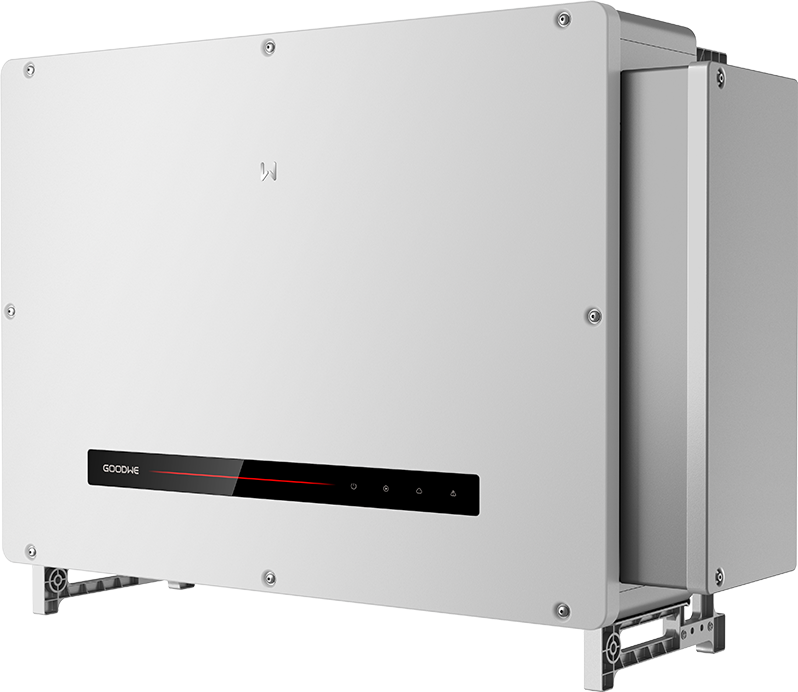
GoodWe UT 320/350 kW
Utility-scale PV inverter
The EMEA UT family lists GW320K-UT, GW320KH-UT, GW350K-UT and GW350KH-UT. GoodWe documents COM2 RS-485 daisy chains and an alternative power-line path to its SCU3000A communications unit. Its datasheet names Modbus RTU, but these sources do not establish an independent Edge read, SCU northbound API or third-party dispatch contract.
- Modbus RTU
Utility-scale PV inverter
Compatibility
GoodWe plant bus documented; direct Edge path unverified
The EMEA datasheet says RS-485 or PLC and Modbus RTU. Manual V1.6 assigns COM2 RS-485 to a daisy chain of UT inverters and a GoodWe smart communication unit or logger; integrated PLC communicates over the AC cable with that unit. No exact-firmware independent client ownership, inverter register map, SCU3000A northbound service, coexistence or write authority is established.
EMEA GW320K-UT, GW320KH-UT, GW350K-UT and GW350KH-UT only. The 250 kW, Korean -KR, HT 100-120 kW and other regional UT variants require separate checks. Preserve the installed nameplate, firmware, grid approval, SCU3000A/logger revision and selected RS-485 or PLC topology.
Models
| Models | Interface | Route into Edge |
|---|---|---|
| GW320K-UT and GW350K-UT | Fifteen MPPTs, two strings each, 30 A maximum input and 50 A maximum short-circuit current per tracker in the EMEA sheet. Both are 800 V AC and 1500 V maximum DC. | Confirm the non-H nameplate, firmware and logger; a published Modbus RTU label does not identify a free third-party client port. |
| GW320KH-UT and GW350KH-UT | Twelve MPPTs, two strings each, 40 A maximum input and 60 A maximum short-circuit current per tracker. The H suffix denotes the higher-current PV input variant, not a separate Edge protocol. | Use the H-variant electrical values and obtain exact firmware/interface evidence before external reads. |
Specifications
The EMEA product page lists four UT variants at 320/350 kW, with 15 MPPTs on K models and 12 higher-current MPPTs on KH models. The EMEA sheet gives 1500 V maximum PV voltage, 800 V three-phase nominal AC, two strings per tracker, IP66 and full-load operation to 40 °C. It also includes a separate 250 kW variant, excluded here.23
- PV input
- 1500 V maximum DC; 480-1500 V MPPT operating range; two strings per tracker2
- K versus KH trackers
- K: 15 MPPTs at 30 A input/50 A short-circuit each; KH: 12 MPPTs at 40 A/60 A each2
- Grid output
- 800 V, three phase, 3L/PE; confirm 350-class rating against nameplate because EMEA sheet lists 352 kW nominal12
- COM2 RS-485
- Pins 1/3 A1, pins 2/4 B1, pins 5/6 grounding; GoodWe inverter/SCU/logger bus1
- RS-485 chain
- Under 1000 m cable; at most 20 inverters when more than two connect to a GoodWe communication unit/logger1
- PLC over AC cable
- Integrated module to GoodWe unit; up to 1000 m multicore or 800 m single-core cable to box transformer1
- Enclosure
- IP66; 1120 × 810 × 368 mm; 133 kg; -35 to +60 °C2
Interface
Documented measurements and integration boundaries for UT 320/350 kW.
- Manual V1.6 assigns COM2 pins 1/3 to RS485_A1 and 2/4 to RS485_B1, with pins 5/6 for grounding. It shows those contacts serving other UT inverters or a GoodWe SCU3000A, not an automatically available Edge polling pair.
- For more than two inverters connected to a GoodWe smart unit/logger, the manual limits one RS-485 daisy chain to 20 inverters and under 1000 m of cable. These are vendor plant-network limits, not an Edge or northbound capacity approval.
- The inverter's integrated PLC module sends data over the AC output cable toward the GoodWe smart unit. The manual gives 1000 m with multicore AC cables or 800 m with single-core cable to the box transformer. PLC is not an Ethernet socket at the inverter.
- GoodWe's EMEA datasheet calls this high-speed power-line communication and names Modbus RTU. Neither statement supplies a point map, client arbitration, SCU3000A northbound API, command authorization or external freshness contract.
- The EMEA sheet tabulates 352 kW nominal AC for GW350K-UT/GW350KH-UT, while the model names and manual label the class 350 kW. Use the installed nameplate and grid approval for electrical design; do not infer a dispatch ceiling from the model name.
Assessment
Four EMEA UT 320/350 kW K/KH variants; physical plant transport documented, third-party read/control unverified.
- InteroperabilityLimited
- COM2 RS-485, PLC and a Modbus RTU label are documented, but no external UT register map, SCU northbound interface or client coexistence contract is retained.123
- AccuracyLimited
- GoodWe provides production monitoring, but a third-party data model, freshness and grid-point measurement accuracy are not specified by these sources.12
- SecurityNot yet assessed
- No approved independent-client authentication, segmentation or write authority is established for the UT/SCU pair.12
- ReliabilityNot yet assessed
- External-client stale-data, retry and loss-of-communication behavior require a separate protocol and site acceptance test.1
- RuggednessSupported with conditions
- The EMEA sheet states IP66, -35 to +60 °C and full-load operation to 40 °C. Maintain required mounting clearances, cooling and sealed cable entries.2
- ScalabilityLimited
- The manual permits up to 20 inverters on one RS-485 chain to a GoodWe unit and gives PLC distances. Those limits do not establish SCU northbound throughput or Edge capacity.1
Setup
-
Identify the regional UT variant
Record the complete K or KH model, firmware, 800 V AC connection, grid-country certificate and SCU/logger revision. Exclude 250 kW and -KR documentation unless the installed nameplate calls for it.
-
Trace the plant communication design
Determine whether the installed units use COM2 RS-485 or integrated PLC over AC cabling. Record the chain, termination, cable length, SCU3000A or other GoodWe logger, transformer and network switch.
-
Acquire external-interface evidence
Ask GoodWe or the EPC for an exact-firmware inverter or SCU northbound specification: approved endpoint, client count, port, addressing, function codes, types, scaling, cadence and network security. Do not place Edge on a vendor bus based on a datasheet protocol label alone.
-
Qualify read-only values
If GoodWe approves an external read path, compare timestamped AC power, lifetime energy, running state and alarms against the inverter display/SEMS and independent site revenue meter. Check scaling, stale values and missing-unit behavior.
-
Treat controls as separate engineering
Reactive-power support, export limitation, emergency shutdown and VPP dispatch require a site control matrix, utility permissions, priority rules, acknowledgements and loss-of-link response. This guide authorizes no writes.
Common questions
- Can Edge poll a GW350K-UT directly over COM2?
- The manual places COM2 on the GoodWe RS-485 plant chain to other inverters or a communications unit. The datasheet says Modbus RTU, but the retained sources do not define an exact-firmware independent-client map or coexistence permission. A direct Edge route is unverified.12
- Does the SCU3000A LAN link expose Modbus TCP or an API?
- The manual shows the SCU3000A connected through a network switch to a monitoring platform. It does not define a northbound local service or credentials for this UT installation. Obtain the SCU-specific interface document before proposing an integration.1
- Is HPLC a separate Ethernet network at each inverter?
- No. The integrated PLC module communicates over the AC output cable to the GoodWe unit. The manual gives cabling distance limits and a transformer-side topology, not an Ethernet jack or address on each inverter.13
- Are K and KH units electrically interchangeable?
- No. The EMEA sheet gives K models 15 MPPTs at 30 A maximum input per tracker and KH models 12 MPPTs at 40 A. Confirm string, cable, fuse and grid design against the exact model and regional documentation.2
Related devices
Sources
- UT series user manual V1.6, 16 January 2026 (opens in a new tab) (PDF)
- UT 250-350 kW EMEA datasheet (opens in a new tab) (PDF)
- UT Series EMEA product page (opens in a new tab)
Further reading
Product names and trademarks belong to their owners. Publication does not imply endorsement or a commercial relationship.