Chint DDSU666
Power and energy meter
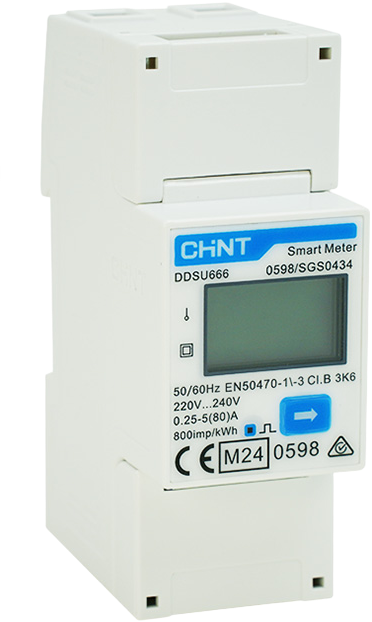
The DDSU666 is Chint's 36 mm wide, single-phase DIN-rail meter for direct connection at 0.25-5(80) A, with an RS-485 port on terminals 24 (A) and 25 (B) that speaks Modbus RTU or DL/T 645-2007. Chint's operation manual ZTY0.464.1224 lists a compact register map in hexadecimal: voltage, current, active and reactive power, power factor and frequency from 2000H, and import and export active energy at 4000H and 400AH, each a two-register single-precision float read with function code 03.
Compatibility
Compatible with EpiSensor Edge over Modbus RTU
Chint documents Modbus RTU on the DDSU666's RS-485 terminals 24 (A) and 25 (B) and publishes an FC03 register map with hexadecimal addresses and two-register float values. Edge reads the meter as a Modbus RTU client through a ZMB-31 Modbus Interface or the Gateway's serial port.
Direct-connected DDSU666, 0.25-5(80) A, read with table 9 of operation manual ZTY0.464.1224 V2 (August 2020). Site check: confirm the display shows the Modbus protocol rather than DL/T 645, and that no inverter already polls the RS-485 pair, then compare the first voltage read with the display. The DDSU666-CT and the DDSU666-H are separate versions. Read-only monitoring.
Connect it with
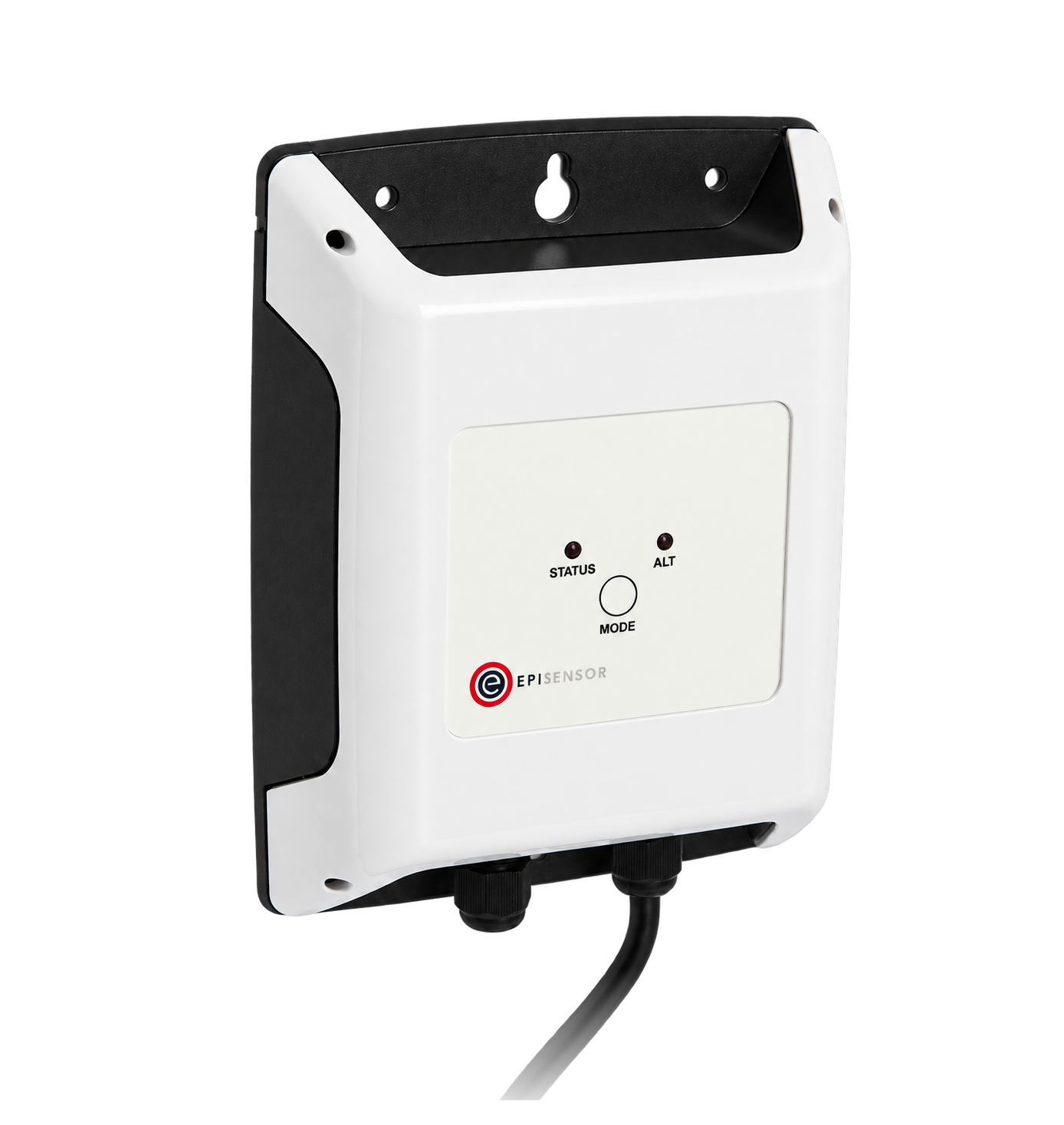
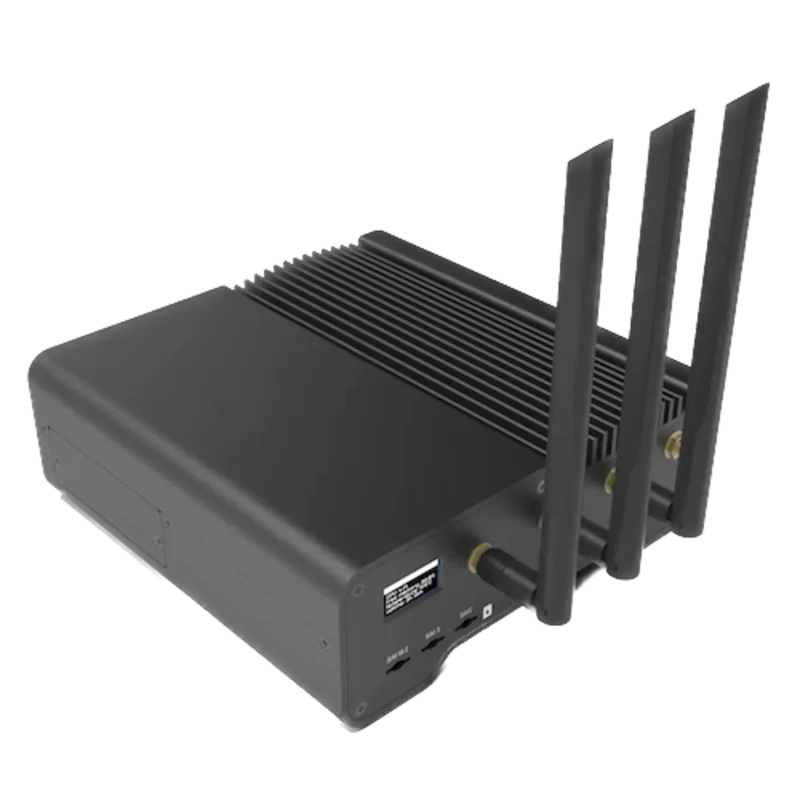
For a DDSU666 whose RS-485 pair is free for Edge, where a wireless link avoids a new data cable
- Modbus
- Wireless
- Edge
- Platforms
When the meter is in the same panel as a Gateway with an RS-485 serial interface
- Modbus
- Edge
- Platforms
When the DDSU666 is a PV inverter's grid meter and its RS-485 pair is wired to the inverter's meter port
- Modbus
- Wireless
- Edge
- Platforms
Models
| Models | Interface | Route into Edge |
|---|---|---|
| DDSU666, direct connection | 0.25-5(80) A, Class B, 800 imp/kWh; RS-485 on terminals 24 (A) and 25 (B), Modbus RTU or DL/T 645-2007; pulse output on 5 (S+) and 6 (S-) | Read the table 9 registers with FC03 once the display shows the Modbus protocol. |
| DDSU666-CT | 0.015-1.5(6) A through a current transformer, Class C, 6400 imp/kWh; the same manual and RS-485 terminals | Outside this guide. The table heads its values secondary side and lists no CT ratio register, so check every value against the display. |
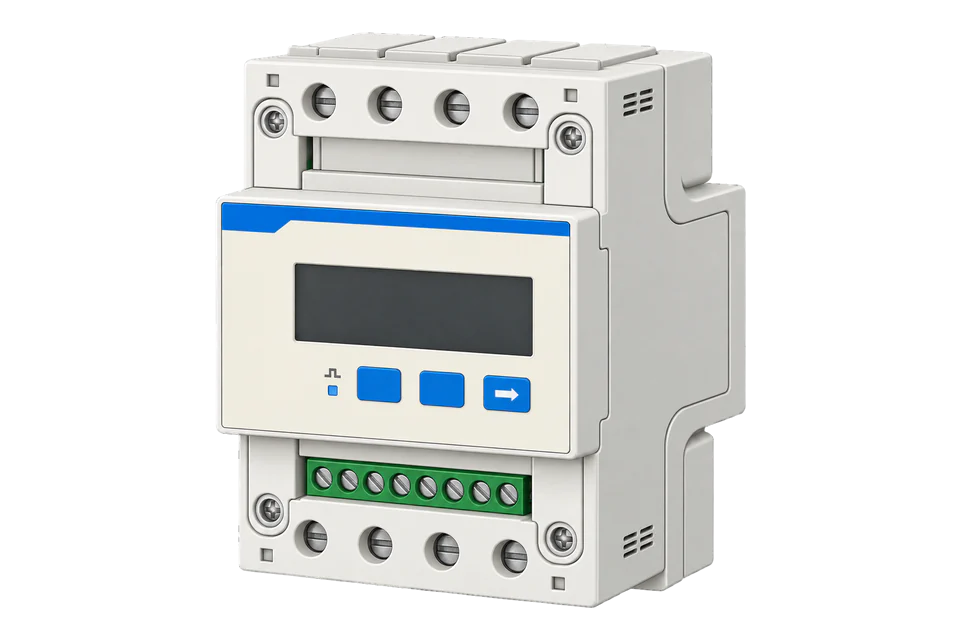
| DDSU666-H 100A | Smart power sensor with a 100 A/40 mA CT and RS-485 on terminals 24 and 25, set to the address and baud rate of the inverter it serves | A separate product with its own quick guide; this map does not apply. Leave it with the inverter that polls it. |
| DDSU666 in an inverter kit | The same meter wired to an inverter's meter port, with the address and settings the inverter expects | The inverter is the bus master. Read the inverter instead, or add an EpiSensor meter at the same point. |
Specifications
A two-wire, single-phase meter for a final circuit, a tenant supply or the grid connection of a small PV system. It counts import and export active energy separately and reads voltage, current, active and reactive power, power factor and frequency over RS-485.12
- Exact version
- DDSU666 for direct connection, 0.25-5(80) A, 800 imp/kWh. The manual covers the DDSU666.004 type and also lists the DDSU666-CT.12
- Voltage
- Reference voltage 230 V; the catalogue gives a nominal 220 to 240 V. Specified operating range 0.9 to 1.1 Un, extended 0.8 to 1.15 Un; 50 Hz or 60 Hz.12
- Accuracy and approval
- Active energy Class B to EN 50470-1 and EN 50470-3. The catalogue lists MID B+D certification.12
- RS-485
- Terminals 24 (A) and 25 (B). Modbus RTU with FC03 reads and FC10 writes, or DL/T 645-2007, chosen on the display. 1200, 2400, 4800 or 9600 bit/s (the catalogue also lists 19200 and gives 9600 as the default). Protocol address 1 to 247; the button sets 1 to 99. The manual's display example reads 8 data bits, no parity, 1 stop bit, address 11 and 9600 bit/s.12
- Bus
- Up to 32 meters on one line, shielded twisted pair of at least 0.5 mm², up to 1200 m, kept away from power cables.1
- Other interfaces
- Pulse output on terminals 5 (S+) and 6 (S-) at 800 imp/kWh, with a pulse LED on the front.12
- Burden
- Voltage circuit 1 W/8 VA or less; current circuit 2.5 VA or less.1
Interface
Documented measurements and integration boundaries for DDSU666.
- Addresses are the hexadecimal PDU addresses Chint prints with an H suffix: 2000H is sent as 20 00 (decimal 8192). Read every point with FC03; FC10 is the only write function.
- Voltage at 2000H and current at 2002H: two registers, single-precision float. The table gives no unit for these rows; the display shows them in V and A.
- Active power at 2004H (kW) and reactive power at 2006H (kvar): two registers, single-precision float.
- Power factor at 200AH and frequency at 200EH: two registers, single-precision float. 2008H, 200CH and 2010H are reserved.
- Import active energy (Ep) at 4000H and export active energy (-Ep) at 400AH: two registers, single-precision float. The display shows energy in kWh.
- Settings: version at 0001H, protocol at 0005H (2 = Modbus RTU, 1 = DL/T 645-2007), address at 0006H, meter type at 000BH and baud rate at 000CH (1 = 2400, 2 = 4800, 3 = 9600 bit/s), each one register, 16-bit signed.
- 0000H (programming password), 0002H (writing 1 clears total energy), 0005H, 0006H and 000CH are writable. Keep them out of the polling configuration.
Assessment
Direct-connected DDSU666, 0.25-5(80) A, read with table 9 of operation manual ZTY0.464.1224 V2 (August 2020) as a best-effort starting point. Compare the first read with the display. The DDSU666-CT, the DDSU666-H and meters already polled by an inverter are outside this guide. Read-only monitoring.
- InteroperabilitySupported with conditions
- Chint documents Modbus RTU with FC03 and FC10, hexadecimal addresses confirmed by its own example frame, register lengths and a float data type. It does not print the float word order or units for voltage, current, frequency and energy, and the port can also be set to DL/T 645-2007.1
- AccuracySupported with conditions
- Class B single-phase metering at 0.25-5(80) A with separate import and export active energy and instantaneous voltage, current, power, power factor and frequency. The register map has no reactive energy counters, although the catalogue lists kvarh.12
- SecurityNot yet assessed
- The map exposes a programming password register and an energy reset over Modbus, but the manual does not say whether Modbus writes need the password.1
- ReliabilitySupported with conditions
- Stored energy survives power loss, the meter works from 0.8 to 1.15 Un in its extended range, and the protocol returns defined exception codes. Treat failed reads as missing data.1
- RuggednessSupported with conditions
- Rated -25 to +55 °C in operation and IP20, so it belongs inside a distribution board; the 80 A version needs its transparent terminal cover.12
- ScalabilitySupported with conditions
- Up to 32 meters per line over 1200 m of shielded twisted pair, with protocol addresses 1 to 247, although the front button sets only 1 to 99.1
- LifecycleNot yet assessed
- The manual gives an 18-month repair or replacement guarantee and is dated August 2020, but there is no firmware or end-of-sale information.1
Setup
Read voltage from hexadecimal address 0x2000
Operation manual ZTY0.464.1224 V2 (August 2020), table 9, lists voltage U at 2000H as two registers of single-precision floating point, read with function code 03H. Use that map as the starting point and compare the result with the display.
- Request
- 01 03 20 00 00 02 CF CB: Modbus ID 1, FC03, address 0x2000, two registers, RTU CRC. Use the address the meter displays and recalculate the CRC.
- Address convention
- The H suffix marks hexadecimal, and the address goes on the wire as printed: the manual's own example reads 000CH as 01 03 00 0C 00 02 04 08. 0x2000 is decimal 8192 as a zero-based PDU address; a client that numbers registers from one shows it as 8193. Do not send decimal 2000.
- Synthetic response
- 01 03 04 43 66 00 00 0F A8: four data bytes, 43 66 00 00.
- Decode
- Chint names the type single-precision floating point but prints no word order. Decode high word first: 0x43660000 as an IEEE-754 Float32 is 230.0 V. If a real reply decodes to nonsense, swap the two registers and decode again, then keep that order for every float.
- Acceptance
- Keep the point when it agrees with the voltage on the display at the same time. If it does not, check the protocol page, the address and frame format, then the word order, before adding more points.
Acceptance: The response bytes are a synthetic decoder check, not a captured meter reply. A real reply must agree with the display before current, power and energy points are enabled.
-
Confirm the version and who owns the bus
Read DDSU666 and 0.25-5(80) A from the front label. If the RS-485 pair runs to an inverter's meter port, leave it there and read the inverter instead.
-
Read the protocol and serial settings from the display
The display pages show the protocol, the frame format, the address and the baud rate. The protocol page must read Modbus; a long press on the button opens the switch between DL/T 645 and Modbus. Enter the same address, speed and frame in the Edge serial client.
-
Wire the RS-485 pair
Connect A to terminal 24 and B to terminal 25 with shielded twisted pair of at least 0.5 mm², give each meter on the line its own address and keep the cable away from power conductors.
-
Make one voltage read
Send FC03 to address 0x2000 for two registers and decode the float as in the worked read below. Compare the result with the voltage on the display.
-
Add the points you need
Add current, power, power factor, frequency and the two energy registers from table 9 with the same word order. Keep FC10 writes out of the polling configuration.
Common questions
- Is 2000H a decimal register number?
- No. Chint prints the DDSU666 addresses in hexadecimal with an H suffix, and its own read example sends 000CH as 00 0C. Send 0x2000, decimal 8192, as the PDU address. A tool that asks for one-based register numbers needs 8193.1
- Why does the meter not answer Modbus requests?
- The DDSU666 speaks either DL/T 645-2007 or Modbus RTU on the same terminals. Check the protocol page on the display: a long press on the button opens the protocol switch, and only the Modbus setting shows the address page. Then check that the address, baud rate and frame format match the Edge client.1
- Can Edge read a DDSU666 that is already wired to an inverter?
- Not on the same pair. Chint describes a host-slave link with one host, and an inverter that uses the meter for export control is that host. Read the inverter's own Modbus interface, or fit an EpiSensor meter at the same point, rather than adding a second master to the meter's bus.13
- Which energy registers should I log?
- Import active energy at 4000H and export active energy at 400AH. The display also shows a combined total, ComEp, which the manual's example gives as the sum of the two, but the map has no register for it, so calculate any net figure from the two counters.1
- Does the map include writable registers?
- Yes. With FC10 the manual allows writes to the programming password, the protocol, the address, the baud rate and an energy reset: writing 1 to 0002H clears total energy. A monitoring configuration should read with FC03 only.1
Related devices
Sources
- DDSU666 Single phase Smart Meter operation manual ZTY0.464.1224 V2 (August 2020), table 9 and Appendix A MODBUS-RTU protocol (opens in a new tab) (PDF)
- DDSU666 Single Phase Smart Meter catalogue pages (opens in a new tab) (PDF)
- DDSU666-H 100A Smart Power Sensor quick guide ZTY0.464.1588, document version 02 (opens in a new tab) (PDF)
Further reading
Product names and trademarks belong to their owners. Publication does not imply endorsement or a commercial relationship.