ABB M2M Modbus
Network analyser
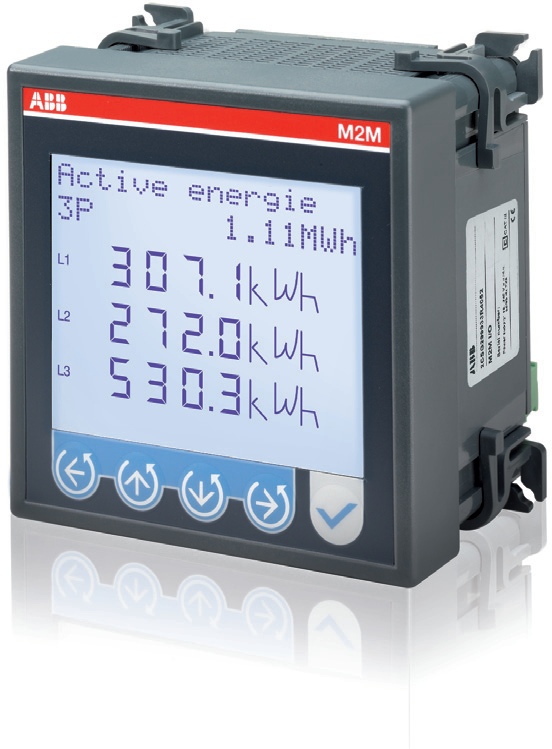
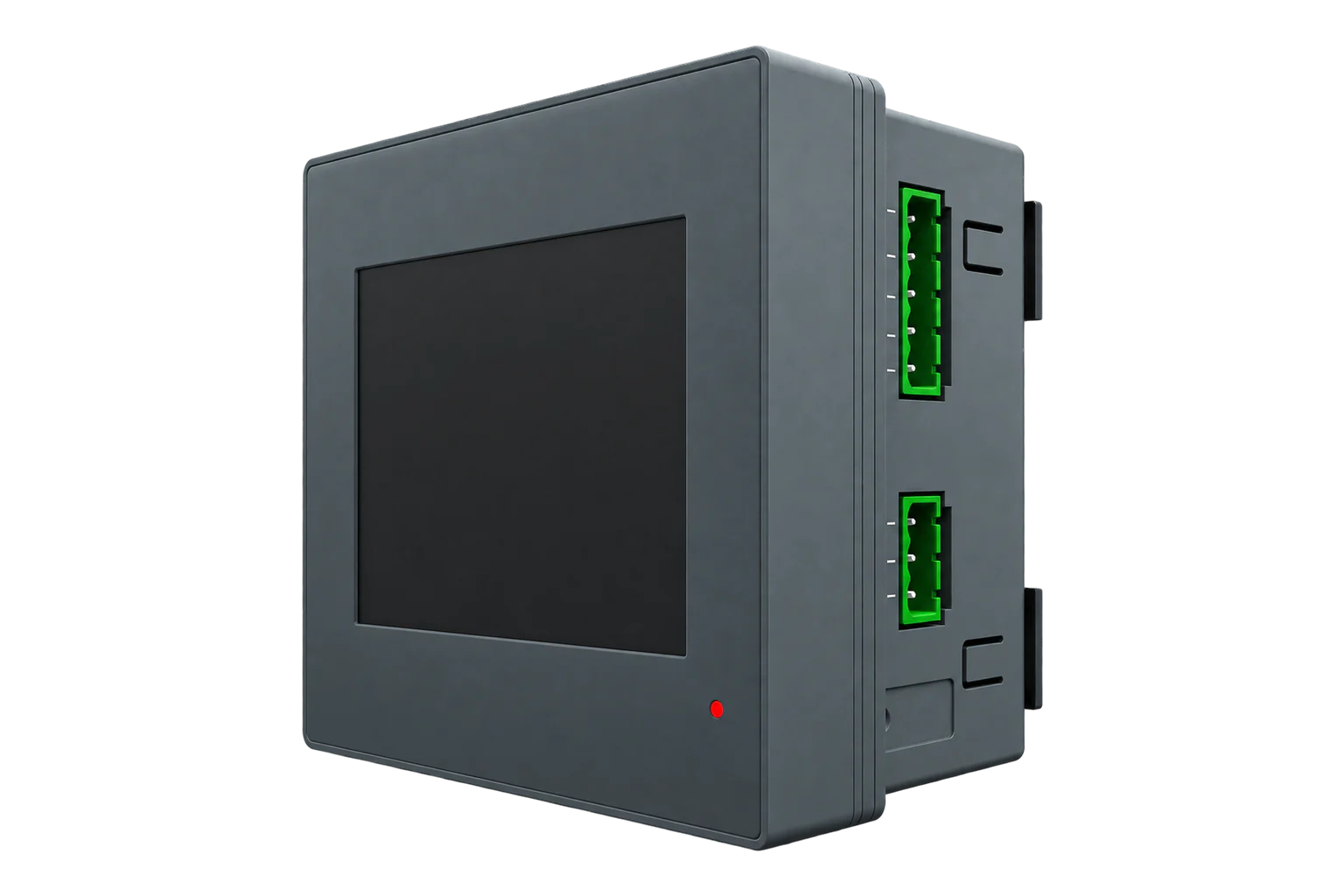
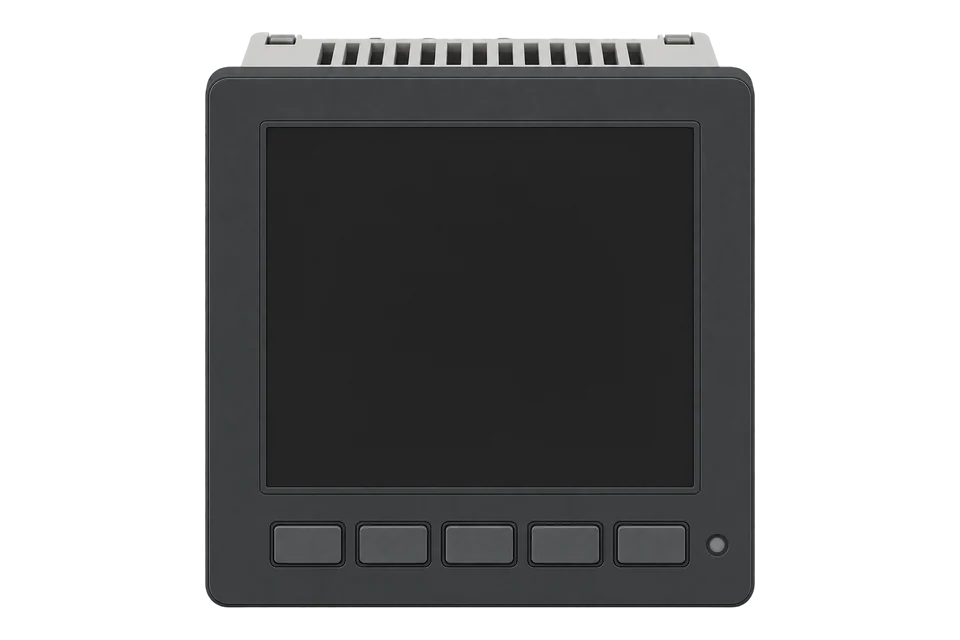
The M2M is ABB's 96 × 96 mm panel network analyser for low- and medium-voltage systems. It measures voltage, current, power factor, frequency, active, reactive and apparent power and energy in both directions, and voltage and current THD, through external 1 A or 5 A CTs and optional VTs. ABB's manual covers seven versions. Three have an optically isolated RS-485 port running Modbus RTU: M2M MODBUS (2CSG299893R4052), M2M ALARM (2CSG299923R4052) and M2M I/O (2CSG299933R4052). M2M ETHERNET (2CSG299903R4052) has an RJ45 port with Modbus TCP. The base M2M (2CSG299883R4052), M2M LV (2CSG299943R4052) and M2M PROFIBUS (2CSG299913R4052) have no Modbus port. ABB prints the register addresses in hexadecimal and sends every measurement as two registers: whole volts, milliamps, watts and energy in units of 100 Wh. ABB's Netherlands catalogue lists M2M MODBUS as discontinued and names the M4M 20 Modbus, 2CSG251141R4051, as its successor.
Compatibility
Compatible with EpiSensor Edge over Modbus TCP or Modbus RTU
The M2M is compatible with EpiSensor Edge over Modbus RTU on the RS-485 port of M2M MODBUS, M2M ALARM and M2M I/O, read through a ZMB-31 Modbus Interface or a Gateway serial port, and over Modbus TCP on the RJ45 port of M2M ETHERNET. ABB publishes the FC03 register map with hexadecimal addresses, 32-bit data types and units, and its own example frame confirms the address convention.
M2M MODBUS 2CSG299893R4052, M2M ALARM 2CSG299923R4052 and M2M I/O 2CSG299933R4052 over RS-485, using the communication protocol specification V2.0 (2CSG445011D0201); M2M ETHERNET 2CSG299903R4052 over Modbus TCP, using the register table in its interface manual Rev. 1.0 (2CSG445012D0201). The base M2M 2CSG299883R4052, M2M LV 2CSG299943R4052 and M2M PROFIBUS 2CSG299913R4052 have no Modbus port. Site check: read the CT ratio at 11A0h and phase voltage L1-N at 1002h and compare both with the meter's setup and display. Read-only monitoring: no writes to the CT or VT ratio, pulse weight, reset or output registers.
Connect it with
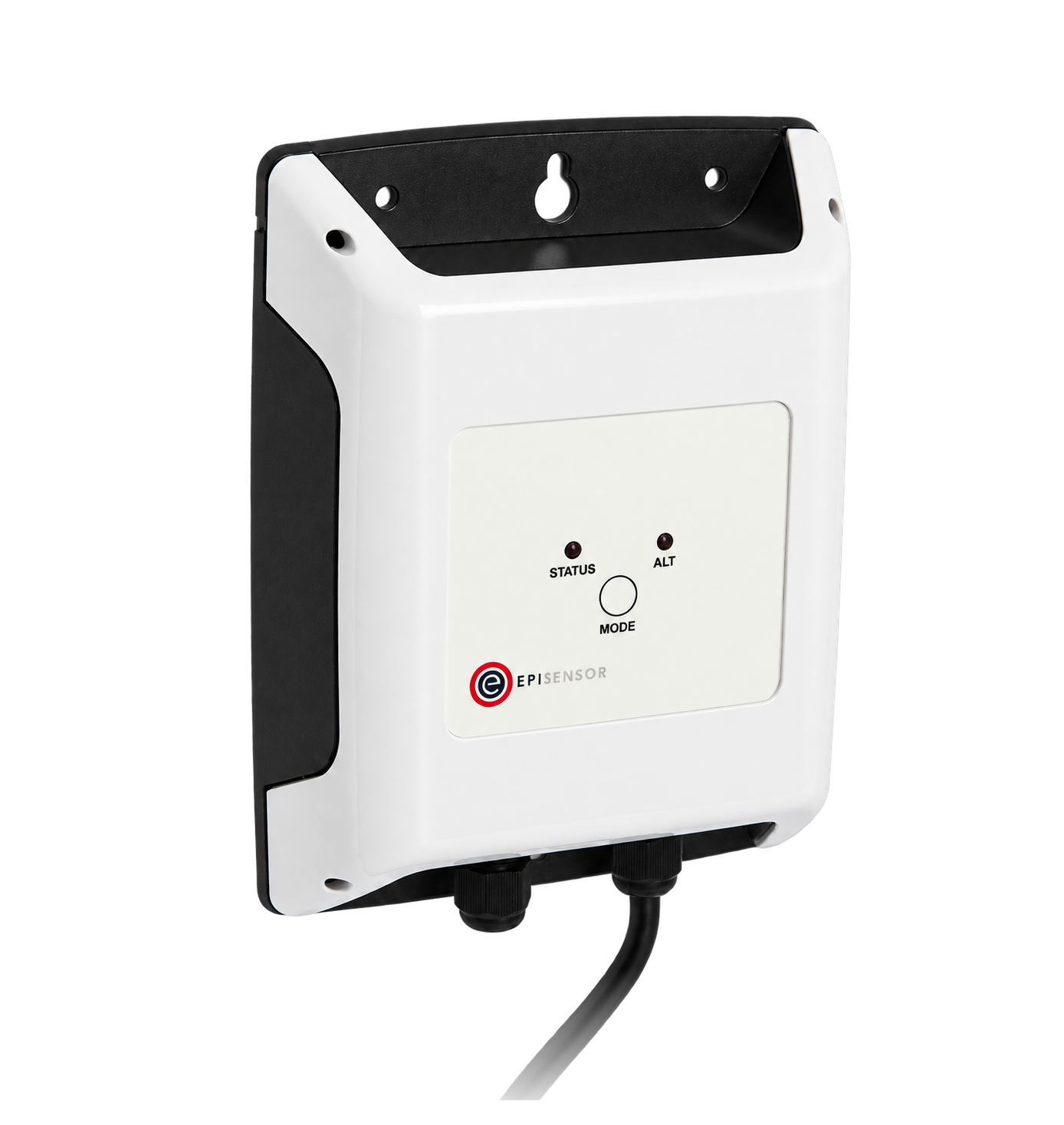
For an M2M MODBUS, ALARM or I/O in a switchboard where a wireless link avoids running a data cable back to the Gateway
- Modbus
- Wireless
- Edge
- Platforms
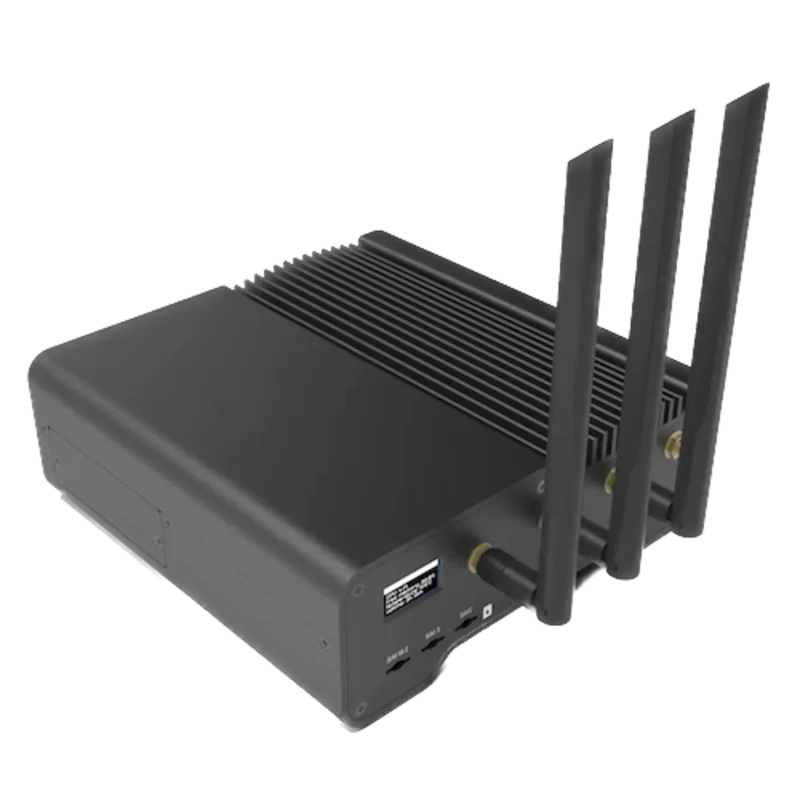
When the Gateway sits near the analyser, or several M2M analysers share one wired RS-485 bus
- Modbus
- Edge
- Platforms
For an M2M ETHERNET, 2CSG299903R4052, on the site network
- Modbus
- Edge
- Platforms
Models
| Models | Interface | Route into Edge |
|---|---|---|
| M2M MODBUS · 2CSG299893R4052 | Two digital outputs for pulses or alarms; optically isolated RS-485 with Modbus RTU on a four-pole terminal; 24 to 240 V AC/DC supply | Read the V2.0 specification registers with FC03 on either serial path. ABB reports instrument type 57 (39h) to FC11. |
| M2M ALARM · 2CSG299923R4052 | Adds two 16 A AC1 relay outputs; the same RS-485 port and map | Same read path. Instrument type 58 (3Ah). |
| M2M I/O · 2CSG299933R4052 | Adds three digital inputs and two 0 to 20 or 4 to 20 mA analogue outputs; the same RS-485 port; 48 to 240 V AC/DC supply | Same read path, plus the pulse-input registers 109Ch to 10A2h that the specification marks M2M I/O only. Instrument type 59 (3Bh). |
| M2M ETHERNET · 2CSG299903R4052 | RJ45 with Modbus TCP and a web server; two digital outputs; 48 to 240 V AC/DC supply | Read with FC03 over Modbus TCP using the table in the M2M ETHERNET manual, which adds registers from 1200h. The manual gives the M2M ETHERNET Slave ID as 71 (47h): FC11 Report Slave ID returns it with the firmware version, in the format of register 1236h, Slave-ID + Ver. FW. |
| M2M 2CSG299883R4052, M2M LV 2CSG299943R4052 and M2M PROFIBUS 2CSG299913R4052 | The base M2M and M2M LV have no communication port, and M2M LV has a shunt current input stage; M2M PROFIBUS uses Profibus DP | No Modbus route. Use the pulse outputs or replace the analyser with a Modbus version. |
Specifications
The M2M measures phase and line voltages, currents, power factor and cos φ, frequency, and active, reactive and apparent power and energy per phase and for the 3-phase system, with energy counted separately for absorbed and generated power when Generation mode is enabled; it is disabled by default. It also gives average and maximum demand, voltage and current THD, two hour counters and energy expressed in euros and kg CO2. Values refresh twice a second. The seven versions share the display and measurement functions and differ in their outputs, their communication port and, on M2M LV, a shunt current input stage.24
- Versions
- M2M MODBUS 2CSG299893R4052, M2M ALARM 2CSG299923R4052 and M2M I/O 2CSG299933R4052 with RS-485 Modbus RTU; M2M ETHERNET 2CSG299903R4052 with RJ45 Modbus TCP. M2M 2CSG299883R4052, M2M LV 2CSG299943R4052 and M2M PROFIBUS 2CSG299913R4052 have no Modbus port.24
- Product status
- ABB's Netherlands catalogue page for M2M MODBUS 2CSG299893R4052 gives its status as discontinued, with 2CSG251141R4051 (M4M 20 Modbus) as successor or alternative.5
- Current inputs
- Through external CTs on every version except M2M LV, which has a shunt input stage: primary 1 to 10 000 A, secondary 5 A or 1 A; measurement range 50 mA to 5 A TRMS. With a 1 A secondary the accuracy is reduced to 2.5% F.S. ±1 digit.24
- Voltage inputs
- Direct up to 500 V AC, measurement range 10 to 500 V L-N; or through VTs with primary 60 to 60 000 V and secondary 60 to 190 V. Single-phase, 3-phase with or without neutral, balanced 3-phase and Aron connections.2
- Accuracy
- Voltage and current ±0.5% F.S. ±1 digit; active power ±1% ±0.1% F.S. and power factor ±1% ±1 digit from cos φ 0.3 inductive to 0.3 capacitive; active energy class 1. The manual cites IEC 62053-21, IEC 62053-23 and IEC 60688.24
- RS-485
- Optically isolated; four-pole terminal B, S, A, T with an integrated 120 Ω terminator on T; 4800, 9600 or 19200 bit/s; parity odd, even or none; 1 or 2 stop bits, where the protocol specification allows 2 stop bits only with no parity; address 1 to 247. Factory settings: MODBUS protocol, address 31, 9600 bit/s, no parity.12
- Ethernet (M2M ETHERNET)
- Isolated RJ45 with MDI/MDIX auto-crossover; web server and Modbus TCP at the same time; TCP port 502 by default. Factory settings: DHCP disabled, IP 192.168.1.239, host name ANALYZER-001. The manual applies to firmware V2.20 or later.23
- Auxiliary supply
- 24 to 240 V AC/DC; 48 to 240 V AC/DC for M2M ETHERNET, M2M PROFIBUS and M2M I/O; 45 to 65 Hz; 7 VA maximum.24
- Housing
- 96 × 96 × 77 mm, 57 mm deep behind the panel, for a 92 × 92 mm cut-out to IEC 61554; 0.4 kg. Current terminals 6 mm², voltage, output and RS-485 terminals 2.5 mm².2
- Environment
- Operating -5 to +55 °C; storage -10 to +60 °C; relative humidity up to 93% at 40 °C, non-condensing. Front IP50, terminals IP25.2
Interface
Documented measurements and integration boundaries for M2M Modbus.
- Addresses are hexadecimal PDU addresses and go on the wire as printed. ABB's own example, 1F 03 10 00 00 14 42 BB, reads 20 registers from 1000h at slave address 31 (1Fh). 1000h is decimal 4096; a client that numbers holding registers from one shows it as 4097 (44097).
- Every measurement is two registers: Unsigned Long or Signed Long, two's complement when negative. The M2M ETHERNET manual states that the first register is the most significant word; the serial specification does not state the word order, so compare one value with the display.
- The specification allows up to 24 consecutive measures in one FC03 request. A request that starts at an address not in the table gets exception 02 ILLEGAL DATA ADDRESS, so begin each block at a listed register.
- 3-phase system voltage at 1000h; phase voltages L1-N, L2-N and L3-N at 1002h, 1004h and 1006h; line voltages L1-2, L2-3 and L3-1 at 1008h, 100Ah and 100Ch. Unsigned, whole volts.
- 3-phase system current at 100Eh; line currents L1, L2 and L3 at 1010h, 1012h and 1014h. Unsigned, in mA.
- Power factor, 3-phase at 1016h and L1 to L3 at 1018h, 101Ah and 101Ch: Signed Long × 1000, positive when inductive and negative when capacitive. A value of 2000 means the power factor is undefined, for example with no current. The serial specification also lists cos φ at 101Eh to 1024h.
- Apparent power 3-phase at 1026h and L1 to L3 at 1028h to 102Ch (unsigned, VA); active power 3-phase at 102Eh and L1 to L3 at 1030h to 1034h (signed, W); reactive power 3-phase at 1036h and L1 to L3 at 1038h to 103Ch (signed, var). Frequency at 1046h, unsigned, in mHz.
- Energy in units of 100 Wh, so a reading of 325 is 32 500 Wh: 3-phase active energy at 103Eh, reactive at 1040h (100 varh) and apparent at 10A6h (100 VAh); active energy L1 to L3 at 1074h, 1076h and 1078h. Generated (exported) 3-phase active energy at 10AEh, reactive at 10B6h and apparent at 10BEh, with the phase counters after each. The generated counters count only with Generation mode enabled in setup, which is disabled by default; with it off, the analyser corrects the current direction itself, so active power is always positive and energy is counted in two quadrants.
- Demand: 3-phase active power averaged over the set period at 1070h and apparent at 1072h; maxima of the averages at 1080h and 1094h. Peak line currents at 1060h to 1064h and peak 3-phase active and apparent power at 1066h and 1068h.
- Voltage THD L1 to L3 at 1082h to 1086h and current THD L1 to L3 at 1088h to 108Ch, scaled × 100. The serial specification returns 0 when THD is undefined; the M2M ETHERNET manual returns FFFF FFFFh.
- The M2M ETHERNET manual sends FFFF FFFFh for any quantity that cannot be calculated or is out of range, shown on the display as ---. Store it as missing, not as a reading.
- CT ratio at 11A0h and VT ratio at 11A2h read back the programmed ratio: a 100/5 A CT reads 20. Pulse weight at 11A4h reads 1 to 4 for 10 to 10 000 Wh per pulse.
- M2M ETHERNET only: its table adds energy balances from 1200h, per-phase average and maximum powers from 120Eh, the wiring configuration at 122Eh, status at 1230h, firmware at 1236h and minimum and maximum voltages and currents up to 1250h. The serial V2.0 specification does not list these registers.
- FC10 writes the CT ratio, VT ratio and pulse weight at 11A0h to 11A4h, and the reset commands at 11B0h to 11B4h clear energy counters, maxima and averages. Keep them out of a monitoring poll.
Assessment
M2M MODBUS 2CSG299893R4052, M2M ALARM 2CSG299923R4052 and M2M I/O 2CSG299933R4052 over RS-485, using the communication protocol specification V2.0 (2CSG445011D0201); M2M ETHERNET 2CSG299903R4052 over Modbus TCP, using the register table in its interface manual Rev. 1.0 (2CSG445012D0201). The base M2M 2CSG299883R4052, M2M LV 2CSG299943R4052 and M2M PROFIBUS 2CSG299913R4052 have no Modbus port. Site check: read the CT ratio at 11A0h and phase voltage L1-N at 1002h and compare both with the meter's setup and display. Read-only monitoring: no writes to the CT or VT ratio, pulse weight, reset or output registers.
- InteroperabilitySupported with conditions
- ABB documents Modbus RTU on RS-485 and Modbus TCP on M2M ETHERNET, with FC03 reads, hexadecimal addresses, 32-bit data types, units and exception codes, and its example frame confirms the address convention. The serial specification does not state the word order; the M2M ETHERNET manual gives it as most significant word first, so confirm one value against the display on RS-485.13
- AccuracySupported with conditions
- Per-phase and 3-phase voltage, current, power, power factor and energy in both directions, with class 1 active energy and ±0.5% F.S. voltage and current. Voltage arrives in whole volts and energy in steps of 100 Wh, and accuracy is reduced to 2.5% F.S. with 1 A CTs or VT secondaries below 100 V.12
- SecurityNot yet assessed
- A four-digit password protects the setup menu on the front panel, and the M2M ETHERNET configuration web pages use a user name and password that ship as admin and admin. The CT and VT ratios, pulse weight and reset commands are writable with FC10.123
- ReliabilitySupported with conditions
- ABB documents exception codes 01 to 03, an invalid-value code for quantities that cannot be calculated, a self-diagnosis with 16 error codes for wiring and phase sequence, and an FC11 identity reply with instrument type and firmware. The manual cites IEC 61010-1 and IEC 61326-1. Treat failed reads as missing data.123
- RuggednessSupported with conditions
- Panel mounting with an IP50 front and IP25 terminals, operating -5 to +55 °C and up to 93% relative humidity at 40 °C, non-condensing. It belongs inside a switchboard.2
Setup
Read phase voltage L1-N from hexadecimal address 1002h
ABB's M2M/DMTME communication protocol specification V2.0 (2CSG445011D0201) lists PHASE VOLTAGE L1-N at 1002h, two words, Volt, Unsigned Long. The M2M ETHERNET manual Rev. 1.0 lists the same register and states that the first register is the most significant. Use that map as the starting point and compare the result with the display.
- Request
- 1F 03 10 02 00 02 62 B5: slave address 31 (1Fh, the factory setting), FC03, address 1002h, two registers, RTU CRC with the low byte first. Over Modbus TCP on M2M ETHERNET: 00 01 00 00 00 06 01 03 10 02 00 02, an MBAP header with transaction 1, protocol 0, length 6 and unit identifier 1, then the same function, address and length. The manual does not specify a unit identifier, so confirm that the analyser answers.
- Address convention
- The table address is hexadecimal and goes on the wire as printed, as ABB's own frame 1F 03 10 00 00 14 42 BB for 1000h shows. 1002h is decimal 4098 as a zero-based PDU address; a client that numbers holding registers from one shows it as 4099 (44099). Do not send decimal 1002.
- Synthetic response
- 1F 03 04 00 00 00 E6 85 B8: four data bytes, high word 00 00 first, then low word 00 E6.
- Decode
- Unsigned 32-bit, high word first: 0 × 65536 + 0x00E6 = 230. The unit is whole volts, so phase voltage L1-N is 230 V with no scaling. A client that takes the low word first reads 0x00E60000 = 15,073,280.
- Acceptance
- Keep the point when it agrees with the L1 phase-neutral voltage on the display at the same time. If it does not, check the address, the word order, the VT ratio and the serial protocol setting before adding more points.
Acceptance: The response bytes are a synthetic decoder check, not a captured analyser reply. A real reply must agree with the display before current, power and energy points are enabled; current, power and energy each have their own unit.
-
Identify the version
Read the order code and version from the label on the side of the case: M2M MODBUS, ALARM or I/O for RS-485, M2M ETHERNET for Modbus TCP. The Info menu shows the configuration, serial number and firmware version. Note the CT and VT ratios set on the analyser.
-
Read the communication settings
On an RS-485 version, open the setup Communication menu and record the serial protocol, which must be MODBUS rather than ASCII, the address, baud rate, parity and stop bits. The factory address is 31 at 9600 bit/s with no parity. On M2M ETHERNET, record the IP address and check that Modbus TCP is enabled in the web menu.
-
Wire the connection
For RS-485, connect the pair to terminals A and B, give each analyser its own address and keep the line under 1200 m with no more than 32 units; link T to B on the last unit to use the built-in terminator. For M2M ETHERNET, connect the RJ45 port to the site network.
-
Make two reads
Read the CT ratio at 11A0h, two registers, and check it against the CT fitted: a 100/5 A CT reads 20. Then read phase voltage L1-N at 1002h, two registers, high word first, as in the worked read below, and compare it with the display.
-
Add the points you need
Add currents in mA, powers in W, var and VA and the energy counters in units of 100 Wh. Treat FFFF FFFFh as missing and a power factor of 2000 as undefined, and keep FC10 writes and reset commands out of the polling configuration.
Common questions
- Is 1002h register 1002?
- No. ABB prints the M2M addresses in hexadecimal, and its own read example sends 1000h as the bytes 10 00. Send 0x1002, decimal 4098, as the PDU address. A tool that asks for one-based holding register numbers needs 4099, or 44099.1
- Why does current read 3400 instead of 3.4 A?
- The M2M sends current in milliamps, voltage in whole volts, power in W, var and VA and frequency in mHz. Divide current by 1000 and frequency by 1000; voltage needs no scaling.13
- How do I convert the energy registers to kWh?
- Energy is counted in units of 100 Wh. ABB's example: a reading of 325 at 103Eh is 32 500 Wh, so divide by 10 for kWh. Absorbed 3-phase active energy is at 103Eh and generated active energy at 10AEh. The generated counters count only with Generation mode enabled in setup, which is disabled by default.123
- What does a power factor of 2.000 mean?
- It means the power factor is undefined, usually because there is no current. The register then holds 2000 instead of a value between -1000 and 1000. Positive values are inductive and negative values capacitive.13
- The analyser does not answer on RS-485. What should I check?
- Check that the serial protocol in the Communication menu is MODBUS, not ASCII, and that the address, baud rate, parity and stop bits match the client. The factory settings are address 31, 9600 bit/s and no parity. Then check the A and B wiring and the termination at the end of the line.12
Related devices


Sources
- M2M/DMTME instruments communication protocol, technical specification V2.0, 2CSG445011D0201 (opens in a new tab) (PDF)
- M2M network analyser assembly and use instructions, 2CSG445010D1001 Rev. 1.0 (English and Italian edition 2CSG445010D1002) (opens in a new tab) (PDF)
- M2M ETHERNET interface user manual, 2CSG445012D0201 Rev. 1.0, with the Modbus TCP register table (opens in a new tab) (PDF)
- M2M The measure of efficiency, brochure 2CSC445021B0201 (11/2011), with technical features and order codes (opens in a new tab) (PDF)
- ABB Netherlands catalogue page for M2M MODBUS 2CSG299893R4052, with status and successor (opens in a new tab)
Further reading
Product names and trademarks belong to their owners. Publication does not imply endorsement or a commercial relationship.