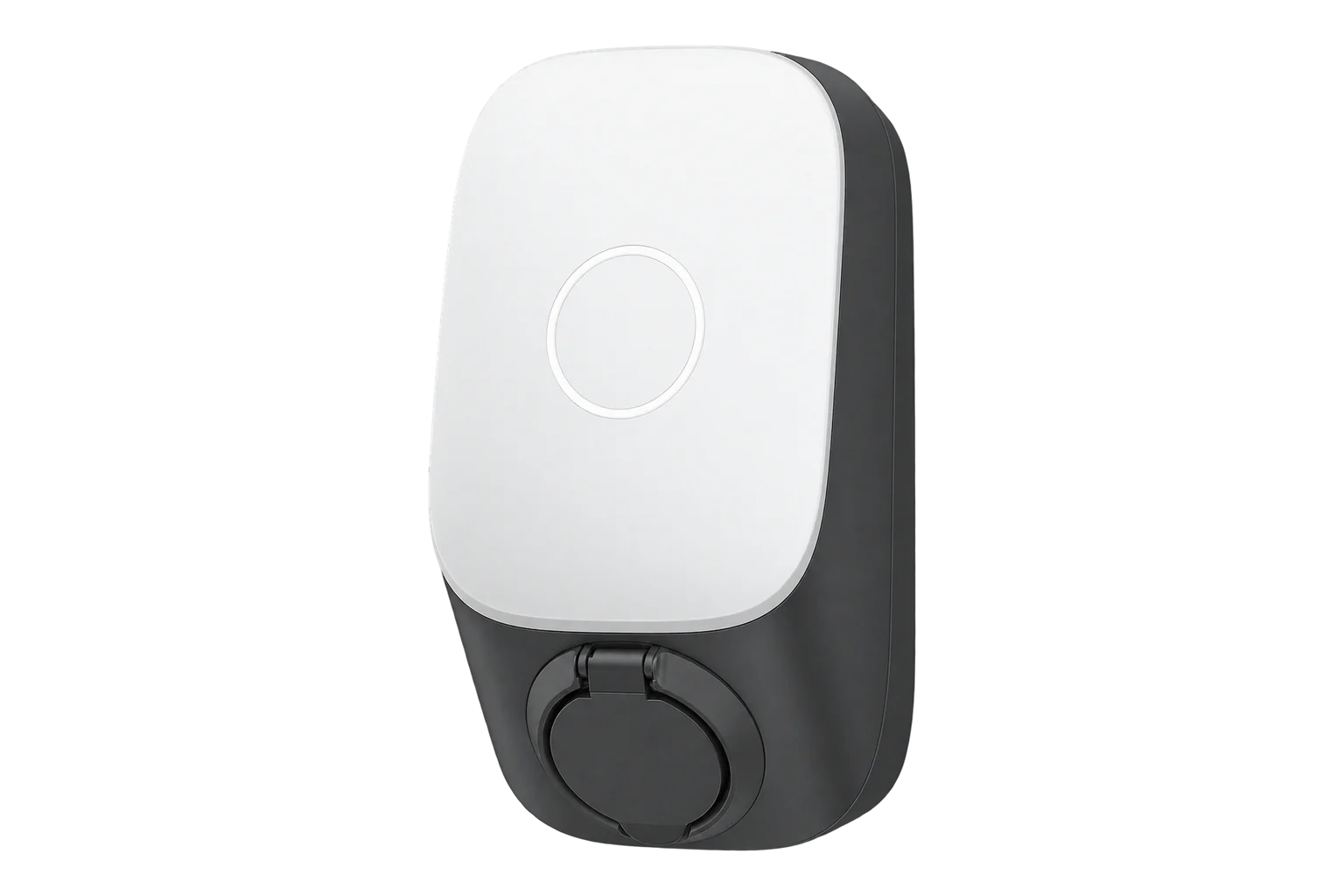
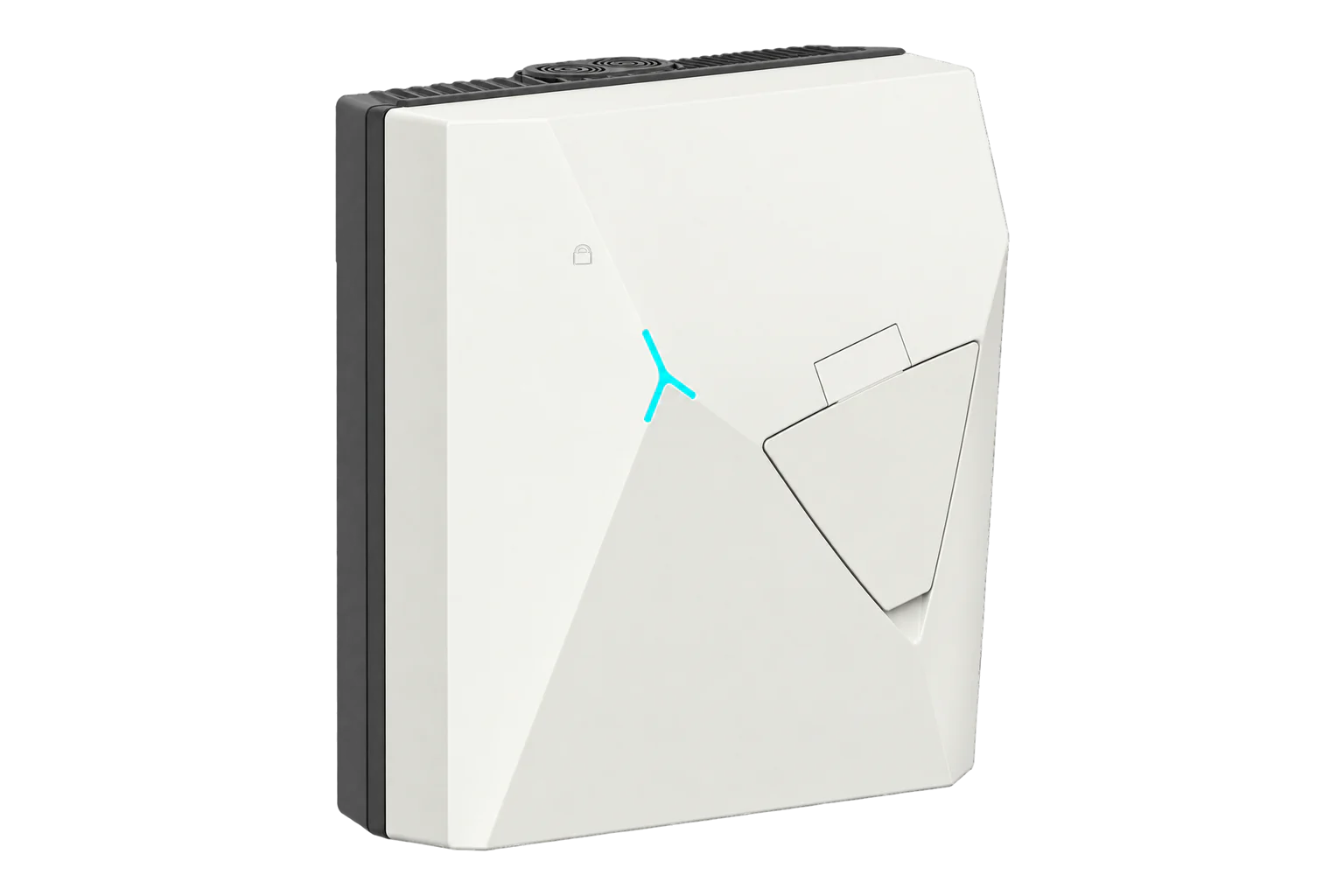
Huawei FusionSolar SCharger-22KT-S0
AC EV charger
A residential AC wall charger with a Type 2 socket and up to 22 kW three-phase output. Huawei lists Modbus TCP and OCPP 1.6, but limits OCPP to residential use without commercial billing. Check the installed firmware and system controller before planning solar-surplus charging or an external monitoring connection.
- OCPP 1.6
- Modbus TCP
AC EV charger
Compatibility
Charger interfaces documented; Edge integration not established
Modbus TCP and OCPP 1.6 are named by Huawei. An exact supported register map or a verified backend-to-Edge handoff is still needed for integration.
SCharger-22KT-S0 three-phase socket version. Do not substitute the single-phase 7KS-S0 ratings or the newer Smart Charger SCharger-C generation. OCPP is residential-only without commercial billing. No endpoint defaults, register map, firmware minimum or ready-to-import Edge template are asserted.
Models
| Models | Interface | Route into Edge |
|---|---|---|
| SCharger-22KT-S0 |
| Obtain the installed firmware’s supported protocol configuration and map before adding a monitoring client. |
| SCharger-7KS-S0 |
| Related housing, different supply and maximum charging power. |
| SCharger-C | Separate Smart Charger generation | Do not use its controller or communications instructions for the S0 model. |
Specifications
The charger supplies AC power to the car; the car’s onboard charger determines how much it accepts. Its 22 kW rating does not guarantee that a particular vehicle charges at 22 kW, and OCPP support does not establish access to the vehicle’s battery state of charge.1
- Charging output
- Up to 22 kW three-phase; adjustable 6–32 A. Minimum power is about 1.4 kW on one phase or 4.2 kW on three phases.1
- Supply and connector
- 400 V ±20%, 50/60 Hz ±1 Hz, TN or TT; Type 2 socket.1
- Communications
- Wi-Fi or Ethernet; Modbus TCP and OCPP 1.6.1
- OCPP scope
- Residential scenarios only; commercial billing capability is not supported.1
- Authentication
- RFID ISO 14443-A, app or Bluetooth.1
- Enclosure
- 335 × 180 × 145 mm, 3.1 kg; IP54, IK10, wall-mounted.1
- Operating temperature
- −35 to +50 °C at 16 A, or −35 to +40 °C at 32 A.1
- Idle consumption
- Standby power below 6 W under the manufacturer’s specified conditions.1
Interface
Documented measurements and integration boundaries for SCharger-22KT-S0.
- Start with charging status, session or cumulative energy and timestamps where the installed interface exposes them. Confirm the exact point list instead of assuming a universal Modbus map.
- A charger power limit is not a measurement of delivered power. Keep requested limits and measured energy separate.
- Record whether measurements cover one charging session or the lifetime total, and how counters behave after replacement or reset.
- Do not infer vehicle battery state of charge or billing approval from OCPP support.
Assessment
SCharger-22KT-S0 three-phase socket version. Do not substitute the single-phase 7KS-S0 ratings or the newer Smart Charger SCharger-C generation. OCPP is residential-only without commercial billing. No endpoint defaults, register map, firmware minimum or ready-to-import Edge template are asserted.
- InteroperabilitySupported with conditions
- Huawei documents Modbus TCP and residential OCPP 1.6; exact firmware and register details are required before integration.1
- AccuracyNot yet assessed
- The cited charger documents do not establish this property for the proposed external monitoring integration.1
- SecurityNot yet assessed
- The cited charger documents do not establish this property for the proposed external monitoring integration.1
- ReliabilityNot yet assessed
- The cited charger documents do not establish this property for the proposed external monitoring integration.1
- RuggednessSupported with conditions
- IP54 and IK10 are specified, with different temperature limits at 16 A and 32 A.1
- ScalabilityNot yet assessed
- The cited charger documents do not establish this property for the proposed external monitoring integration.1
- LifecycleNot yet assessed
- The cited charger documents do not establish this property for the proposed external monitoring integration.1
Setup
-
Confirm the S0 identity
Record SCharger-22KT-S0, firmware and the local market variant from the unit. Verify the installed mains arrangement and available current with the commissioning installer.
-
Choose the required function
Use solution manual issue 05, sections 2.1 and 4.4.2. With a direct FE meter, disable the WLAN/FE Smart Dongle’s Modbus TCP. With an RS485 virtual meter, enable the dongle’s Modbus TCP and use wired networking. This virtual-meter path cannot simultaneously serve a third-party Modbus TCP management client.
-
Obtain the interface instructions
Ask for Huawei’s supported S0 protocol configuration and register list for that firmware, or the approved residential OCPP backend process. The datasheet alone does not establish port, unit ID, address convention or write permissions.
-
Use a controlled network
Connect over the documented Ethernet or Wi-Fi path and retain authorised commissioning access. Do not expose a prospective Modbus service directly to the internet.
-
Prove one measurement
During a known charging session, compare app power and energy with the site meter over the same interval. Review main-breaker capacity and the configured current on meter loss in Advanced Settings. Meter disconnection normally reduces charging to minimum current; distinguish that response from an offline measurement.
-
Keep charging control separate
Do not alter charge-current limits or solar-control settings as part of a monitoring check. Record communication failures as unavailable data, not zero consumption.
Common questions
- Can this charger support a commercial billing scheme over OCPP?
- Huawei explicitly limits this model’s OCPP support to residential scenarios and excludes commercial billing capability. Choose equipment and a complete metering process approved for the intended commercial use.1
- Is there a ready-to-import Modbus map here?
- No. Huawei names Modbus TCP, but the retained specifications do not establish exact registers, firmware requirements or decoder settings. Obtain the matching communication document before configuring a client.1
- Will an 11 kW car charge at 22 kW?
- No. Actual AC charging power is limited by the vehicle, the available supply and charger configuration. Use the smallest applicable power limit in the charging-time calculator.1
- Why can the minimum solar charging power change?
- At 6 A, one phase needs about 1.4 kW while three phases need about 4.2 kW. A supported phase-switching system and the actual vehicle determine how those thresholds are used.1
Related devices
More from Huawei FusionSolar
Sources
- SCharger-7KS-S0 and 22KT-S0 current technical specifications (opens in a new tab)
- Smart Charger datasheet, version 01-202411 (opens in a new tab) (PDF)
- PV+ESS+Charger solution manual, issue 05: networking and commissioning (opens in a new tab)
Further reading
Product names and trademarks belong to their owners. Publication does not imply endorsement or a commercial relationship.