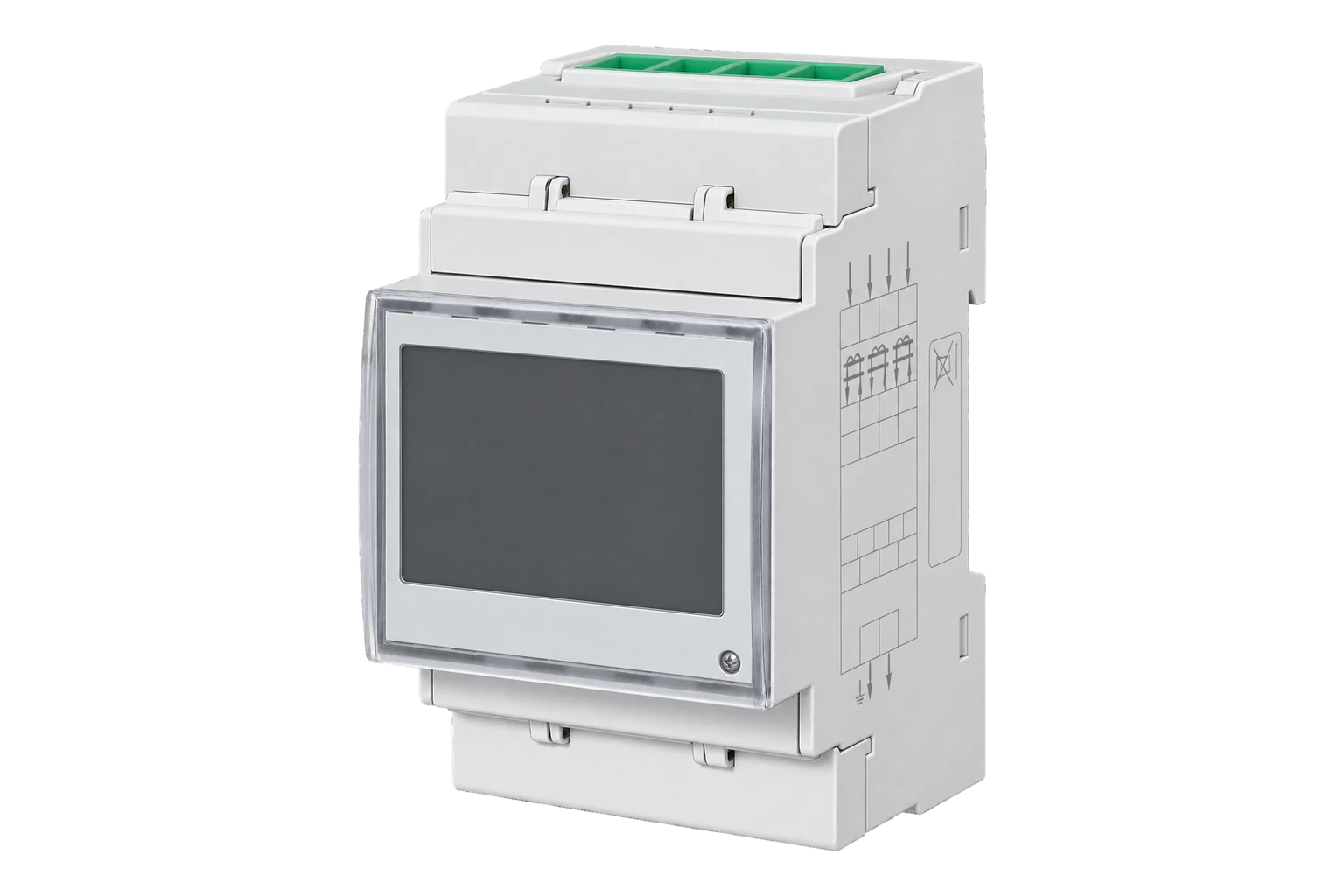
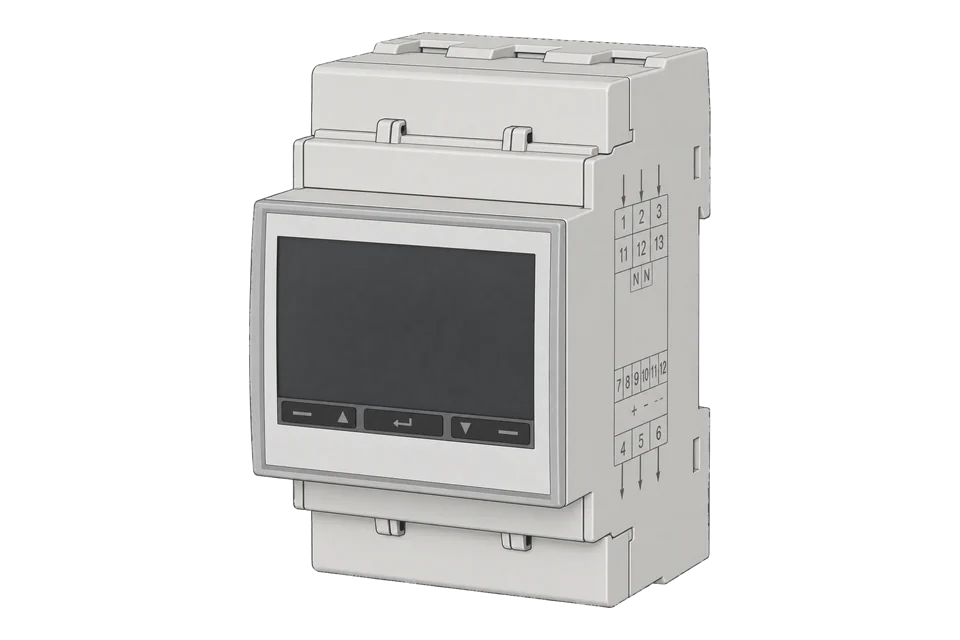
Camille Bauer LINAX PQ5000
Power quality analyser
The LINAX PQ5000 combines power quality recording with electrical and energy measurements. Its manufacturer manual documents Ethernet Modbus/TCP and a separate Modbus/RTU option. The retained register manual defines read functions, addresses and floating-point order, but does not establish a general unavailable-value rule for instantaneous Modbus measurements. Direct Edge integration remains unverified.
- Modbus TCP
- Modbus RTU
- HTTP
- IEC 61850
- PROFINET
Power quality analyser
Compatibility
Direct Edge integration not yet verified
The manufacturer publishes a detailed LINAX PQx000 Modbus map that identifies PQ5000 and documents its wire format. The retained documents do not define a complete validity and freshness contract for instantaneous Modbus readings on the installed firmware. A source-documented register format alone does not release an Edge point set.
Stationary DIN-rail LINAX PQ5000 only. Record the full order configuration, firmware, current-input option and installed communications. PQ5000-MOBILE, PQ5000-Rack and PQ5000CL require their own review. Resolve unavailable values and freshness with firmware-specific evidence and site checks before enabling a direct Edge path. This guide authorizes no writes, resets or control outputs.
Models
| Models | Interface | Route into Edge |
|---|---|---|
| Stationary DIN-rail LINAX PQ5000 | Standard RJ45 Ethernet interface with Modbus/TCP and HTTP/HTTPS; confirm whether the separate Modbus/RTU interface is fitted | Retain the exact installed firmware and options before selecting any monitoring interface. No direct Edge path is released here. |
| PQ5000 with conventional current inputs or Rogowski current inputs | Conventional inputs use nominal 1 to 5 A current signals. The Rogowski version uses the documented ACF3000 arrangement and has additional sensor uncertainty. | Confirm the input hardware, sensor, transformation ratio and wiring. Do not apply a conventional CT configuration to a Rogowski input. |
| PQ5000 with optional IEC 61850 or PROFINET interfaces | The handbook describes separate interface modules and network settings for IEC 61850 and PROFINET. | These options do not establish an Edge interface. A rule for the PROFINET process image must not be applied to Modbus values. |
Specifications
The PQ5000 is the DIN-rail member of the PQx000 family. The handbook distinguishes its voltage limits and power-quality class from other family members. Select the full hardware configuration before choosing sensors or a communications path.2
- Current input
- Conventional nominal input 1 to 5 A; maximum 7.5 A sinusoidal. Rogowski versions require their separately specified sensor arrangement.2
- Nominal voltage
- 57.7 to 400 V phase-neutral and 100 to 693 V phase-phase; UL limits 347 V and 600 V respectively. PQ5000 maximum sinusoidal measurement is 520 V phase-neutral / 900 V phase-phase; this is not a nominal connection rating.2
- Power quality
- PQI-A for PQ5000 under IEC 62586-1; handbook describes IEC 62586-2 conformity assessment and IEC 61000-4-30 flagging. Retain the applicable instrument evidence for a formal PQ report.2
- Energy accuracy
- Active energy class 0.2S under EN 62053-22; reactive energy class 0.5S under EN 62053-24. Sensor and installation conditions still apply.2
- Acquisition and storage
- 18 kHz internal sampling and 16 GB internal memory. These do not define the Modbus polling rate or external data retention.2
- Ethernet
- RJ45, 100BaseTX, 10/100 Mbit/s; Modbus/TCP and HTTP/HTTPS on the standard interface. IEC 61850 and PROFINET have separate optional interfaces.2
- Environment
- Indoor use, up to 2000 m; -10 to +55 degrees Celsius without UPS, 0 to +35 degrees Celsius with UPS. Housing IP30 and terminals IP20.2
Interface
Documented measurements and integration boundaries for LINAX PQ5000.
- The Modbus map covers voltage, current, frequency, power, energy, harmonics, unbalance and status groups. Availability depends on the configured electrical system and fitted options; these groups are not an approved Edge reading count.
- The manual uses one-based 4x register references and zero-based addresses in transmitted requests. Function 0x03 reads holding registers; the table marks function 0x04 as not implemented.
- REAL32 and REAL64 use IEEE 754 with the least-significant 16-bit register first. The documented reply keeps the high byte first within each register. Preserve the selected field type rather than decoding every value as a two-register float.
- Energy counters have separate REAL64 and REAL32 read representations. The map also contains writable counter-setting and remote-output areas, which are outside this monitoring review.
- For several minimum/maximum and mean-value records, a timestamp of 1 January 1970 marks an invalid associated measurement. The retained manual does not establish that rule, NaN or zero as a universal invalid sentinel for instantaneous Modbus values.
Assessment
Stationary LINAX PQ5000, using retained manufacturer manuals; no released Edge point set or physical-device validation.
- InteroperabilityLimited
- The exact model is identified in the Modbus document, with function, address and floating-point rules. Missing firmware-specific validity behavior prevents a complete read contract.1
- AccuracySupported with conditions
- The handbook defines input ranges, energy accuracy and PQ functions. Correct current-input selection, sensor uncertainty and electrical-system configuration remain conditions.2
- SecuritySupported with conditions
- The handbook documents service blocking, client whitelists, HTTPS and role-based access. HTTPS protection must not be assumed to encrypt Modbus/TCP; network restrictions and disabled writes remain necessary.12
- ReliabilityNot yet assessed
- The retained sources do not establish the complete unavailable-value and freshness behavior needed for an instantaneous Modbus monitoring series.12
- RuggednessSupported with conditions
- Indoor temperature, altitude and enclosure limits are documented; the UPS option narrows the operating temperature range.2
- ScalabilitySupported with conditions
- The handbook states at least five simultaneous Ethernet client connections. A bounded polling design still needs response and load checks against the installed device.2
Setup
-
Identify the installed configuration
Retain the nameplate, full ordering code, firmware and available options. Distinguish the stationary PQ5000 from mobile, rack and Current Link models.
-
Document the measurement boundary
Record the electrical system, voltage connection, current-input variant, sensor ratios, polarity and phase assignment. Match the selected quantities to the manual’s system-availability table.
-
Resolve data validity before integration
Obtain firmware-specific evidence for unavailable instantaneous values, startup behavior and data freshness. Do not assume the PROFINET zero-value rule or timestamp rules for historical extrema also apply to instantaneous Modbus registers.
-
Constrain the network and function set
Confirm enabled services and client restrictions with the owner. Keep the future client on documented read operations. Exclude counter writes, min/max resets, alarm resets and remote outputs.
-
Commission against independent evidence
After the validity contract is resolved, compare selected values with the device interface and an independent reference under known operating conditions. Retain raw responses, decode settings, timestamps and missing-data behavior before expanding the point set.
Common questions
- Can Edge read the LINAX PQ5000 over Modbus TCP?
- The manufacturer documents Modbus/TCP and the register wire format, but this guide keeps direct Edge compatibility unverified. Firmware-specific validity and freshness behavior must be resolved and the installation commissioned before a read-only point set can be released.12
- Does the documented zero value mean an invalid Modbus reading?
- The handbook’s zero-value statement is in its PROFINET process-image section. The Modbus map separately identifies invalid timestamps for some historical records. Neither statement establishes a universal invalid-value rule for instantaneous Modbus measurements.12
- Can an operational copy replace the instrument’s power-quality report?
- No. Retain the instrument’s event recording, time synchronization, flagging and applicable conformity evidence for the intended power-quality assessment. An external monitoring series has its own sampling, transport and retention behavior.2
- Are resets and remote outputs included?
- No. The Modbus map includes writable functions for counters, resets and remote outputs. This guide reviews monitoring requirements only and authorizes none of those operations.1
Related devices
Sources
- LINAX PQx000 Modbus interface (opens in a new tab) (PDF)
- LINAX PQx000 device handbook (opens in a new tab) (PDF)
Further reading
Product names and trademarks belong to their owners. Publication does not imply endorsement or a commercial relationship.