
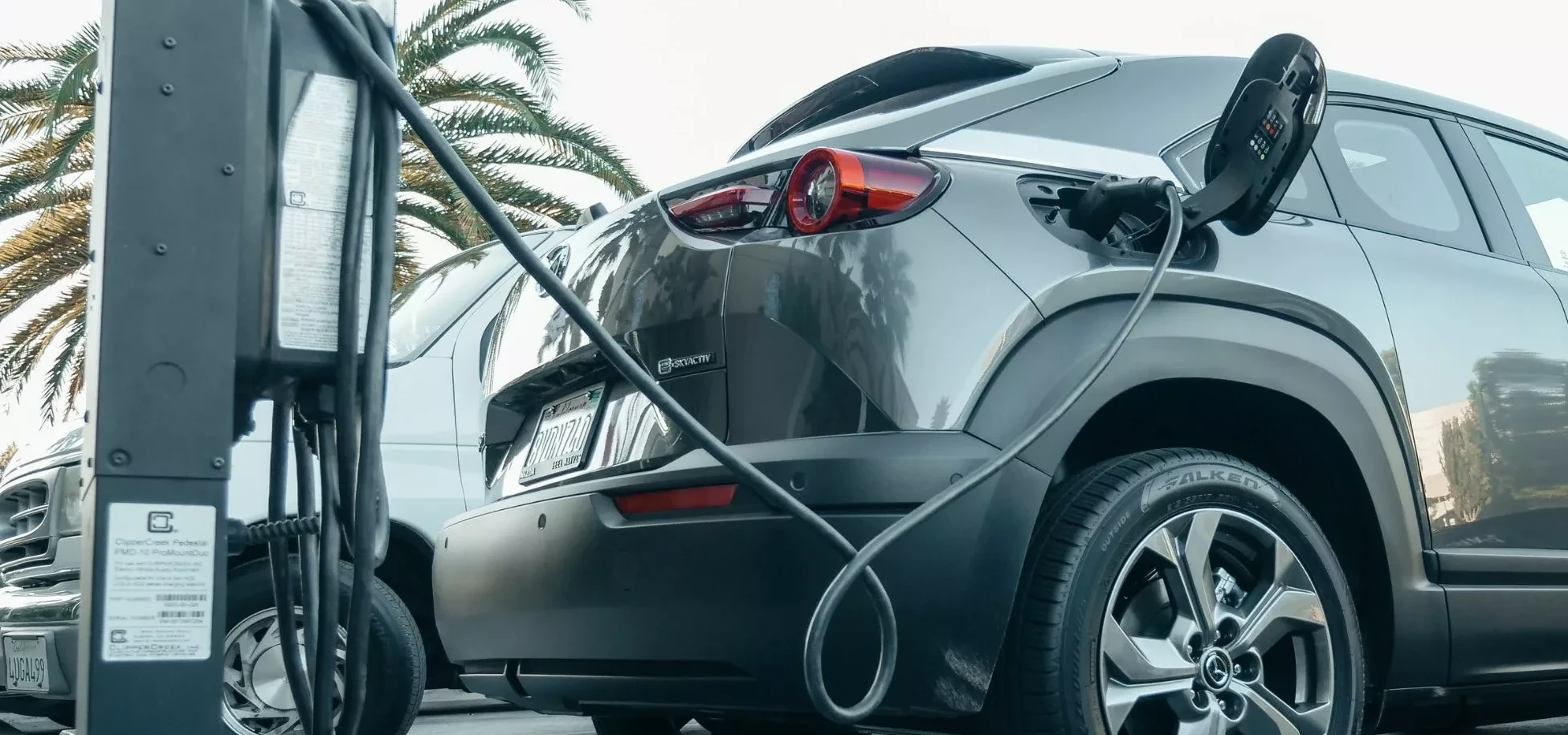
A 7.4 kW home charger draws 32 A on one phase. Ten 22 kW chargers in a depot car park can draw 320 A per phase, more than many commercial supplies can carry. Both are flexible, because a parked car rarely needs its full charging window. The modes below differ in which way power flows, where the car connects, and what the grid connection must allow.
This guide is part of the flexibility series.
The modes
| Mode | Power flow | Where it connects | What it needs |
|---|---|---|---|
| V1G, smart charging | Grid to car | Any charger | A controllable charger. On AC, IEC 61851-1 PWM control is enough |
| V2L, vehicle-to-load | Car to a socket on the car | Not connected to the grid | A vehicle with a V2L outlet |
| V2H, vehicle-to-home | Car to home | Behind the meter | A bidirectional path, and either a changeover switch for islanded backup or a G98 or G99 connection for parallel running |
| V2B, vehicle-to-building | Car to building | Behind the meter | As V2H, with building-level control. Commercial ratings usually need G99 |
| V2G, vehicle-to-grid | Both ways, with export | Through the site meter | ISO 15118-20 or CHAdeMO, a bidirectional path, a G98 or G99 connection and export metering |
A car that supplies a home while the home stays connected to the grid is a generator running in parallel, and the network operator treats it as one. In Great Britain it needs G98 or G99 even if it never exports. A scheme that caps export must meet G100. Only a backup supply that disconnects the home from the grid through a changeover switch before the car supplies it stays outside the connection process. The G99 guide covers the thresholds.
V1G: smart charging
A car that arrives at 18:00 needing 20 kWh charges in about 2 hours 45 minutes at 7.4 kW. If it leaves at 07:30, nearly 11 hours are free. Smart charging moves the charge into low-tariff hours, into periods of solar surplus, or away from the site peak.
On an AC charger, the control signal to the car is the IEC 61851-1 PWM duty cycle. It sets the current the car may draw. The lowest value is 6 A per phase, which is about 1.4 kW single-phase or 4.1 kW three-phase at 230 V. Below that, the charger must pause the session. Some vehicles go to sleep during a long pause and do not restart when current returns. Test pause and resume with the vehicles the site actually sees.
In Great Britain, the Electric Vehicles (Smart Charge Points) Regulations 2021 apply to home and workplace charge points sold since 30 June 2022. The charge point must be smart. Its default charging hours must avoid 08:00 to 11:00 and 16:00 to 22:00 on weekdays. It must apply a random delay of up to 600 seconds at each start, and must be able to extend that to 1,800 seconds when told to over its communications link. The delay stops thousands of chargers starting in the same second when a tariff changes. Public charge points and rapid charge points of 50 kW or more are outside the rules.
In Germany, Section 14a of the Energy Industry Act applies to wallboxes, heat pumps and batteries rated above 4.2 kW and installed since 1 January 2024. The network operator can dim them, but must leave at least 4.2 kW per device. In return, the site pays lower network charges. The Section 14a guide explains the modules.
Headroom on a commercial site
On a commercial site, the charger limit per phase is the agreed supply capacity, less a reserve, less the measured non-EV load on that phase. The worst phase sets the limit for three-phase chargers.
Single-phase chargers add a second problem. If every 7.4 kW charger is wired to L1, L1 reaches its limit while L2 has more than 90 A spare. Rotate the phase connection between chargers at installation, and control on per-phase current, not on total kW.
A lost data link must not leave the chargers at a limit that was set when the site was quiet. For OCPP 1.6, one possible fallback uses a site-approved TxDefaultProfile at a low stackLevel and a dynamic TxDefaultProfile at a higher stackLevel with a short validTo. This works only while no applicable TxProfile overrides those default profiles. Profile validity, schedule duration and transaction scope still apply. Verify the resulting limits, including active transactions, in a site-approved bounded offline test. Profile expiry alone does not establish a safe site limit. The EV charging capacity calculator runs the headroom calculation against each interval of a site profile.
V2G: bidirectional charging
Most V2G chargers in service are DC units with the inverter in the charger. AC export is also in commercial service. Renault's Mobilize offer, launched in France in October 2024, pairs the Renault 5 with an AC bidirectional charging station. With AC export, the inverter that the grid code applies to is in the car, not on the wall.
| Requirement | What satisfies it |
|---|---|
| Vehicle | A car that supports export, from a manufacturer whose warranty terms allow it |
| Car-to-charger communication | ISO 15118-20 (2022), which defines bidirectional power transfer for AC and DC, or CHAdeMO. ISO 15118-2 and DIN SPEC 70121 do not, which is why most cars on the road cannot export even from a V2G charger |
| Command | OCPP 2.1 (January 2025, published by IEC as IEC 63584-210), which adds bidirectional power transfer and DER control, or the charger maker's own interface |
| Connection | In Great Britain, G98 for fully type-tested units up to 16 A per phase, G99 above that, and G100 for any export limitation scheme |
The OCPP guide covers the protocol side.
Response time decides which grid services V2G can offer. GB Dynamic Containment needs a change in output within 0.5 s of a frequency deviation and full delivery within 1 s, sustained for 15 minutes, with performance data at 20 Hz. A setpoint that travels from a cloud platform over OCPP to the charger and then to the car must complete that chain inside 1 s. OCPP 2.1 lets the platform install a frequency-watt curve on the charger, so the charger responds to local frequency without the round trip.
What the site must measure
| Measurement | Why |
|---|---|
| Import and export at the site connection, per phase | The limit that charging and export must stay inside, including any export capacity agreed under G99 or G100 |
| Each charger, or each charger board | What the chargers did in an event, separate from the rest of the site |
| Other large loads and generation | Why the headroom changed |
| Time resolution to suit the service | Half-hourly for GB settlement periods, and 20 Hz for Dynamic Containment performance data |
EV charging makes baselines harder than most loads. Charging demand depends on whether a car is plugged in, so a baseline built from historical averages can overstate or understate the turn-down in an event. A meter on the charger board shows the charging load directly, and the site meter shows that the rest of the site did not change. The baseline guide explains the methods.
Metering and control with EpiSensor
A ZEM electricity monitor on the site connection and another on the charger board give the per-phase currents in the headroom calculation. Edge on the Gateway calculates headroom with a stated reserve and publishes the value and its freshness to the charging platform over MQTT, HTTP or Modbus. Edge does not talk to the chargers. The platform applies the limit and its own fallback. The EV charging load management application shows the architecture.
A ZDR demand response controller meters the supply and answers under-frequency through its own relay. The relay can open a contactor on a charger group or switch a charger's enable input. That suits V1G turn-down only. V2G export is commanded through OCPP or the charger maker's interface.
Common questions
What is the difference between V1G and V2G?
V1G (smart charging) controls when and how fast a vehicle charges. Power only flows into the car. V2G (vehicle-to-grid) also lets the car export through a bidirectional charger. That needs ISO 15118-20 or CHAdeMO between car and charger, and a G98 or G99 connection in Great Britain.
What is V2H?
Vehicle-to-home: the car's battery supplies the home, for example during a power cut or at peak prices. If it runs in parallel with the grid, it is generation and needs G98 or G99 in Great Britain, even when it never exports. V2B is the same for a commercial building.
Do EV chargers in the UK have to be smart?
Home and workplace charge points sold in Great Britain since 30 June 2022 must be. The Electric Vehicles (Smart Charge Points) Regulations 2021 require smart functionality, default charging hours outside 08:00 to 11:00 and 16:00 to 22:00 on weekdays, and a random delay of up to 600 seconds at each start. The rules do not apply to public charge points or to rapid charge points of 50 kW or more.
Does V2G damage the car battery?
It adds energy throughput. Exporting 14 kWh on each of 250 weekdays is 3,500 kWh a year, about 58 full cycles of a 60 kWh battery. Driving 15,000 km at 0.17 kWh/km is about 2,550 kWh. The effect on life depends on the cell chemistry, depth of discharge and temperature. The vehicle manufacturer's warranty terms say whether export is allowed and on what conditions.