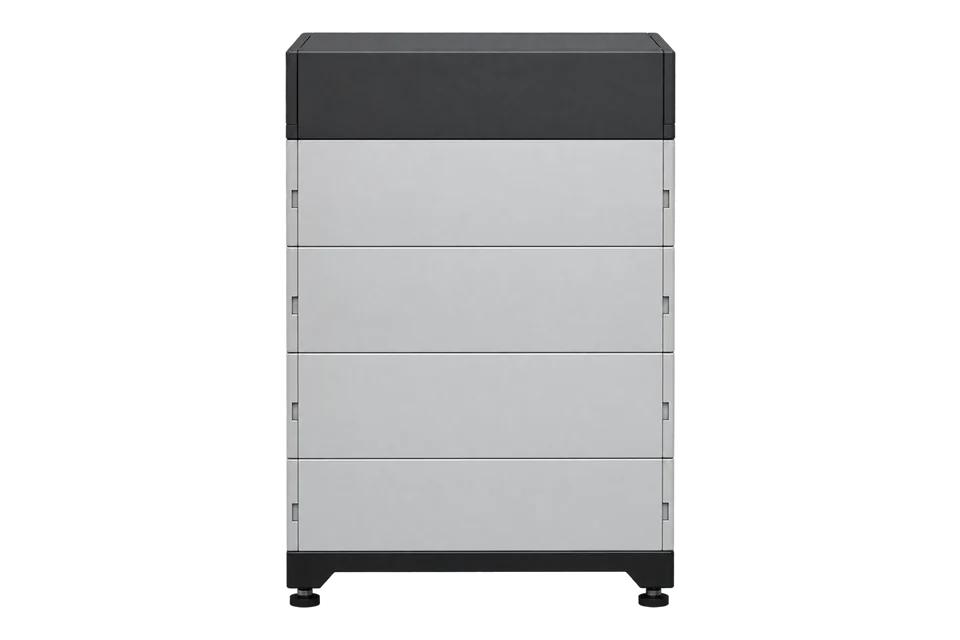
BYD Battery-Box Premium HVS and HVM
High-voltage battery energy storage system
Modular high-voltage batteries for compatible residential inverters. Compare HVS and HVM by module count, operating voltage and the inverter’s approved battery configuration. External monitoring reads the inverter’s documented interface; battery communications remain part of the approved storage system.
- CAN
- RS485
High-voltage battery energy storage system
Compatibility
Monitoring through a supported inverter only
For example, BYD approves specified Symo GEN24 Plus combinations and Fronius documents read-only storage charge level and state through the inverter Modbus interface. This is an inverter-mediated route, not a direct Battery-Box interface to Edge.
Original Battery-Box Premium HVS 5.1–12.8 and HVM 8.3–22.1 using the original BCU document set. BCU2.0, HVS+/HVM+, HVM-US, HVL and low-voltage families are outside this scope. No battery CAN adapter, register import or battery control is supplied.
An approved inverter exposes documented local battery telemetry
- Wired
- Edge
- Platforms
Models
| Models | Interface | Route into Edge |
|---|---|---|
| HVS: 2–5 modules | 2.56 kWh and 102.4 V nominal per module; 5.12–12.80 kWh per tower | Compare against the inverter’s HVS module-count column, not its HVM column. |
| HVM: 3–8 modules | 2.76 kWh and 51.2 V nominal per module; 8.28–22.08 kWh per tower | More modules do not imply every inverter supports the largest tower. |
| Original BCU versus BCU2.0 | BYD publishes separate manuals and compatibility lists for the two generations | Identify the installed control unit before using this original-family guide. A shared HVS/HVM name does not replace that check. |
Specifications
These are DC usable-energy ratings at 100% depth of discharge, 0.2C charge/discharge and +25 °C. Delivered AC energy depends on the inverter, operating window and losses. The advertised tower name is rounded: HVM 22.1 contains 22.08 kWh of rated usable DC energy.12
- HVS usable DC energy
- 5.12 / 7.68 / 10.24 / 12.80 kWh for 2 / 3 / 4 / 5 modules1
- HVS nominal voltage
- 204.8 / 307.2 / 409.6 / 512 V for 2 / 3 / 4 / 5 modules1
- HVM usable DC energy
- 8.28 / 11.04 / 13.80 / 16.56 / 19.32 / 22.08 kWh for 3–8 modules2
- HVM nominal voltage
- 153.6 / 204.8 / 256 / 307.2 / 358.4 / 409.6 V for 3–8 modules2
- Chemistry and enclosure
- LiFePO4; IP55; indoor/outdoor floor-standing installation subject to the manual124
- GEN24 single-tower minimum firmware in V2.21
- Symo GEN24 Plus: inverter 1.9.7-0, BMU 3.13, BMS 3.19; Primo GEN24 Plus: inverter 1.11.6-0, BMU 3.15, BMS 3.21. Parallel systems have a separate column.3
Interface
Documented measurements and integration boundaries for Battery-Box Premium HVS and HVM.
- Storage charge level and operating state where the installed inverter exposes them, such as GEN24 model 124.
- Inverter AC power and energy for the conversion boundary; these are not the same as DC battery energy.
- Battery alarms and commissioning status in the manufacturer system; external visibility depends on the inverter interface.
- Installed module count and inverter/battery firmware as configuration records, not invented Modbus channels.
Assessment
Original Battery-Box Premium HVS 5.1–12.8 and HVM 8.3–22.1 using the original BCU document set. BCU2.0, HVS+/HVM+, HVM-US, HVL and low-voltage families are outside this scope. No battery CAN adapter, register import or battery control is supplied.
- InteroperabilitySupported with conditions
- The battery interface belongs to an approved inverter combination. GEN24 provides a documented indirect monitoring path, but this is not an open direct battery register map.36
- AccuracySupported with conditions
- DC usable-energy test conditions and nominal voltage are explicit. Operational charge state comes from the inverter; neither its estimate nor the battery rating is a revenue-meter measurement.126
- SecurityNot yet assessed
- The reviewed battery manuals and datasheets do not establish an authenticated external battery telemetry API. Network access and monitoring permissions must be assessed at the chosen inverter.46
- ReliabilitySupported with conditions
- The manufacturer publishes safety standards, temperature derating, installation conditions and qualified inverter/firmware combinations. Those conditions govern system operation.123
- RuggednessSupported with conditions
- IP55 and -10 to +50 °C are specified, with low-temperature derating. Follow the placement limits rather than treating IP55 as permission for any outdoor exposure.124
- ScalabilitySupported with conditions
- Module and parallel-tower limits depend on the inverter and firmware. The list includes specific exclusions, including three HVM 22.1 towers with Fronius.3
Setup
Read BYD charge level through GEN24
A best-effort read-only start for an approved original HVS/HVM system on Symo GEN24 Plus. The network endpoint is the inverter, not the battery CAN/RS485 connector. SunSpec model 124 supplies charge level and battery operating state.
- Enable monitoring
- On the GEN24 interface, enable Modbus TCP monitoring; retain the configured inverter unit ID and port (default TCP 502). Leave inverter control via Modbus disabled. Read FC03 at wire 40000, quantity 2: PDU 03 9C 40 00 02. Expect SunS bytes 53 75 6E 53, then model headers from wire 40002.
- Discover storage model
- Read each two-register model header (ID and data length L); next header = current header + L + 2. Stop at ID 65535. Locate ID 124 with data length 24 and call its wire header address H. Storage is exposed only when the inverter has a storage solution; other models and int+SF/float selection can shift H.
- Charge level
- ChaState is U16 at H+8; ChaState_SF is signed S16 at H+22. SOC % = raw × 10^SF. Synthetic H = 45000 gives FC03 requests 03 AF D0 00 01 and 03 AF DE 00 01. Raw 1C DF = 7391 and SF FF FE = -2 give 73.91%. These synthetic addresses illustrate the offsets, not an installed GEN24 fixed map.
- Battery operating state
- ChaSt is enum16 at H+11. Values: 1 off, 2 empty, 3 discharging, 4 charging, 5 full, 6 holding, 7 testing. With synthetic H = 45000, PDU 03 AF D3 00 01 reads it; payload 00 04 means charging. ChaSt is a state code, while ChaState is SOC: do not scale or display them as the same measurement.
- Quality and comparison
- Keep U16/enum16 0xFFFF and scale factor 0x8000 unavailable, not zero. Compare charge level and state with the inverter at the same timestamp. An OFF state is distinct from missing telemetry. Keep AC inverter power separate from battery DC energy and leave storage limits and charge/discharge writes unchanged.
Acceptance: This provides manufacturer-documented battery monitoring through an approved inverter. It is not a direct BYD Modbus interface, proof of physical Edge operation, or authorization to take over battery control.
-
Choose the approved combination
Start with the exact inverter model, original battery control unit and proposed tower capacity. Use original-family compatible inverter list V2.21 dated 20 August 2025 and check for a newer manufacturer revision before purchase. It gives separate inverter, BMU and BMS minimum firmware for single and parallel towers.
-
Check module counts rather than matching brand names
For example, V2.21 permits Symo GEN24 Plus with 2–5 HVS or 4–8 HVM modules. Primo GEN24 Plus is narrower: 2–3 HVS or 4–7 HVM. An HVM 8.3 tower has only three modules, so the larger family’s capacity range does not make it an approved GEN24 Plus combination.
-
Have the complete battery system commissioned
Follow the exact BYD and inverter installation manuals through a qualified installer. This guide is not a pack-assembly procedure. Do not mix HVS and HVM modules or improvise parallel arrangements. The compatibility list specifically excludes three HVM 22.1 towers in parallel with Fronius inverters.
-
Use the inverter telemetry interface
First confirm the battery is healthy and visible at the inverter. For GEN24, enable local Modbus TCP monitoring on a restricted network while leaving control disabled. Discover model 124; read ChaState at header+8 with its signed scale factor at header+22 and ChaSt at header+11. Use the worked read below; the battery CAN/RS485 connection stays with the inverter.
-
Validate the energy boundary
Compare charge level and state with the inverter screen at the same time. Compare AC power with AC power, not module DC ratings. Record unavailable data distinctly from zero and recheck model exposure after firmware or hardware changes.
Common questions
- Is HVM always better because its tower can hold more energy?
- No. HVS and HVM use different module voltages, capacities and current ratings. The inverter’s battery voltage window and approved module count determine which configurations are usable. Compare permitted usable energy and power for the complete system, not only the largest battery tower.123
- Does RS485 mean I can import a Battery-Box Modbus template?
- No. RS485 describes an electrical interface. These BYD documents do not provide a direct monitoring register map for Edge. Use an approved inverter’s documented external monitoring interface and keep its battery-management connection intact.1246
- Can I use this list for BCU2.0?
- BYD publishes a separate BCU2.0 compatibility list and manual. Identify the control-unit generation and use its own documents; this guide deliberately covers the original HVS/HVM document set.5
- What is a useful alternative to a high-voltage battery tower?
- A low-voltage battery system with a dedicated BMS and inverter/charger is a different architecture. The Lynx Smart BMS NG guide explains one Victron approach. Its batteries, protective devices and DC currents are not interchangeable with an HVS/HVM tower.12
Sources
- Battery-Box Premium HVS datasheet V1.4, 12 December 2024 (opens in a new tab) (PDF)
- Battery-Box Premium HVM datasheet V1.4, 12 December 2024 (opens in a new tab) (PDF)
- Original HVS/HVM compatible inverter list V2.21, 20 August 2025 (opens in a new tab) (PDF)
- Original HVS/HVM operating manual V2.2, 19 August 2024 (opens in a new tab) (PDF)
- Battery-Box downloads: separate original and BCU2.0 document sets (opens in a new tab)
- GEN24 Modbus instructions: storage model 124 and read-only information (opens in a new tab)
- SunSpec model 124: storage charge level, state and scale factors (opens in a new tab)
Further reading
Product names and trademarks belong to their owners. Publication does not imply endorsement or a commercial relationship.