Motor full-load current calculator

Work out the full-load current of a single-phase or three-phase motor from its kW or hp rating, efficiency and power factor.

Electrical power and current Updated Free, no sign-up

Example values
Supply
Motor
Motor rating

Common supplies

V

From the nameplate: shaft power

IE3 motors: about 80% to 96%, rising with size

%

At full load, typically 0.75 to 0.9

Full-load current, each line

27.69A

15 kW shaft output, 400 V three-phase.

Electrical input at full load
16.3 kW
Apparent power
19.18 kVA
Losses in the motor
1.304 kW
Rated output in horsepower
20.12 hp

Use the nameplate current where you have it. Starting current is several times higher and is not shown.

How it’s calculated
  1. Pin = Pout ÷ η=15 ÷ 0.92=16.3 kW
  2. I = Pin × 1000 ÷ (√3 × V × PF)=16.3 × 1000 ÷ (1.732 × 400 × 0.85)=27.69 A

Choose the meter and CTs for this motor.

Three-phase at 400 V · 27.7 A per phase, sized for 120 A CTs

Build a system

A 15 kW (20.12 hp) motor at 400 V three-phase, 92% efficient with a power factor of 0.85, draws 27.69 A in each line at full load.

Tip: The nameplate current beats any calculation. Use this when the nameplate is unreadable or you are planning ahead of the motor arriving.

How to calculate motor full-load current

A motor nameplate rating, in kW or hp, is shaft output. Divide it by the efficiency to get the electrical input, then divide by √3, the line voltage and the power factor. A 15 kW motor at 400 V, 92% efficient with a power factor of 0.85, draws 27.69 A in each line at full load.

Use the result to choose CTs, to check a measured current against the motor rating, or to estimate a motor with an unreadable nameplate. For cable and protection sizing, follow the wiring rules that apply to the installation.

Three-phase motors

I = Pout × 1000 ÷ (√3 × V × η × PF)

Pout is the rated output in kW and V the line-to-line voltage. η is the efficiency as a fraction and PF the power factor, both at full load.

Single-phase motors

I = Pout × 1000 ÷ (V × η × PF)

Use V as the phase voltage. Small single-phase motors are often less than 80% efficient, so the loss term matters more than on a three-phase motor.

Horsepower to kW

P (kW) = hp × 0.7457

US nameplates and many older ones use mechanical horsepower: 550 ft·lbf/s, or 745.7 W. Metric horsepower (PS, CV) is 735.5 W.

Take efficiency and power factor from the nameplate. If the efficiency is not readable, use the minimum for the motor’s IE class in IEC 60034-30-1. For example, an IE3 four-pole 7.5 kW motor at 50 Hz is at least 90.4% efficient. EU Ecodesign Regulation 2019/1781 has required IE3 for most new three-phase motors from 0.75 kW to 1000 kW since July 2021. Power factor rises with size: a four-pole motor is typically near 0.75 at 1 kW, 0.82 at 7.5 kW and 0.85 to 0.88 above 30 kW. Two-pole motors run a little higher.

The formula gives the full-load current only. Below full load, power factor falls steadily. Efficiency peaks at about 75% load, stays near the full-load value down to about 50%, and falls below that. The magnetising current does not fall with load, so a motor with no load still draws 20 to 50% of its full-load current. A motor at half load therefore draws much more than half its full-load current. To find how loaded a motor is, measure kW, not amps.

The nameplate current applies at rated voltage. IEC 60034-1 Zone A allows ±5% on voltage and ±2% on frequency for continuous operation. With the shaft load unchanged, the current rises about as much as the voltage falls. A fully loaded 400 V motor on a 380 V supply draws about 5% more than its nameplate current.

Motor full-load current examples

A 7.5 kW pump motor at 400 V

The efficiency is 90.4%, the IE3 minimum for a four-pole 7.5 kW motor at 50 Hz. The input is 7.5 ÷ 0.904 = 8.296 kW. With a power factor of 0.82, the current is 8,296 ÷ (1.732 × 400 × 0.82) = 14.6 A in each line. The motor turns about 0.8 kW into heat at full load. A direct-on-line start draws roughly 90 to 115 A for a few seconds.

Full-load current, each line 14.6 A Open in the calculator
A 50 hp motor at 480 V

50 hp is 37.28 kW. At 94.1% efficiency and a power factor of 0.86, the full-load current is 55.42 A in each line. NEC Table 430.250 gives 65 A for a 50 hp motor at 460 V, 17% higher. Under NEC 430.6(A), size conductors and short-circuit protection from the table and overload protection from the nameplate. Use the calculated figure for monitoring and CT selection.

Full-load current, each line 55.42 A Open in the calculator

A 1.1 kW single-phase motor at 230 V

At 78% efficiency the input is 1.41 kW. At a power factor of 0.9 the current is 6.813 A. If you treat the 1.1 kW rating as the electrical input, you get 5.3 A, which is 22% low.

Full-load current 6.813 A Open in the calculator

Motor kW to hp table

Standard motor output ratings in kW and the equivalent mechanical horsepower (1 hp = 745.7 W).

Output (kW)Horsepower (hp)
0.370.4962
0.550.7376
0.751.006
1.11.475
1.52.012
2.22.95
34.023
45.364
5.57.376
7.510.06
1114.75
1520.12
18.524.81
2229.5
3040.23
3749.62
4560.35
5573.76
75100.6
90120.7
110147.5
132177
160214.6
200268.2
250335.3

Download this table (CSV)

Questions about motor full-load current

Should I use the nameplate current or a calculated one?

Use the nameplate current when you can read it. The manufacturer measured it for that motor at rated voltage. A calculated current is only as good as the efficiency and power factor you enter.

How much current does a motor draw when it starts?

A direct-on-line start typically draws 6 to 8 times full-load current. The current falls as the motor reaches speed, usually within a few seconds. IEC 60034-12 sets locked-rotor limits by design class, and NEMA nameplates give a code letter for locked-rotor kVA per hp. A star-delta starter reduces the line current to one third of the direct-on-line value. A soft starter typically limits it to 2 to 4 times full-load current, and a variable-speed drive to about full-load current. This calculator does not give starting current.

Why does a lightly loaded motor draw so much current?

The magnetising current is almost constant from no load to full load, and it is 20 to 50% of full-load current. Smaller motors are at the top of that range. At light load most of the current is reactive, so the power factor is low. Current alone overstates the load. Real power in kW shows the true load.

What CT do I need to monitor a motor?

Start with the lowest and highest running currents you need to measure, the insulated conductor dimensions and the meter input. If starting current must be captured, verify the sensor and meter’s transient range and response as well. Current transformer selection builds that brief and checks a candidate’s rating, aperture and output. Its optional EpiSensor matching is a catalogue comparison; it does not establish accuracy or suitability for motor starting.

Limits of this result

  • Efficiency and power factor fall at part load, so a lightly loaded motor draws more current per kW than this shows.
  • Starting current is several times full-load current and depends on the starter; it is not calculated here.
  • In the United States, NEC Article 430 requires its own full-load current tables, not the nameplate or a calculation, when sizing conductors and short-circuit protection.

Measure it continuously

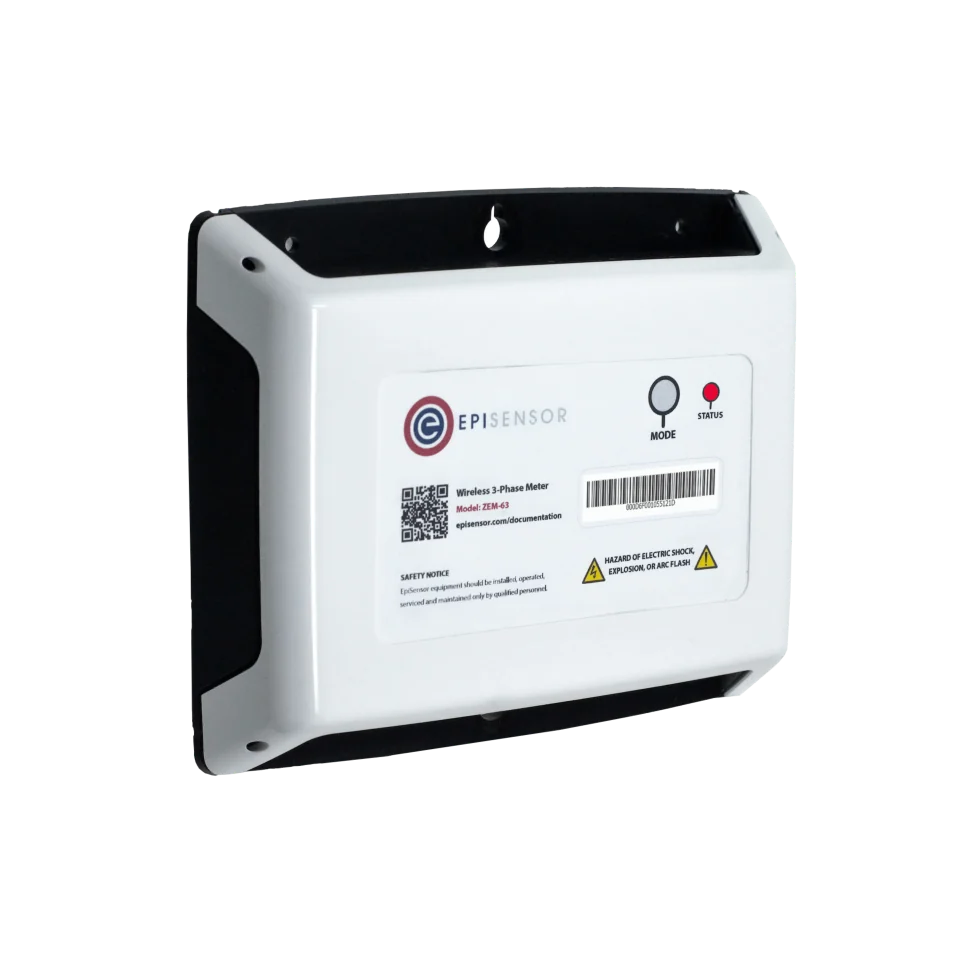
A ZEM on the motor supply records kW, current and power factor on each phase. Measured kW against the rated input shows how loaded the motor is, which current alone cannot show, and the per-phase readings show imbalance.

Related guides

Sources

  1. Calculation of electrical powers in Schneider Electric PMDs (opens in a new tab) Schneider Electric, 7EN52-0464-00, 2022-03-18
  2. NIST Guide to the SI, Appendix B.9: horsepower (550 ft·lbf/s) = 745.6999 W (opens in a new tab) NIST, Special Publication 811, 2008