Three-phase power calculator

Work out active, reactive and apparent power for a balanced three-phase load from line voltage, line current and power factor.

Electrical power and current Updated Free, no sign-up

Lagging

480line to line; 277.1 V line to neutral
100in each line
0.85power factor, 31.79° lagging
70.67active, 23.56 kW a phase
83.14apparent
43.8reactive, lagging
φL1L2L3
volts, amps70.67 kWtotal, steadyeach phase

Solid lines are voltage, dashed are current.

Supply

Common supplies

V
Load
A

Typically 0.8 to 1.0

Load

Active power, total

70.67kW

Apparent power, total
83.14 kVA
Reactive power, total, lagging
43.8 kvar
Active power, each phase
23.56 kW
Phase angle
31.79°

Balanced three-phase load.

How it’s calculated
  1. S = √3 × VLL × I ÷ 1000=1.732 × 480 × 100 ÷ 1000=83.14 kVA
  2. P = S × PF=83.14 × 0.85=70.67 kW
  3. Q = S × √(1 − PF²)=83.14 × √(1 − 0.85²)=43.8 kvar

Choose the meter and CTs for this load.

Three-phase at 480 V · 100 A per phase, sized for 120 A CTs

Build a system

A balanced 480 V three-phase load drawing 100 A in each line at a power factor of 0.85 uses 70.67 kW (83.14 kVA).

Tip: Enter the line-to-line voltage (400 V, not 230 V) and the current in one line, not the total of three.

How to calculate three-phase power

Three-phase power is √3 times the line-to-line voltage times the line current, which gives apparent power in kVA. Multiply by the power factor for the real power in kW.

The formula assumes the three phases carry equal current at the same power factor. Enter the current in one line, not the total of three.

Apparent power (kVA)

S = √3 × VLL × I ÷ 1000

Use the voltage between two lines (400 V, 480 V) and the current in one line. Cables, breakers and transformers heat with current, whatever the power factor, so they are rated on this figure.

Active power (kW)

P = √3 × VLL × I × PF ÷ 1000

The power that does work and that an energy meter integrates into kWh. The power factor is the ratio P ÷ S.

Reactive power (kvar)

Q = √(S2 − P2)

Motors and transformers draw it lagging to magnetise their cores; capacitor banks supply it leading. The formula holds for sinusoidal current. With harmonic current, √(S2 − P2) also includes distortion power, so it overstates the kvar a capacitor bank can correct.

Power in each phase

Pphase = VLN × I × PF ÷ 1000 = P ÷ 3

Use the line-to-neutral voltage (400 ÷ √3 = 231 V, nominally 230 V). The multiplier is then 3 rather than √3, and the total is the same.

For an unbalanced load, measure voltage, current and power factor on each phase and add the three phase powers. The balanced formula with the average current gives the correct total only when all three power factors are equal.

Three-phase power examples

A 32 A three-phase circuit at 400 V

A machine draws the full 32 A rating at a power factor of 0.95: 1.732 × 400 × 32 × 0.95 ÷ 1000 = 21.06 kW. The apparent power is 22.17 kVA and the reactive power 6.92 kvar. The cable and the breaker carry 5% more current than a 21.06 kW load at unity power factor, so size the circuit on amps, not kW.

Active power, total 21.06 kW Open in the calculator
A 100 A load on a 480 V supply

On a North American 480 V system, 100 A in each line at a power factor of 0.85 is 1.732 × 480 × 100 × 0.85 ÷ 1000 = 70.67 kW, with 83.14 kVA and 43.8 kvar lagging. At a power factor of 0.95 the same 70.67 kW needs 70.67 × tan(cos−1 0.95) = 23.2 kvar. A capacitor bank of about 20.6 kvar closes the gap. The power factor correction calculator works this through for other targets.

Active power, total 70.67 kW Open in the calculator

A clamp meter reading on a distribution board

A spot reading of 180 A on each line of a 400 V board, with a power factor of 0.92 from the meter, gives 114.7 kW. That is the load at one moment. A maximum-demand tariff bills the highest 15 or 30 minute average, so log the board over a full working week before you use the figure to size a supply or a transformer. The interval demand calculator turns logged kWh into that demand figure.

Active power, total 114.7 kW Open in the calculator

Three-phase kW at common currents

Active power for a balanced load at a power factor of 0.9, with the current in each line. For kVA, divide a figure by 0.9.

Three-phase kW at common currents, values in kW
Current (A)208 V (kW)400 V (kW)480 V (kW)690 V (kW)
103.26.27.510.8
165.210.012.017.2
206.512.515.021.5
258.115.618.726.9
3210.420.023.934.4
4013.024.929.943.0
5016.231.237.453.8
6320.439.347.167.8
8025.949.959.986.0
10032.462.474.8107.6
12540.577.993.5134.5
16051.999.8119.7172.1
20064.8124.7149.6215.1
25081.1155.9187.1268.9
315102.1196.4235.7338.8
400129.7249.4299.3430.2
500162.1311.8374.1537.8
630204.3392.8471.4677.6
800259.4498.8598.6860.5
1,000324.2623.5748.21,075.6

Download this table (CSV)

Questions about three-phase power

Why √3 and not 3?

Both are right, with different voltages. Each phase carries VLN × I, so the total is 3 × VLN × I. Because VLL = √3 × VLN, the same total is √3 × VLL × I. Mixing the two is a common mistake: 3 × 400 V overstates the power by 73%, and √3 × 230 V understates it by 42%.

Does a delta-connected load change the formula?

No. √3 × VLL × I gives the total for a star or a delta load, because it uses line quantities. The error comes from where the current is measured. Each winding of a delta carries I ÷ √3. After a star-delta starter, the six leads to the motor carry winding current, so a CT on one of them reads 58% of the line current and understates the power by 42%. Put the CTs on the three supply conductors upstream of the starter.

Which power factor should I enter?

Enter the true power factor, P ÷ S, to get kW. Displacement power factor, cos φ1, is the cosine of the angle between the fundamental voltage and current only. The two are equal when the current is sinusoidal. With harmonic current and a sinusoidal voltage, true power factor = displacement power factor ÷ √(1 + THDI2). A drive at a displacement power factor of 0.95 with 40% current THD has a true power factor of 0.88, so entering 0.95 overstates its kW by 8%. Many meters label both values PF, so check which one the display shows.

Can I use this for an unbalanced load?

Only when the three power factors are about equal. Take a 230/400 V board with 150 A at 0.95 on L1, 100 A at 0.80 on L2 and 50 A at 0.60 on L3. Phase by phase, that is 32.78 + 18.40 + 6.90 = 58.1 kW. The average current of 100 A with the L1 power factor of 0.95 gives 65.8 kW, which is 13% high. Measure each phase and add the three powers.

Limits of this result

  • Confirm the source data, device datasheet and installation conditions before relying on the result.

Measure it continuously

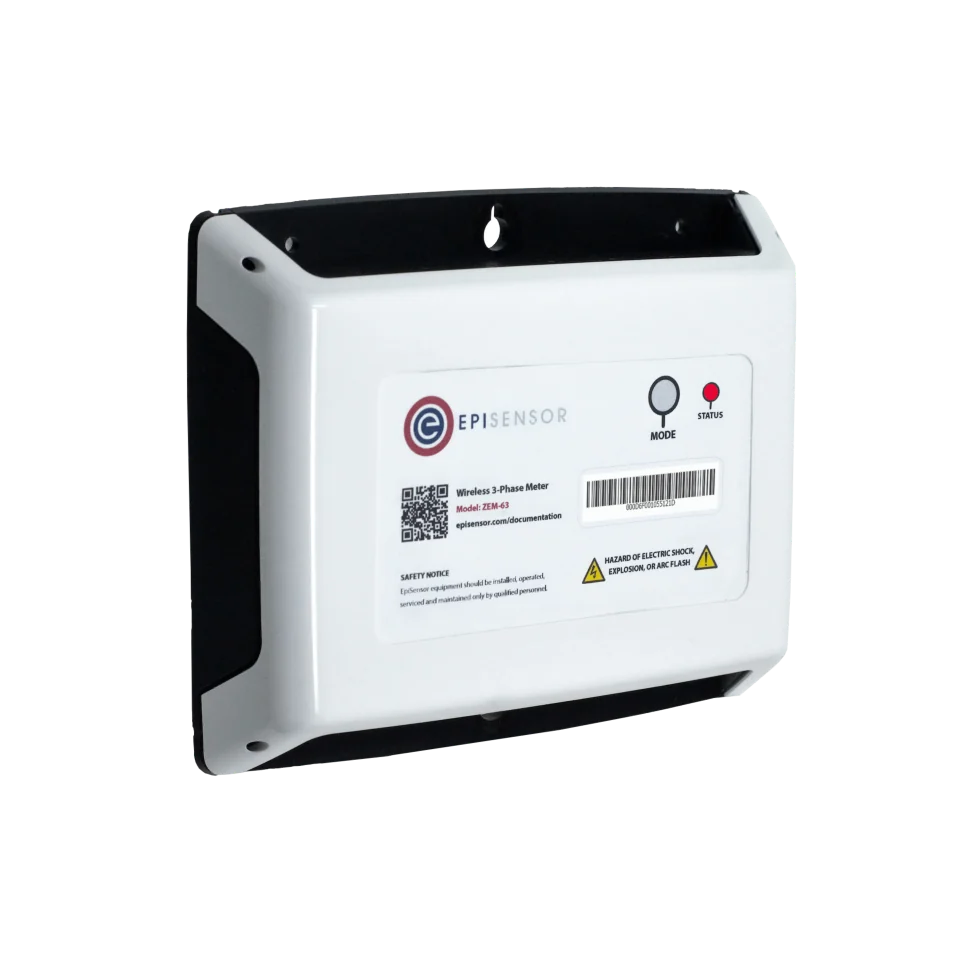
A ZEM measures voltage, current and power factor on each phase, so an unbalanced load is measured phase by phase rather than estimated from an average.

Related guides

Sources

  1. Calculation of electrical powers in Schneider Electric PMDs (opens in a new tab) Schneider Electric, 7EN52-0464-00, 2022-03-18
  2. Electrical devices: electrotechnical formulas (opens in a new tab) (PDF) ABB, 1SDC010001D0202