How to convert kVA to kW, kvar and power factor
To convert kVA to kW, multiply by the power factor: 500 kVA at a power factor of 0.85 is 425 kW. The three powers form a right-angled triangle. Active power (kW) is the base, reactive power (kvar) the upright and apparent power (kVA) the hypotenuse, so any two give the third.
kVA to kW
P = S × PF
Use this for a transformer or generator rated in kVA, to find the kW it can supply at the power factor of the load. A generator also has a kW limit set by its engine, so check that figure too.
kW to kVA
S = P ÷ PF
A lower power factor needs more supply capacity for the same work. 425 kW takes 447.4 kVA at 0.95 and 500 kVA at 0.85.
kvar from kW and kVA
Q = √(S2 − P2)
Pythagoras on the triangle, or Q = S × sin φ. Use it when a meter reports kW and kVA but not kvar. The result is a magnitude: kW and kVA do not tell you whether the kvar is lagging or leading.
Power factor from kW and kvar
PF = P ÷ √(P2 + Q2) = cos φ
The calculator takes kvar as a size and asks for its direction separately, because meters sign the power factor in two ways. Under the IEC convention the sign follows the direction of kW, so a site that imports reads positive whether it lags or leads. Under the IEEE convention an inductive load reads negative. Find out which one the meter uses before you act on a minus sign.
Motors, transformers and magnetic ballasts draw lagging kvar. Capacitor banks, cable charging current on lightly loaded feeders and some LED drivers push it leading.
The triangle is exact only for sinusoidal waveforms. With harmonic current and a sinusoidal voltage, the power factor a meter shows is the true power factor: the displacement power factor (cos φ at the fundamental) divided by √(1 + THDi2), with THDi as a fraction. A drive with a displacement power factor of 0.97 and 80% current THD has a true power factor of 0.97 ÷ √1.64 = 0.76. The kvar the triangle gives from 0.76 is mostly distortion power. Capacitors do not correct it, and on a harmonic-rich supply they can resonate with the transformer. That load needs filtering or a drive with a lower-distortion input.
kVA to kW examples
A 500 kVA transformer at a power factor of 0.85
At full rating and a power factor of 0.85 lagging, a 500 kVA transformer delivers 500 × 0.85 = 425 kW. The other side of the triangle is 263.4 kvar. That current heats the windings and the cables but does no work. Raise the power factor to 0.95 and the same 425 kW needs only 447.4 kVA, which frees 52.6 kVA of the rating.
Active power
425 kW
Open in the calculator
Power factor from a meter reading
A site meter shows 250 kW and 120 kvar lagging. The apparent power is √(250² + 120²) = 277.3 kVA, so the power factor is 250 ÷ 277.3 = 0.9015. At 0.95 the same load would draw 82.2 kvar, so about 38 kvar of correction brings it there.
Power factor
0.9015
Open in the calculator
Sizing a generator for a 400 kW load
Diesel generating sets are rated in kVA at a power factor of 0.8 lagging. A 400 kW load at 0.8 needs 400 ÷ 0.8 = 500 kVA. The engine of a 500 kVA set is sized for 400 kW, so the set cannot give 500 kW to a resistive load at unity power factor. The alternator limits the kVA and the engine limits the kW.
Motor starting often decides the size instead of the running load. A motor started direct on line draws typically 6 to 8 times its full-load current, at a power factor near 0.3. Check the voltage dip for the largest motor with the set manufacturer before you settle on 500 kVA.
Apparent power
500 kVA
Open in the calculator
Questions about kVA to kW
How do I convert kVA to kW?
Multiply by the power factor. For a generator with no figure given, use 0.8, the power factor its kVA rating is quoted at. For a site supply, divide kWh by kVAh from the bill to get the average power factor for the period.
Why are generators and transformers rated in kVA?
Winding losses and heating depend on current, and current depends on kVA, whatever the power factor of the load. A transformer has no kW limit of its own. A generator does: its engine is sized for the kVA rating × 0.8, so a 500 kVA set gives at most 400 kW even when the load is at unity power factor.
What power factor avoids reactive charges?
In Ireland, the ESB Networks DUoS low power factor surcharge applies to kvarh above one third of kWh in the billing period. That is an average power factor of 0.9487. In Great Britain, distribution networks charge half-hourly metered LV and HV sites for kvarh above 32.87% of kWh, which is 0.95. A 425 kW load at 0.85 draws 263.4 kvar against an allowance of 141.7 kvar, so 121.7 kvarh of every hour is chargeable. Both tests use the average over the billing period, so a site can pass on its bill and still run at 0.8 for part of every shift.
What is the difference between lagging and leading?
With a lagging power factor the current peaks after the voltage, as it does for motors and transformers. With a leading power factor it peaks before, as it does for capacitor banks. The kvar has the same size either way. A correction bank sized for full load can push a site leading when the load is light, GB distribution charges count leading kvarh during import as well as lagging.
Limits of this result
- Inputs and results are magnitudes; the selected leading/lagging direction supplies the sign of reactive power.
- Do not infer displacement angle or compensation requirements from total PF where harmonics are material.
- Capacitor sizing, switching and resonance checks require a separate engineering study.
Measure it continuously
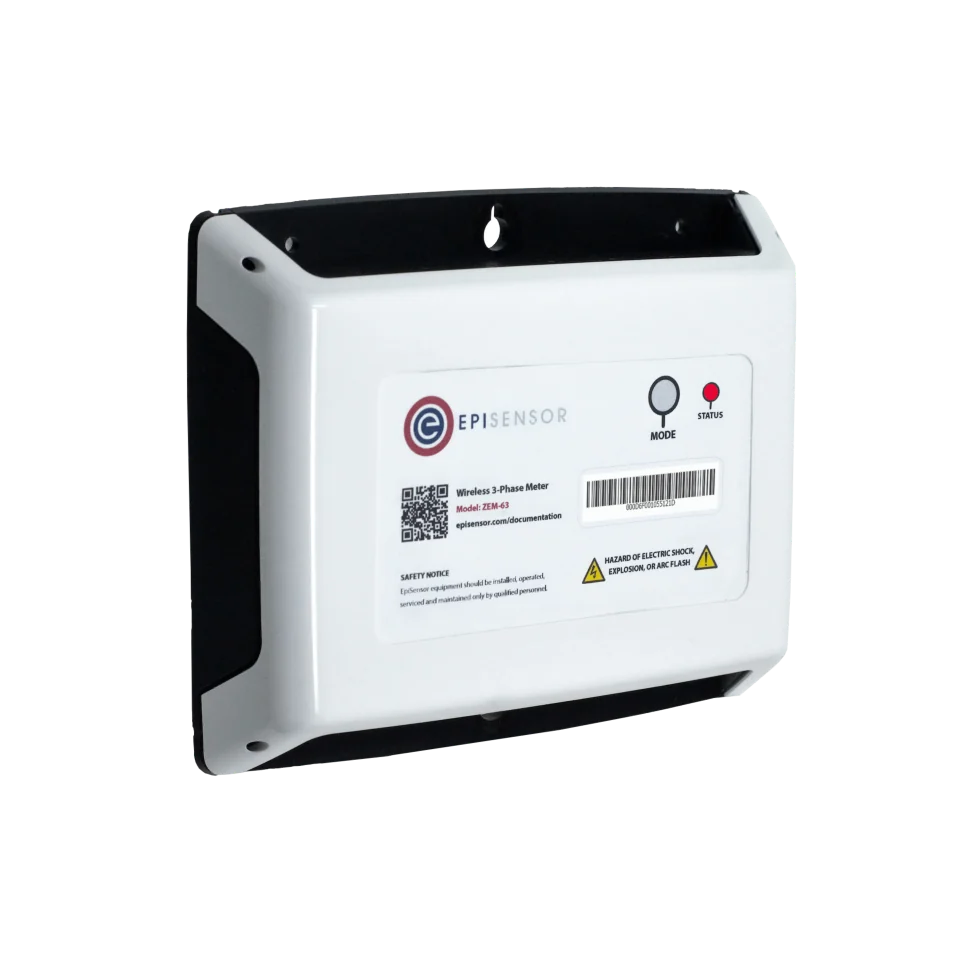
A ZEM reports active power, apparent power and power factor for each phase and in total, with kWh and kVAh, on every interval. The average power factor for any period is kWh ÷ kVAh, so the hours that fall below a tariff threshold show up directly.
Get the EpiSensor newsletter
Occasional updates on energy monitoring and demand response, with new Knowledge Base articles and engineering tools.
You are subscribed. The next newsletter will come to this address.